Tales from the George Troup vs. John Clark Era in Georgia Politics (In Pursuit of Dead Georgians, 24)

[NOTE: A while ago, I offered a post about a frequently overlooked family memoir from antebellum Georgia that offered keen insights into the links between politics and religion during the bitterest era of factional politics in the state’s history. Even as I did so, I began to think about other such stories in primary sources I had scouted out during my research into Georgia political history. These accounts generally produced a three-fold reaction when I encountered them:

  1. Oh, this is interesting!
  2. But, wait, this probably didn’t happen the way the source says it did. . . .
  3. On the other hand, if it didn’t happen that way, it probably should have!

In other words, forewarned is forearmed.  (For example, notice how poor John Clark can’t catch a break, since virtually all of the “hairy-dog stories” come from Crawford/Troup partisans.  But they’re still fun!)  Another thing to keep in mind is that a number of these examples from the nineteenth century have a definite modern resonance to them.]

* * * * *
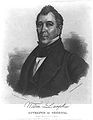
Wilson Lumpkin

According to former Georgia Governor and U.S. Senator Wilson Lumpkin, by the early 1820s he discovered that, as far as the Troup and Clark parties were concerned:

Truly and indeed, [John] Clark and most of his leading friends of that day professed to be, and in many respects sustained well, the character of real Democrats. . . .

[A]lthough we had no Federal[ist] party in Georgia, . . . we had many more Federalists than I had heretofore supposed. And further, that while these Federalists, of the old [Alexander] Hamiltonian stamp, were dispersed and scattered amongst both parties [in Georgia], yet the majority of them were in the Clark ranks.  This last fact I regretted, because my personal attachments were every day becoming stronger for this [Clark] party.  They were my most devoted friends, and were more congenial to my Democratic feelings than the other party, who embraced the largest share of the aristocracy of wealth.  I was not however entirely satisfied with the political complexion of either of these state parties, and after the close of this session [of the legislature] returned to my family, intending to remain in private life.  [But, surprise!, he didn’t “remain in private life” for long.]

[SOURCE:  Wilson Lumpkin, The Removal of the Cherokee Indians from Georgia (2 vols.; 1907), I: 14; 32-33]

* * * * *
Gilmer2

Former Governor George R. Gilmer, who succeeded to leadership in the Crawford/Troup party after Troup retired, had known John Clark, and in his memoirs offered a description of Clark during a dispute with Governor David B. Mitchell:

General John Scott was the special friend of Gen. [sic] Clark.  He found him one day in Milledgeville, preparing himself by getting drunk, for abusing or doing some violence to his enemy, Gen. Mitchel [sic], who was then Governor of the State.  To prevent the execution of his purpose, Gen. Scott [sic] endeavored to draw [Clark] away by inviting him to dinner.  Gen. Scott lived two or three miles out of town.  Clark insisted that [Scott]  should go on home, promising that he would follow soon.  Scott, knowing that it would be useless to attempt to control [Clark], and that he would only incur his displeasure by offering to do so, went home.  He delayed dinner until night.  Apprehending that Clark might have become so drunk as to have lost his way, or suffered some other mishap, [Scott] went in search of him, accompanied by many of his negroes [sic], with torches.  He found [Clark] asleep upon a log which projected over a precipice, where a turn the wrong way would have precipitated him below, and probably killed him–the recklessness of his temper and his desire to fight Mitchel [sic] having put him into the humor to hunt for danger.

Gilmer also recounted an episode revealing the bitterness of the rivalry between the Crawford and Clark parties:

An ardent Crawford supporter, Baptist preacher Jesse Mercer, delivered a sermon at the funeral of Governor William Rabun, a member of the Crawford party, with newly-elected Governor John Clark in attendance. According to Gilmer, Mercer “enforced the doctrine with great zeal, that when the Lord taketh away a good and righteous man [Rabun], he does it on account of the sins of the people, and will punish them by putting wicked rulers [Clark] over them, and ended by saying Georgia had reason to tremble.” 

[SOURCE:  George R. Gilmer, First Settlers of Upper Georgia (Reprint; 1965), p. 159;214

* * * * *

George Troup

Augusta newspaper editor Joseph Bevan endorsed George M. Troup for governor in 1821 as follows:

Col.  [Troup] commenced his political career under the auspices of Governor [James] Jackson, at the time when the dividing line was struck between Federalism and Republicanism, and at a time too when the state was agitated by the sale of its western territory to the Yazoo Speculators. No wonder then, that he cannot hold communion with those who were opposed to him at that crisis; and small blame to him, if he bares his arm and girds his waist for combat.

[SOURCE:  E. Merton Coulter, Joseph Vallence Bevan: Georgia’s First Official Historian (1964), p. 42]

* * * * *
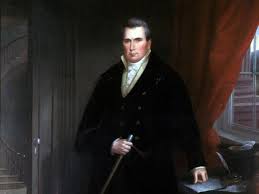
Governor John Clark

John Clark did not run for Governor in 1823, leaving that chore to his loyal lieutenant, Matthew Talbot, in what was the last election in which the Governor was chosen by the legislature.  Once again, George Troup was the opposition’s candidate, and this time he managed to secure victory for his party, but only by a single vote.  When members of the Troup party learned the outcome, their joy was unbounded:

Bedlam broke out and continued for some time.  Daniel Duffy, an ardent Methodist and an equally ardent Troupite, ran across the Statehouse Square shouting that “the state of Georgia has been redeemed from the devil and John Clark!”  Jesse Mercer, the Baptist divine, was seen running down the street, waving his hat above his bald head, and shouting “Glory, Glory!” until he grew hoarse and disappeared from view over the rugged terrain of Statehouse Square.  General David Blackshear, holding his hands in prayer, was heard to say:  “Now, Lord, I am ready to die.” 

[SOURCE: James C. Bonner, Milledgeville:  Georgia’s Antebellum Capital (1978), p.53]

* * * * *

In the pivotal 1825 gubernatorial contest, the first time in the state’s history the Governor was chosen by popular vote, George M. Troup won a narrow victory over John Clark himself.  Over three decades later, Joseph B. Cobb, son of a member of the Troup party, described the parties’ tactics in his memoirs:

Every log had been rolled—every stone had been turned. Obscure, unfrequented county corners had been diligently scoured to swell the voting hordes.  The sinks of cities had been ransacked.  Cross-road and village drunkards, who had slept for months in ditches or in gutters, and whose sober moments had been as few and far between as angel visits, were assiduously excavated and hauled to the polls.  The prison doors were flung open to pining and hapless debtors, who, but for this fierce war of parties, might have languished away the prime of their lives within the gloomy walls of a dungeon.  Old men who had been bed-ridden for years, and who had long since shaken adieux with the ballot-box, were industriously hunted up, and conveyed by faithful and tender hands to the nearest precinct.  Patients shivering with ague or burning with fever, struggled with pain long enough to cast their votes; and it is within the recollection of many now living, that drooping paralytics, unable to move from the carts or dearborns [sic] which had borne them from their couches, were served with the box at the court-house steps, by zealous and accommodating officers. Nothing, in fact, had been left undone which might contribute to bring the struggle to a decisive and unquestioned issue.  Accordingly, when the day arrived, each party, marshaled by its favorite chieftain, was ready for action; and amidst drinking, cavillings [sic], partisan harangues, quarrels, and ring fights, the polls were opened. Every minute of time was wranglingly [sic] contended for in favor of lagging voters—every suspicion was made the pretext for a challenge. But the scrolls soon showed on which side the tides of victory were rolling.  The contest resulted in a complete triumph of the Crawford or Troup party, which the Clarkites [sic], chagrined and crest-fallen, acknowledged for the first time that they had been fairly overcome.

[SOURCE:  Joseph B. Cobb, Leisure Labors (1858), pp. 141-142]

* * * * *

Then there was this reaction of “a violent partisan of Troup politics,” Colonel “Phil” Alston, when he overheard a victory celebration of Clarkites in a Milledgeville tavern:

Oh! If I was death on the pale horse I would ride rough-shod over that den, reeking with infamy, when hell should reap a richer harvest than at the destruction of Sodom and Gomorrah.

[SOURCE:  Garnett Andrews, Reminiscences of an Old Georgia Lawyer (1870), p. 63]

* * * * *
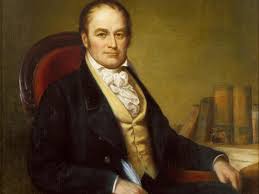
WHCAn early biographer of William Harris Crawford, J.E.D. Shipp, related an anecdote about an Irishman who opened a tavern in Greene County, with the naïve hope of remaining politically neutral so that members of both factions would trade there. He gave up in disgust after a week, because, he said:

As soon as a Crawford man would come in, he would at once inquire if this was a Crawford bar; and, faith, when I told him it was neither, he cursed me for a Clarkite and refused to drink. When a Clark man came in and I told him I was neither, he cursed me for a Crawfordite, and I sold not a gill to anyone.  Faith, it pays to be a politician in Georgia.

[SOURCE:  Lucian Lamar Knight, Georgia’s Landmarks, Memorials and Legends (1913), p. 23]

* * * * *

W.H. Sparks

Descriptions of John Clark and his party, from W.H. Sparks, dripping with acid, from his memoir, published a few years after the Civil War:

. . . Every old Federalist in the State who had clung to his principles attached himself to Clark.  There were many strong families, wielding a potent influence in their neighborhoods, attached to Federal principles. . . . A press in its support was greatly needed, and was soon established, and given in charge of  Cosam E. Bartlett [the Milledgeville Georgia Patriot], than whom no man was better calculated for such a service as was demanded of him.

John Clark was “a man of strong will, without much mind, brave, and vindictive, and nursed the most intense hatred of [William Harris] Crawford constantly in his heart.”

Clark also was “a man of violent passions, and had been, to some extent, irregular and dissipated in his habits. When excited by any means, he was fierce; but when with drink, he was boisterous, abusive, and destructive.  Many stories were related of terrible acts of his commission—in riding into houses, smashing furniture, glass, and crockery—of persecution of his family and weak persons he disliked.”

[SOURCE:  W.H. Sparks, Memories of Fifty Years (3rd ed.; 1872), pp.82; 78-79]

* * * * * *

For those interested in reading more about Georgia History, here are links to my books on the subject:

REABP CoverRancorous Enmities and Blind Partialities:  Parties and Factions in Georgia, 1807-1845 (University Press of America, 2015)

Pursuit Cover

In Pursuit of Dead Georgians:  One Historian’s Excursions into the History of His Adopted State (iUniverse, 2015)

Politics on the Periphery:  Factions and Parties in Georgia, 1783-1806 (University of Delaware Press, 1986)


Posted in American History, Books, Education, George M. Troup, George R. Gilmer, Georgia History, Historical Reflection, History, John Clark, Research, Retirement, Southern (Georgia) History, Southern History, Uncategorized, Wilson Lumpkin | Tagged , , , , , , , , | Leave a comment

A Post for Martin Luther King, Jr., Day, 2016

The Reverend Martin Luther King, Jr., has long been one of my personal heroes, beginning when I was a youngster growing up in an industrial suburb of Baltimore, Maryland.  Later, after I decided that I wanted to teach History, I pondered where Dr. King and his legacy would fit into this.  Fortunately for me, I didn’t really have to answer that question, either while I was in college at the University of Delaware (because the American History course I took did not get past World War II); or, after a two-year tour in the U.S. Army, in graduate school at Emory University in Atlanta (because I was studying American History before the Civil War and, even as a teaching assistant, never took my American History survey course much past the end of the Second World War).

Once I signed on at The Westminster Schools, an Atlanta “prep school,” and learned that I would be teaching United States History, among other courses, the need to fit The Rev. King into the American story became more pressing.  Given the pace of the typical academic year at Westminster, however, I discovered that, by the time I reached the post-World War II world, there was little time left before I had to begin prepping my Advanced Placement U.S. History students for their end-of-the-year, comprehensive exam.

So many important postwar trends to cover and so little time available!  Eventually, I decided to focus on a few “big themes” for the post-1945 period:  the Presidency; the War in Vietnam; and–wait for it–the modern Civil Rights Movement.  And yet, the chance to emphasize the role of King in the Civil Rights Movement was, for me, a long road (look here, here, and here for the initial steps along that road).

I was able to develop a brief unit on the Civil Rights Movement for APUSH, but I still felt as if I were giving it short shrift.  Then, a few years before the end of my time at Westminster, I inherited a one-semester, junior/senior elective course on the Modern American Civil Rights Movement that I taught for several years.

During that same period, I also had the opportunity to take over the editorship of the History Department Newsletter.  As editor, I naturally felt compelled to opine from time to time about issues in the study of American History that I felt were important and should not be ignored at Westminster.  And–surprise!–chief among said themes was the Civil Rights Movement in general and Dr. King’s role in particular.

Following my retirement, and the launching of this blog as a sort of replacement for my role as editor of the History Department Newsletter, I continued to maintain that students must understand both the background of the Civil Rights Movement (i.e., the so-called “Age of Jim Crow”) and the Movement itself. And, perhaps this was inevitable, in January 2012 I decided to offer a post centered on my personal reflections about Dr. King and the Civil Rights Movement, the main sources for which were several editorials I had written for the History Department Newsletter.

That 2012 post soon became one of the most popular at “Retired But Not Shy,” and, I must admit, it remains my personal favorite of more than one hundred posts at this site.  I revised the King post–and re-posted it–in January 2015. I know that a number of you who follow this blog have probably read one of the versions of this post, but, if you haven’t; or if you’re new to the blog; or if you’ve read one of the posts but are in the mood to meditate on Dr. King’s role in the American story, I’m attaching a link to the most recent version:

https://georgelamplugh.wordpress.com/2015/01/01/civil-rights-and-wrongs-reflections-on-the-rev-dr-martin-luther-king-jr-and-his-legacy/

I hope you enjoy it.

* * * * * *

For those interested in reading more about Georgia History, here are links to my books on the subject:

REABP CoverRancorous Enmities and Blind Partialities:  Parties and Factions in Georgia, 1807-1845 (University Press of America, 2015)

Pursuit Cover

In Pursuit of Dead Georgians:  One Historian’s Excursions into the History of His Adopted State (iUniverse, 2015)
Politics on the Periphery:  Factions and Parties in Georgia, 1783-1806 (University of Delaware Press, 1986)

Posted in "The Race Beat", Age of Jim Crow, American History, Civil Rights Movement, Current Events, Dr. Martin Luther King, Georgia History, Historical Reflection, History, Martin Luther King, Popular Culture, Southern History, Uncategorized | Tagged , , , , , , , , , , | Leave a comment

Historical Problem: Who Was “A Citizen”? (Georgia,1783-1788)–Part 1: Introduction


One thing that made historical research bearable, even fun for me at times,  was how I ran into interesting characters during my studies in Georgia history, people about whom I wished to learn more; began storing references to their activities; and, eventually, tried to flesh out their characters, either as part of my ongoing book research or, separately, in an article.

In one particular case, the “character” I pursued was a pseudonymous essayist who signed himself  “A Citizen.” This writer first appeared on the scene in 1783; his major production, Cursory Remarks on Men and Measures in Georgia, was “scattered about the streets of Savannah” in 1784; and subsequent contributions by “A Citizen,” his supporters, and his opponents stretched almost to the end of the 1780s.

One reason I pursued this scribbler with such determination was that initially I thought he might have been John Wereat, who, I knew, had contributed to the pamphlet warfare surrounding his good friend General Lachlan McIntosh (and McIntosh’s brother, George) during the Revolution.  I had been collecting information on Mr. Wereat for a while, hoping to learn more about him, and the possibility that he might have carried his pamphleteering activities into the post-Revolutionary world was exciting.

In the end, however, I decided that I did not, at that time anyway, have sufficient evidence to support my belief that John Wereat was “A Citizen”; there was no “smoking gun.”  Besides, I had other fish to fry, including a doctoral dissertation in which Wereat was an important actor.  So, I put my information on “A Citizen,” his newspaper essays and his pamphlet, along with his journalistic supporters and opponents, into a file cabinet in our basement–for, um, decades. . . . Recently, however, having finally published the big book on Georgia history I had been working on since 1996 (and, as a bonus, a second volume, a collection of essays), and searching for additional posts for “Retired But Not Shy,” I dug out that folder and began to review the material I had collected surrounding “A Citizen.”

I had hardly begun that exercise before it occurred to me that, because one theme of my blog was Georgia history, there was no real need for me to tackle the topic of the “A Citizen’s” identity by myself.  Rather, in the spirit of the “documents-based essay question” (also known as the “DBQ”), a long-standing part of the Advanced Placement United States History examination that I had prepared students for over nearly four decades of teaching at an Atlanta “prep school,” I decided to offer my readers the opportunity to enlist in the quest to identify “A Citizen,” through what I call an “historical problem” (i.e., like the “DBQ,” but longer and more detailed).

[NOTE:  At first, the DBQ was the jewel of the APUSH exam.  It provided APUSH students with the opportunity to do what many historians do–work through documents in search of a thesis; extract useful information from said documents; bring in “outside information,” i.e., the context provided by the AP folks and stuff they remembered from their course; and, finally, combine all of that into an essay answering the question.  In more recent years, however, like the rest of the APUSH exam, the DBQ has essentially been “dumbed down,” but I guess that’s a topic for another post.]

* * * * *

Here’s the plan:  over the next few months, I plan to put up a series of posts summarizing–and excerpting from primary sources–what I’ve learned about “A Citizen” and his critics.  At the end of the series, I’ll invite you give your answer to the question, “Who was ‘A Citizen?,'” and provide my own.  It’ll be fun!

For now, though, I’m going to give those who might find it interesting to pursue “A Citizen” through the primary sources, a “homework assignment.”  (Sorry, but I’ve been waiting for more than five years to do this!)

Some of you may remember that I published several essays on “Georgia and the American Revolution” a while ago.  Well, the final one in that series, on “The Factious Whigs of Revolutionary Georgia,” forms the immediate background for this “historical problem” (i.e., the material that, in numerous “DBQs,” would be summarized in an introductory paragraph as a way to establish the historical context for the documents-based essay question that follows, but I’m sure my readers expect more of a challenge).

Your assignment, should you choose to accept it, is to click on the link in the preceding paragraph; read the essay on Georgia’s “factious Whigs”; and prepare for the next post, which will introduce you to “A Citizen” and his initial foray into journalistic combat in Savannah in 1783–then it’ll be off to the scholarly races!

By the way, please read the post about the “factious Whigs” carefully, because you never know when there might be a quiz. . . .  Good luck–and, in honor of the latest “Star Wars” movie, may the force (of post-Revolutionary Georgia history) be with you!

* * * * *

For those interested in reading more about Georgia History, here are links to my books on the subject:

REABP CoverRancorous Enmities and Blind Partialities:  Parties and Factions in Georgia, 1807-1845 (University Press of America, 2015)

Pursuit Cover

In Pursuit of Dead Georgians:  One Historian’s Excursions into the History of His Adopted State (iUniverse, 2015)

Politics on the Periphery:  Factions and Parties in Georgia, 1783-1806 (University of Delaware Press, 1986)


Posted in American History, American Revolution, Education, Georgia History, Historical Reflection, History, History Curriculum, Prep School, prep school teaching with a PhD, Research, Retirement, Southern (Georgia) History, Southern History, Teaching, Uncategorized | Tagged , , , | Leave a comment

The “Great Migration”: Two Views (Teaching Civil Rights, 2)

A Review of:

Nicholas Lemann, The Promised Land: The Great Black Migration and How It Changed America (1991); and Isabel Wilkerson, The Warmth of Other Suns: The Epic Story of America’s Great Migration (2010)

[Note:  I’ve been thinking a lot about the titles of my blog posts lately, and how difficult it might be for people to find posts on certain topics, given the way I’ve titled them.  One result of this was that I have re-titled quite of few of my earlier posts, basically moving the generic, series title to the end, so that the specific, post title comes first.  As I reviewed these past posts, I noticed that I had grouped the Lemann/Wilkerson review with one about Gore Vidal’s novel, Lincoln, in a post with the rather vague title of “Book Notes.”

Perhaps, back in March 2011, when that post went up, such a grab-bag title might have been adequate, but no longer.  During the four years since I put up that post, I’ve had a lot of time to develop this blog, and one strong theme I’ve chosen has been the history of the modern Civil Rights Movement.  So, I decided to separate this review from the one about Vidal’s novel, revise it, add a couple of pictures, but–more importantly–give it a clear title that would point to a key aspect of the Civil Rights Movement.]

* * * * *

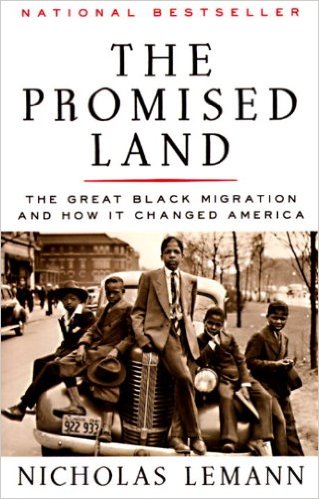
A while ago, I posted a review of two works that I wished I had read while teaching the History of the Modern American Civil Rights Movement course, during my previous life as a “prep school” History instructor. The present volumes obviously might seem to merit that same rubric, but I think I actually read Lemann’s book when it first came out in 1991, before I tackled my school’s Civil Rights course.

Anyway, Lemann’s work and Wilkerson’s nicely complement each other in assessing the impact of the “Great Migration,” the flight (not to put too fine a point on it) of nearly six million African-Americans from the South that occurred over much of the twentieth century. Like the exodus of East Germans through West Berlin that forced the Soviets to erect the Berlin Wall, this vast out-migration of African Americans from the Jim Crow South gave the lie to its defenders’ claims that the whole population flourished under, and of course was content with, a brutal system designed to maintain a cruel status quo.

* * * * *

Wilkerson, Warmth of Other Suns

     Chronologically, Isabel Wilkerson paints on a broader canvas, dating the Migration from 1915 to 1970, while Nicholas Lemann focuses on the latter stages, 1940 to 1970. Lemann’s book, which served as the basis for a PBS documentary television series, The Promised Land, in the 1990’s, has a slightly narrower human focus as well, mainly emphasizing a single group of black Mississippians who escaped from Clarksdale to Chicago. Wilkerson, on the other hand, provides thorough treatments of three African-American individuals over the whole course of their lives, analyzing why they left the South, how they managed that feat, and what their lives were like in the “Promised Land.”

One of those Wilkerson followed, Ida Mae Brandon Gladney, and her sharecropper husband George, like the leading characters in Lemann’s drama, uprooted themselves from Mississippi and made their way to Chicago. Her other two main characters were from quite different backgrounds than the Gladneys and found refuge in other “gateway” Migration cities:  George Swanson Starling, a laborer and organizer in Florida orange groves, headed for Harlem, where he spent the rest of his life as a railroad baggage handler on trains traveling up and down the east coast; Robert Joseph Pershing Foster made his way from Monroe, La., to Los Angeles, seeking, and to some extent finding, a world where his skills as a physician would be appreciated and where he could live the sort of life he had always dreamed of.

Lemann, Promised Land

     One thing Lemann’s book has that Wilkerson’s lacks is a detailed look at how the ramifications of the Great Migration played out in the Nation’s Capital and in national politics. While Wilkerson does not ignore this wider context, her concern throughout is for how these developments affected her three main characters.

Lemann’s treatment of national politics in the wake of the Great Migration is interesting and important, but his 114 page detour in that direction means that readers do not learn nearly as much about the individual Clarksdale refugees Lemann studies as they do about political and bureaucratic infighting.

On the other hand, Wilkerson’s more richly textured portraits, though of a far smaller sample, allow the reader really to know the people she focuses on, while at the same time suggesting that, although not completely irrelevant, national forces had less to do with the lives her chosen trio made for themselves outside the South than their own grit, determination, and, sometimes, luck.

     I’m not sure which of these books I would have assigned in the Civil Rights course I taught before retirement. Wilkerson’s biographical approach would have better complemented the two autobiographies I used in the course, one by a black female author, Anne Moody, and one by a white male, Melton McLaurin, about growing up in the Jim Crow South. Still, I also showed excerpts from the video series based on Lemann’s book in the course, and using sections of his book to supplement the documentary images might also have worked well.

Both books definitely merit close attention from anyone interested in the tremendous impact of the economic, demographic, and political tidal wave that was the Great Migration.

* * * * *

For those interested in reading more about Georgia History, here are links to my books on the subject:

REABP CoverRancorous Enmities and Blind Partialities:  Parties and Factions in Georgia, 1807-1845 (University Press of America, 2015)

Pursuit Cover

In Pursuit of Dead Georgians:  One Historian’s Excursions into the History of His Adopted State (iUniverse, 2015)


Politics on the Periphery:  Factions and Parties in Georgia, 1783-1806 (University of Delaware Press, 1986)

Posted in Age of Jim Crow, American History, Books, Civil Rights Movement, Education, History, History Curriculum, Southern History, Teaching, The "Great Migration", Uncategorized | Tagged , , , , , , , , , , , , | Leave a comment

2015 in review

john-quincy-adams-pictureThe WordPress.com stats helper monkeys prepared a 2015 annual report for this blog.

Here’s an excerpt:

A San Francisco cable car holds 60 people. This blog was viewed about 3,600 times in 2015. If it were a cable car, it would take about 60 trips to carry that many people.

Click here to see the complete report.

* * * * * *

For those interested in reading more about Georgia History, here are links to my books on the subject:

REABP CoverRancorous Enmities and Blind Partialities:  Parties and Factions in Georgia, 1807-1845 (University Press of America, 2015)

Pursuit Cover

In Pursuit of Dead Georgians:  One Historian’s Excursions into the History of His Adopted State (iUniverse, 2015)

POTP Cover

Politics on the Periphery:  Factions and Parties in Georgia, 1783-1806 (University of Delaware Press, 1986)
Posted in Uncategorized | Leave a comment

Remembering Arnold Shankman (1945-1983)

[NOTE:  A couple of months ago, I did an online search because I was curious about the legacy of Arnold Michael Shankman, my best friend from graduate school, who died on March 1, 1983, after a lengthy battle with lymphatic cancer, at the age of 37.  He was a fine teacher, a gifted researcher, and a productive scholar—four books and forty articles in only fifteen years as a historian!  (I only knew the end was near for him when Arnold told me that he had begun limiting his research projects to those he could finish in a short time.)

What I discovered on that search surprised me.  I ran across references to a number of Arnold’s publications, as I’d expected to, but then I was stunned to learn that there was an “Arnold Michael Shankman Collection” in the archives of the Dacus Library at Winthrop University in Rock Hill, South Carolina.  And, when I visited the library’s website, I discovered much, much more about Arnold’s post-graduate school career, so much in fact that I began to reflect on Arnold, his career as a historian, and what he had meant to me and my family.]

* * * * *

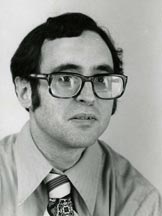
Arnold Shankman (Winthrop University)

Arnold and I met in grad school in the autumn of 1968.  Arnold, born on November 11, 1945, in Cleveland, Ohio, graduated from Cleveland’s Shaker Heights High School and Knox College in Galesburg, Illinois, then headed south to study American History at  Emory University in Atlanta, Georgia.  I had just finished two years in the Army in 1968 and, dreaming of becoming a college professor, also accepted a fellowship from Emory to earn a PhD. in American history.  The two of us quickly became fast friends.

Arnold had energy to burn when it came to graduate study, but he didn’t limit his activities to attending classes, writing papers, and prowling the stacks. In addition, he helped organize the history grad students for some (mild) political action, and he was always eager to help colleagues facing difficulties, whether academic or personal.

Arnold and I lived near each other, and our dissertation studies in Emory’s Woodruff Library were also close together.  Since we were both majoring in American history, we took some of the same courses and spent hours hashing over many a puzzling historical work or interpretation, either in the library, over coffee at the student center, or, occasionally, over cheap beer at grad student parties or in a local watering hole.  We studied for our preliminary written exams together, took them at the same time, and passed.  (NOTE:  We were supposed to discuss our preliminary exams with a few faculty members in a session open to the public, but, son of a gun, the department couldn’t actually gather enough professors to do that, so Arnold and I were told that we had passed “with distinction,” and, thus, no “orals” session was necessary!)

Arnold received his degree a year before I did (he obviously possessed a bit more self-discipline), completing his dissertation, on the anti-war movement in Pennsylvania during the Civil War, under the direction of noted Civil War scholar Bell Irvin Wiley.  But, in the early 1970s, having a PhD in hand did not guarantee a college-teaching position.  In fact, things were so tough that Arnold and I had tried to spur the History faculty to become more active on the job-search front, but to little avail.  Perhaps the nadir of this effort came when one of our professors recommended both of us for the same vacancy at a North Carolina university, which naturally guaranteed that neither of us got the job!

Arnold and I sweated out, by letter and over the phone, the vagaries of his early professional career.  He moved from Emory to a post-doctoral fellowship at Harvard, where he studied immigration history under the renowned Oscar Handlin and sat in on classes taught by other “big guns” of that era, including Bernard Bailyn and David Donald.  His comments about those august scholars were an absolute hoot to read; let’s just say that Dr. Shankman was not intimidated by academic nabobs–he had very high standards, and those historical demigods sometimes failed to meet them!

Following his year at Harvard, Arnold returned to Atlanta to take up to a one-year appointment at Oxford College, the junior college adjunct of Emory, located in Covington, Georgia. During his time there, incidentally, the ever considerate Arnold arranged for me to be a “guest lecturer” in his American History class, speaking on the American Revolution in Georgia.  It was a nice gesture, sincerely appreciated, especially when he managed to wangle a small honorarium for me!

* * * * *

I was almost as happy as Arnold when he finally landed a tenure-track appointment in  History at Winthrop College [now Winthrop University].  (It was just as he was moving to Winthrop that the lymphatic cancer that would eventually kill him reared its head.)  I followed Arnold’s career at Winthrop closely, and he helped me by sending frequent letters, as well as copies of some of his articles.

Arnold and I were inveterate frequenters of book sales.  As our bank accounts dwindled, the number of volumes in our personal libraries increased, a phenomenon neither of us minded very much.  Even after he was out on his own, Arnold kept me apprised of book bargains, occasionally going so far as to purchase volumes for me and send them to Atlanta at his own expense.

Not only was Arnold a bibliophile, but he also loved libraries and archives, and woe betide the librarian or staff member who fell below his standards.  For example, I still recall the time when, in high dudgeon, he claimed that he had found a copy of St. Augustine’s City of God shelved in one library [identity omitted to protect the guilty] under “urban history”!  (But I think—at least I hope—he was just jerking my chain.  The man had a sly, but infectious, sense of humor.)  Arnold also enjoyed research trips; when it came to visiting libraries and archives, he was a firm believer in “the more, the merrier.”

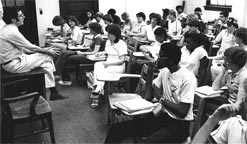
Arnold in Class

(Winthrop University)

One of the first things Arnold did upon joining the Winthrop faculty was to throw his still considerable energies into the effort to create a college archive, serving on the committee charged with that task.  The effort was successful, and, perhaps naturally, Arnold eventually bequeathed his papers to the new archive, where they can still be viewed today.  Moreover, he obviously earned the friendship and respect of both students and colleagues during his all too brief tenure at Winthrop, as is evident from a wonderful overview of his life and career by Joyce E. Plyler, “Custodian of the Past:  Arnold M. Shankman,” that serves as an introduction to the website for Winthrop’s Dacus Library’s Arnold Shankman Collection.

* * * * *

Arnold was one of the most thoughtful people I’ve ever known.  He showed up at my dissertation prospectus to cheer me on, and, during my time as an Emory teaching assistant, if I got in a bind trying to keep ahead of my classes, I could always count on Arnold to lend me lectures he had written on topics like Jacksonian Democracy, the New Deal, and McCarthyism.

On research trips to various libraries for his own projects, Arnold somehow managed to keep his eyes open for documents that might be of use in my work and that of other friends.  I wish I had a nickel for every letter I received from Arnold that included useful information of this kind, usually scribbled on the back of the discarded library catalogue cards he used for notes.

When our first son was born, in 1972, Arnold bought him a large stuffed panda bear, which Jim named “Big Panda,” and which became a treasured possession.  When Jim was a little older, Arnold purchased for him a set of huge plastic trucks and a plastic “hard hat” to wear when he played with them.  Even after the trucks were gone, the hard hat reposed for several years in our basement.

Once I had finished my graduate work and taken a job in Atlanta, Arnold and I only saw each other perhaps once a year, though we continued to correspond and to keep in touch by phone.  Arnold had a large circle of friends, and he kept up with all of them.  It amazed me that every time he wrote or phoned, he brought me up to date—and in detail—on people I had not seen for years!

* * * * *

Arnold Shankman was a first-rate scholar, deeply interested in the study of the past and in conveying what he learned to his students, as well as to a wider public.  A lot of what he published over his brief career illuminated the contributions of minority groups to the American story, despite the fact that these contributions could be (and often were) overlooked by  historians—as well as the views of  elderly former “radicals” who, before they made Arnold’s acquaintance, believed their efforts had been in vain.

Arnold summarized his worldview, the thing that made him so precious to friends and colleagues, in an unpublished essay in 1973:  “We live in a world, and unless we wish to be an island, we need to learn how to appreciate our differences and to love people because they are different.” (Quoted in Plyler, “Custodian of the Past,” p.9)

Not a bad epitaph, that.

Arnold at lectern

(Winthrop University)

* * * * * *

For those interested in reading more about Georgia History, here are links to my books on the subject:

REABP CoverRancorous Enmities and Blind Partialities:  Parties and Factions in Georgia, 1807-1845 (University Press of America, 2015)

Pursuit Cover

In Pursuit of Dead Georgians:  One Historian’s Excursions into the History of His Adopted State (iUniverse, 2015)

Politics on the Periphery:  Factions and Parties in Georgia, 1783-1806 (University of Delaware Press, 1986)

Posted in American History, Arnold M. Shankman, Education, Historical Reflection, History, History graduate school, Research, Retirement, Southern History, Teaching, Uncategorized, WP Long Read | Tagged , , , | 2 Comments

Creeks and Cherokees–Walking Native Ground (In Pursuit of Dead Georgians, 23)

john-quincy-adams-picture[NOTE:  Recently, I finished reading Tiya Miles’s fine study, The House on Diamond Hill: A Cherokee Plantation Story, the history of the property we now know as the Chief Vann House State Historic Site, in Chatsworth, Georgia.

Miles Book

The House on Diamond Hill reminded me of road trips my wife and I took a number of years ago.  At that time, I was researching the evolution of political parties and factions in Georgia after 1806.  One of the issues I already knew would give me trouble was Indian removal.  So, I decided to “walk (some of) the ground” involved in the drama of Georgia’s expropriation of lands from her Native American inhabitants.

What follows are excerpts from my research journal.]

* * * * *

Thurs., Mar. 8, 2007 (McIntosh Reserve Park, Carrollton, Ga.)

We own a book entitled 60 Hikes Within 60 Miles of Atlanta; today we made a 110 mile round trip to go on one of those hikes–at the McIntosh Reserve Park, south of Carrollton, Ga.  It is the site where Creek Chief William McIntosh was assassinated/legally executed by his fellow tribesmen (depending upon whether you believe Georgia Governor George Troup or the Creek National Council) for his role in negotiating the corrupt Treaty of Indian Springs (1825), transferring all of the Creeks’ remaining land to Georgia, apparently at the behest of his cousin, Governor Troup.

Acorn Bluff, McIntosh Reserve Park

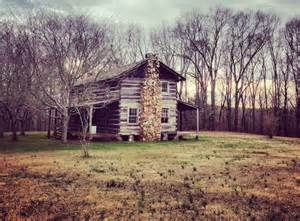
McIntosh’s killers burned down his house, but Carroll County has replaced it with a purportedly similar structure, moved to the site from a lot near Centre, Ala.  It’s a two-story, dog-trot cabin that now sits across from William McIntosh’s grave.  The building is open, and, as we walked through it this morning, the main question I had was, “Which direction(s) did his killers come from?”

The restored homestead is within perhaps a quarter of a mile of the Chattahoochee River.  We weren’t sure we even found the “walking trail” we were looking for, but at least we saw the house and McIntosh’s grave.  As has been the case on several earlier “research trips” to sites related to my project [see below], I’m not really sure how useful this one will be, but the visit was certainly not wasted.

* * * * *

Sat., Oct. 14, 2000  (North Georgia–The “Chieftains Trail”)

New Echota Marker

We drove north for an hour or so on I-75 to Ga. Rte. 225.  About three miles east on Rte. 225 is the site of New Echota, the one-time capital of the Cherokee Nation.  Maintained as a state historic site, New Echota is a shadow of its former self, yet quite suggestive nonetheless. The only original building still on the site is the home of missionary Samuel A. Worcester, of Worcester v. Ga. fame.  Other period buildings have been moved to New Echota, however, and these show how middle-class and common Cherokee families lived on their farmsteads:  a cabin, barn, corn crib, and smokehouse on the “middle-class” farm and a cabin, stable, corn crib, and smokehouse on the “common” one.

Another period structure, Vann’s tavern, has been relocated to New Echota, and reconstructed versions of the tribe’s Council building; Print Shop [where the Cherokee Phoenix was published]; and Supreme Court building complete the display.  As a bonus, the state Natural Resources Department has created a mile-long nature trail that winds around the rear of the Worcester home.  The Visitors Center has a small museum featuring lots of artifacts dug up on the grounds, as well as a tiny library and movie theater.

newechota pic

A couple of notes on progress, sort of:  1) A one-time Cherokee farm on the other side of Rte. 225 has been transformed into a golf course.  2) The Worcester House was occupied by a series of white farmers following the missionary’s forced eviction.  The last farmer moved away in the 1950s, at which time a group of local citizens bought the property with an eye towards its renovation as a memorial to the Cherokees.

Chief Vann Historic Site

About seventeen miles farther east on Rte. 225 is the Vann House, the noblest edifice by far in the modern-day hamlet of Spring Place.  It sits on a knoll overlooking the spring that gives the town its name (though we could not see it), at the intersection of routes 225 and 52A.  The state Department of Natural Resources, which manages the house, is currently building a new visitors center, so there was a temporary parking area and a rather crowded entry hall in the house itself for books, other souvenirs, and, of course, a cash register.

I already knew quite a bit about Spring Place from my newspaper research.  One of the earliest white settlements in Murray County, it was the headquarters of Colonel William N. Bishop, commander of the Georgia Guard and one of Governor Wilson Lumpkin’s most notorious agents in the Cherokee Territory.  I had also taken copious notes on the shootout at the Vann House in 1835 between Bishop and Spencer Riley, a supporter of the anti-Lumpkin State Rights Party, but had never actually been there before today. . . .

I was surprised, but guess I shouldn’t have been, when our feisty, 60-something tour guide regaled us with the story of the Bishop-Riley encounter first thing.  She told us that, as we reached the landing halfway up to the second floor, we would be able to see the very spot where Bishop and his minions had tossed a burning log in a successful effort to “smoke Riley out”—and we did.  Evidently, Bishop had arrived to claim the Vann House for the state (I believe his brother Abraham eventually ended up running a tavern and store there), only to have Riley, who was boarding at the Vann House, enter his own claim and refuse to leave.  Thus the gunplay, in which Riley was wounded and hauled off to the jail in Cassville “through the snow,” where, in his version of events, he narrowly escaped assassination at the hands of a Bishop loyalist.

As was the case at New Echota, there are very few original items at the Vann House, but period pieces have been brought in, and they suggest something of the affluence of the last Cherokee owner, “Rich Joe” Vann, who inherited the house after his father’s murder in a tavern sixty miles away.  The basement, which puts the “d” in “dank,” was divided into a wine cellar and a dungeon for unruly slaves (the “civilized” Cherokee Joseph Vann owned a couple of hundred slaves).  There are guest bedrooms on the second floor and two children’s rooms on the “vertically challenged” third floor, with its low doorways, steep stairs, and six-foot ceilings.

Once again, progress has not been kind to the Vann House.  There it sits, like a diamond in a dunghill, looking down on a four-way stop intersection and a mini-mart.  Nevertheless, it was certainly worth the trip!

* * * * *

Mon., July 14, 2008 (Rome, Ga.)

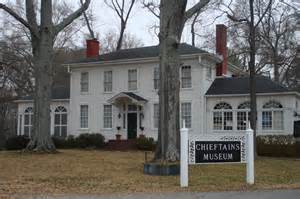
Chieftan's Museum/Major Ridge Home

Chieftains Museum/Major Ridge Home

We drove to the Chieftain’ Museum/Major Ridge Home, which was a disappointment.  It had originated in the early 1800s as a two-story log house in dog-trot style, but even before Ridge left for the West, it had been made over into what the Museum calls a “New England style plantation house.”  After Ridge’s involuntary departure, the house was further modified.  When it wound up on one corner of the vast Celanese industrial complex, the house served as the home of the plant manager.

In its latest incarnation, as the Chieftains Museum, Ridge’s home is mostly just a structure to hold an eclectic collection of displays and artifacts having to do with the Cherokees, on the main floor, with the upper floor given over to a meeting room and office space.  On both floors, one section of wall has been laid bare to show something of the original construction, with the evolution of the house explained on a poster mounted on the bared section on the main floor.

* * * * *

Thurs., July 28, 2011 (Cherokee, N.C.)

Museum of the Cherokee Indian (NC)

. . . We spent a couple of hours this afternoon in the Museum of the Cherokee Indian in downtown Cherokee, North Carolina, and it was pretty impressive.  The displays covered the whole span, from ancient America through the Trail of Tears, and beyond.  The tone was, as one might expect, on the sentimental side at times, but I found the treatment of Cherokee removal and the Trail of Tears surprisingly even-handed on the whole.

We are staying in a motel near downtown, in a suite named after a Cherokee leader I’ve never heard of, but we are next to the Chief David Vann suite and right below the John Ross suite (both names I’m familiar with).  We also drove into downtown Cherokee, but the part we saw was just drenched in what, for lack of a better term, I’ll call “Cherokee kitsch.”  (Or perhaps “tourist kitsch” is more accurate?)  I’ve never seen so many shops selling leather goods, tomahawks, t-shirts, etc., all on Cherokee themes, of course.

Tomorrow, we plan to go to a reconstructed Cherokee village near the museum.  It’s set up as a “living history” center, like Williamsburg, Va., but about the Cherokees, . . . .

Fri., July 29, 2011 (Cherokee, N.C.)

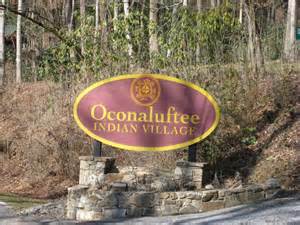
oconaluftee-indian-village sign

. . . [W]e arrived at our first stop, the Ocanoluftee Indian Village, just about opening time, 9:00 am.  There were only four of us in the first tour group; our guide, a fast-talking young man named Joel, who looked like he might be a high school junior, did a terrific job.  He certainly knew his Cherokee culture, history, and language, but he delivered his talk with enough modern expressions to keep us loose.

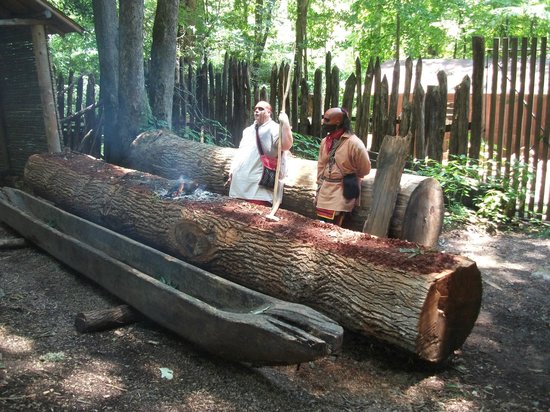
oconaluftee-indian-village

Joel escorted us through most of the stops, all of them representing a Cherokee village, c. 1750.  About half the exhibits involved crafts, and most were created by older members of the tribe.  We saw basket weaving, pottery, a demonstration of weapons, a canoe being hollowed out, weaving, and the making of beaded belts.  There also were a few examples of Cherokee dwellings, showing the evolution of the structures over time.

Another Cherokee, Don, spoke to us at the council ring, explaining cultural aspects like masks, religion, the evolution of the Cherokee language, dances, and musical instruments.  The final presentation, on Cherokee “government” before the adoption of the tribal constitution modeled on that of the United States, was given by a woman who also talked about the seven clans, as had Don before her.  Fascinating stuff, and it reinforced a number of things we had read about and seen yesterday in the Museum of the Cherokee Indian.  Leaving the village, we drove back to Cherokee to walk on Oconaluftee Island, and the short, so-called River Trail.

* * * * *

Mountain Farm

Our next stop was the Great Smoky Mountains National Park, a couple of miles away.  There, we walked the longer section of the River Trail, an in-and-out, mostly shaded hike of perhaps three miles all told. . . . We might have left then, but we decided to visit the “Mountain Farm” that has been recreated behind the Visitors Center, between the river and the first part of the River Trail.  It was typical National Park Service minimalism (not a bad thing, mind you), comprised of structures moved to the site from their original locations.  The result was “farms” that were probably more elaborate than most white farmers actually owned in the early nineteenth century.  In addition to the cabin, there were also a barn, a chicken coop, an apple house, blacksmith shop, two corn cribs, a smokehouse, and a spring house.  [An interesting contrast to the middle-class and common Cherokee farms re-created at New Echota.]

_______________

For those interested in reading more about Georgia History, here are links to my books on the subject:

REABP CoverRancorous Enmities and Blind Partialities:  Parties and Factions in Georgia, 1807-1845 (University Press of America, 2015)

Pursuit Cover

In Pursuit of Dead Georgians:  One Historian’s Excursions into the History of His Adopted State (iUniverse, 2015)

Politics on the Periphery:  Factions and Parties in Georgia, 1783-1806 (University of Delaware Press, 1986)
 

Posted in American History, Books, Cherokee Indians, Creek Indians, Georgia History, Historical Reflection, History, Research, Southern (Georgia) History, Southern History, Uncategorized | Tagged , , , , , , , | 4 Comments

Alive and Still Bloggin’: “Retired But Not Shy” at Five

john-quincy-adams-pictureA little over a year ago, I posted an account of the evolution of this blog as it reached its fourth birthday. It’s now time to provide an update, a few months after the fifth anniversary of “Retired But Not Shy,” and the appearance of the 100th post at the site.

First, some context: As I said in the previous “birthday” post, I had originally envisioned this blog as a sort of adjunct to my major retirement project, the completion of a sequel to my 1986 book on factions and parties in Georgia, which carried the story from the American Revolution through the death of the state’s first party boss, James Jackson, in 1806.  This past summer I published this sequel, which ran to more than 400 pages and carried the story through 1845.  I also brought out a collection of essays on the political history of antebellum Georgia, presented within an autobiographical framework.  Strangely enough, the closer I got to completing these volumes, the less I wrote about them in the blog.

* * * * *

So, what did I consider post-worthy between the summer of 2014 and the summer of 2015?

1) I added eight posts to the “In Pursuit of Dead Georgians” series, finishing the sequence on the American Revolution in Georgia, and moving into the postwar period.

2) I also added seven posts to the “History Lesson Plans” series:  three [here, here, and here] traced the road I followed on my way to creating one of my favorite courses, “The History of the Modern American Civil Rights Movement” [here]; the other four posts in this series encompassed my approach to “The History of American Republicanism.” [here, here, here, and here]

3) Then there were the book reviews.  One, on James Krefft’s Short, a novel about the domestic side of the Vietnam War that I really identified with; another, a fine classroom biography of Ronald Reagan by an old friend, Jim Broussard; a post treating two hefty works, Rick Perlstein’s Nixonland and Sean Wilentz’s The Age of Reagan that brought a response from Perlstein; and a review of a fine book by another long-time scholarly acquaintance, Hardy Jackson, The Rise and Decline of the Redneck Riviera, which I’d first read in 2012, but inexplicably delayed reviewing until the fall of 2015, a year or so after I’d used his book as a sort of travel guide for a driving tour of the Redneck Riviera.

4) My brother Rick and I collaborated on a post about the hatred of wolves, a passion of Rick’s, asking whether such an attitude could be termed ‘wolfism,” something that was akin to “racism,” a concept at the center of my Civil Rights course over the last few years before my retirement. Whatever you might think about the post, Rick and I had a lot of fun putting it together!

5) In the wake of publishing two books this past summer, I used one post to discuss their “back stories,” as well as that of my first book.

* * * * *

I’ve also got an updated “top ten” list, based on the last year or so of visits to “Retired But Not Shy”:

Teaching Prep School With a PhD: Is It for You?

History Lesson Plans, 1: Teaching History “Backwards”

Civil Rights—and Wrongs: Personal Reflections on Dr. King and His Legacy

In Pursuit of Dead Georgians, 4: Getting Reacquainted With Georgia Governor Wilson Lumpkin

Blues Stories, 10: Son House—Preacher, Killer, “Father of the Delta Blues”

Blues Stories, 11: Mississippi John Hurt, The Yoda of the Blues

High School, Now—and Then: Reflections on a 50th Reunion

Blues Stories, 7: Electric Mud—The Life and Music of Muddy Waters (1915-1983)

In Pursuit of Dead Georgians, 5: Governor George R. Gilmer (1829-1831, 1837-1839) and the Cherokees

Blues Stories, 6: The Mississippi Delta and the Blues

* * * * *

There are some changes in the latest “top ten,” and a few of these popular posts raise some questions:

1) Who could have predicted that the Internet version of a talk I gave at Emory University, “Teaching Prep School with a PhD: Is It for You?”, would have become the most visited of my posts?  Certainly not I.  It undoubtedly has a lot to do with the job market for History PhDs, or, more accurately, the lack of same.

2)  Those wonderful folks at wordpress.com have pointed out in their annual reviews of “Retired But Not Shy’s” performance that the Blues posts seem to have “legs,” i.e., people return to them again and again.  Although I’m glad to know that, I’m not sure I understand quite why things turned out that way.  For instance, the post on “Mississippi John Hurt: The Yoda of the Blues” was visited infrequently before this past year, at which point it seemed as though members of the “Mississippi John Hurt Fan Club” (if such an organization exists) discovered it and passed the word along, so that everyone in the club could read it!  Thank you very much, all you Mississippi John Hurt fans!  I certainly appreciate your interest and your visits to this blog.

3)  And perhaps it’s a function of age, but I cannot believe the popularity of the post I put up after returning from my fiftieth high school reunion!  I mean, I’m happy that so many people visited the post, but I can’t help but wonder how my view of the Newark (Del.) High School Class of 1962’s 50th Reunion squared—or didn’t—with those of visitors to the site.

4)  Then there is the continuing popularity of two posts in the “In Pursuit of Dead Georgians” series, on Georgia governors Wilson Lumpkin and George R. Gilmer and their policies towards the Cherokees.  I still don’t understand why they remain so popular, though of course I’m glad they have!  The cynic in me reminds that perhaps a few History teachers somewhere in Georgia have assigned Cherokee removal as a term paper topic. . . . But, once more, thanks to all you fans of Gilmer and Lumpkin!  Oh, and by the way, I hope more of you will visit the last post in the series, which compares and contrast those two antebellum Georgia memoirists in a broader context than their views of Cherokee removal.

5)  Another conundrum is the continuing popularity of my treatment of the “History of the Modern Civil Rights Movement” course, which I sort of disguised as “Teaching History ‘Backwards.’”  It’s not like I wrote it as a straightforward treatment of the “teaching history backwards” idea.  Rather, my effort was in response to a suggestion by our junior high principal at the time about how much fun it might be to teach a history course “backwards.”  I agreed with him, but, looking over my teaching schedule, the only course I could envision teaching “backwards” was the Civil Rights course, a junior-senior elective, so I did.  And the result somehow became a model for “teaching history backwards.”  I can’t help but wonder what visitors think when they visit the site because of the post’s “cosmic” title, only to discover that the course described is rather narrow.

6)  Finally, although they didn’t make the “top ten” list, I’ve got to wonder why the four part series on the history of “American republicanism” [here, here, here, and here] has become so popular in recent weeks. Once more, I’m guessing that History teachers have assigned projects to their classes about “American republicanism,” and their students have been doing, um, “research” on the Internet!  Oh, well:  a blogger can never know where his/her influence ends. . . .  Kudos to all of you online “republicans”!

* * * * *

If I’ve learned anything about blogging over the past five years, it is that once you’ve sent a post into cyberspace, there’s no telling how many (or few!) people will be interested in it, or why.  My thanks to all who have visited “Retired But Not Shy” over the past five plus years.  I hope you will continue to follow my musings on Georgia, Southern, and American history; the teaching of History; American culture’s “History Wars,” and, of course, the history of the Blues.

* * * * * *

For those interested in reading more about Georgia History, here are links to my books on the subject:

REABP CoverRancorous Enmities and Blind Partialities:  Parties and Factions in Georgia, 1807-1845 (University Press of America, 2015)

Pursuit Cover

In Pursuit of Dead Georgians:  One Historian’s Excursions into the History of His Adopted State (iUniverse, 2015)


Politics on the Periphery:  Factions and Parties in Georgia, 1783-1806 (University of Delaware Press, 1986)


Posted in Age of Jim Crow, American "republicanism", American Revolution, Books, Cherokee Indians, Civil Rights Movement, George R. Gilmer, Georgia History, Historical Reflection, History, History Curriculum, History graduate school, Martin Luther King, Mississippi John Hurt, Muddy Waters, Newark (Del.) High School Class of 1962, prep school teaching with a PhD, Research, Retirement, Rick Lamplugh, Ronald Reagan, Son House, Southern (Georgia) History, Southern History, Teaching, The Blues, Uncategorized, Wilson Lumpkin, Wolves | Tagged , , , , , , , , , | 4 Comments

Rev. Gary Davis, Blind Guitar Guru (Blues Stories, 20)

john-quincy-adams-picture


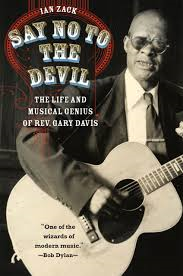
A Review of Ian Zack, Say No to the Devil: The Life and Musical Genius of Rev. Gary Davis.  The University of Chicago Press, 2015.

Davis7

“I done come this far, I don’t find no fault, well I feel just like goin’ on” (Rev. Gary Davis)

* * * * *

During the “folk revival” of the 1960s, the Rev. Gary Davis had “been hiding in plain sight all along,” so there was no need either to “find” or “rediscover” him. (xv) He’d been obscure because of the choices he’d made earlier in his career:  once he became a minister, Davis refused to perform the blues publicly, preferring to devote his life to God as a street singer and preacher, though privately he could be much more obliging.

Davis’s story combined “survival against the odds, gritty perseverance, unshakable faith,  and talent’s triumph over towering adversity. It’s also a story of generosity—his own and that of his followers, who worked tirelessly on his behalf both during his lifetime and after his death to try and get him his due.” (xvii)

* * * * *

Gary Davis was born in Laurens County, S.C., on April 30, 1896, to sharecroppers John and Evelina Davis.  There are conflicting accounts of how he was blinded soon after his birth, but the common denominator was a lack of even rudimentary medical care in his rural community. After his father left, Gary’s mother, who had problems of her own, turned over responsibility for raising him to her mother.

As a result, “the themes of death, abandonment, the lost child in the wilderness, and a reunion with his mother ran through Davis’s gospel message and music.” (9) A second theme that would occupy him as a performer, “personal salvation and rejection of sin,” also probably grew from his memories of his parents’ problems with philandering and alcoholism. (10)

The church became important to Gary Davis early in life, as did music. He learned the harmonica at age 5; the banjo at 7, from his stepfather; and, at about the same time, the guitar, from a local musician.  According to his biographer, Davis’s approach to the guitar was nothing short of revolutionary. It was not simply an accompaniment to his singing, but rather, given his uncanny skill, “a band in a box, with cornets, trombones, tubas, clarinets, and drums at his disposal.” (17) Yet, like a lot of older African Americans, Davis’s grandmother, who, remember, was raising him, considered the blues “the devil’s music.”

Davis’s exposure to formal education was minimal, culminating, at age eighteen, in six months or so in the South Carolina Institution for the Education of the Deaf and the Blind near Spartanburg.  Until the late 1920s, he was a “street-corner bard,” mostly playing blues in Greenville, S.C., and Asheville and Durham, N.C.  Davis and his wife Mary, who shortly left him, were caught up in the “Great Migration,” heading north, but at a very deliberate pace.

Blind Boy Fuller

Blind Boy Fuller

It was while he played on the street corners of Durham that Davis took under his wing Fulton Allen (AKA Blind Boy Fuller), his first student. Despite his influence on Fuller, Davis continued to evolve from a blues man to an evangelist, and he was ordained as a minister sometime between 1933 and 1937.  Davis and Fuller were taken by blues talent scout J.B. Long to New York City in 1935, where Fuller emerged as a star while Davis, who was reluctant to record blues songs under his own name, was shunted into the “musical evangelist” category. In late 1943, Davis married Annie Belle Hicks, a religious woman who couldn’t stand the blues.  Her views, combined with his own increasing religiosity, would constrain Davis’s career for the rest of his life.

By early 1944, Gary and Annie were living in the Bronx, and Davis was ordained a second time, through the Union Grove Missionary Baptist Church, a storefront outfit that, unlike more traditional Baptist churches, used guitars and other musical instruments during the service. In addition, Davis became a street preacher/musician in Harlem. Living conditions for the Davises were awful, and Gary’s blindness also created problems as he plied his ministry in the streets—he was mugged, his guitar damaged or stolen, and sometimes the money he’d earned disappeared, a situation that only improved once he began having his students “lead” him to those Harlem street corners.

Alan Lomax

Alan Lomax

Gary Davis made a splash in January 1950, at a memorial service for the recently deceased “rediscovered” folksinger Leadbelly in New York’s Town Hall, yet the folk music revival was still a decade away.  Davis did attract supporters, not least Alan Lomax, who wanted to document his life. Moreover, Davis’s students hoped to learn how the Rev played his guitar; they weren’t particularly interested in his gospel songs, but the techniques he used while playing them did attract them, because they could be applied to the blues.

Of course, the Rev didn’t play blues much anymore, for his wife Annie was adamantly opposed to it.  Davis worked out a compromise: his students could come to his home; he’d show them how to apply his awesome guitar licks to gospel tunes; and, if Annie was either out of the house or far enough away not to be able to hear what he was playing, Davis would show his acolytes how to play “Candy Man” or “Cocaine” and other secular songs.

By the mid-1950s, performers like Ramblin’ Jack Elliott were playing American blues, including Gary Davis’s “Cocaine,” in Europe, and the folk music revival was beginning to take off in the United States. The problem was that, even when he had a chance to record, Davis was held back by his reputation as a singing preacher.

Davis5

Manny Greenhill, who would shortly become Davis’s manager, didn’t consider new, white folk groups like the Kingston Trio “authentic” folkies; instead, he promoted “real folk singers,” among them Gary Davis. Davis was a standout at the first Newport Folk Festival, and the number of his students continued to grow. Although it was all gospel, Prestige Records released Davis’s Harlem Street Singer album on its new Bluesville label in December 1960, which, according to Ian Zack, was the Rev’s “masterpiece and one of the most breathtaking recordings of the folk era.” (124)

While all this attention brought Davis additional opportunities to perform in public, sometimes the results were negative. Facing a hostile, mostly white audience at Brighton Beach, for example, the Rev took the stage telling an accompanist that “I have my gun and I’m gonna sing my songs”–and he did.  (131)  Racism was ever-present, even in the supposedly “enlightened” Northeast. For example, on one occasion, when Davis was stiffed at a gig at a Boston club, he showed up afterward “with his cane—and a gun” to receive his due. (145)

Zack points out that Davis’s view of religion, especially after he was caught up in the folk music revival, was complicated: “Davis certainly left the impression that he enjoyed his Saturday nights [playing or listening to blues] as much as his Sunday mornings [in church].” (146)

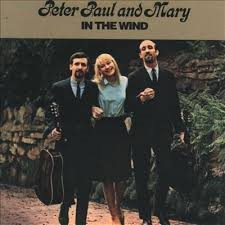
The folk music revival took off in the early 1960s, presenting a real challenge to older performers like Gary Davis.  Peter, Paul, and Mary and Bob Dylan covered songs previously recorded by Davis and others, which raised the thorny issue of copyright that Zack treats in a clear, sprightly fashion. (154-158)

Peter, Paul, and Mary

Peter, Paul, and Mary

As far as Zack is concerned, the most significant development of the era was the decision by Warner Brothers Records to apply for a copyright on behalf of the Rev, because Peter, Paul, and Mary (PPM) had covered one of his gospel songs, “Samson and Delilah,” as “If I Had My Way.” This was the first time Davis had ever had a song protected by copyright, and, because of the popularity of PPM, it brought him “the biggest checks of his life.” (163)  On the other hand, there was no stampede on the part of other young “folk singers” and their labels to follow Warner’s example and award copyright protection to the older, original creators of folk songs like Davis.

The Rev was not a fan of the skills of the “rediscovered” blues men like Mississippi John Hurt, Son House, and Skip James. According to Zack, Davis’s “need to deride his contemporaries probably says more about his own insecurities than it does about the relative merits of the other musicians.” (175) And yet, thanks to Warner Brothers’ and PPM’s efforts to secure copyright for “Samson and Delilah,” Davis’s income rose significantly.  The Rev and Annie were able to buy their first car, although neither of them could drive it—squiring them around in the Ford became another way for the Rev’s students to “pay their tuition.”

By the mid-1960s, Davis, aided by students, was able to travel, usually without Annie, to concerts at home and abroad, which allowed him finally to “assert himself publicly as a master of both religious and secular music.” (178) Yet, according to Ian Zack, Davis also used these opportunities to “sample” young women, either on the stage or afterward.

Zack also argues that “few, if any musicians of [Davis’s] caliber in the modern era could claim as many students and as much influence as a teacher.” (197)  To Davis, teaching was “yet another way for an evangelist to spread the gospel,” and his students “also saw firsthand how he struggled to keep his spiritual life intact despite intrusions from the blues life.” (199, 201)

As the “folk revival” dried up in the 1960s, Davis latched onto every opportunity he could to travel abroad and perform, as another way to spread his “gospel.”  The Rev also became more willing to perform his blues songs in public, perhaps because he finally realized that was why most young people had been coming to hear him all along.

By the summer of 1965, “Right before everyone’s eyes, the Beatles and Dylan were ushering in the rock era and closing the chapter in which folk music had become synonymous with pop and traditional artists like Gary Davis had enjoyed the fruits of a thriving folk scene.” (214)  Davis continued to perform wherever he could, and his students worked to cement his reputation.

Early in 1972, the Rev experienced both kidney and heart problems; on May 5, he suffered a fatal heart attack.  Zack feels that Gary Davis has not received his due, largely because of the choices he made during his career. In fact, he claims, Davis’s greatest legacy is probably his students, talented guitarists like Stefan Grossman and Ernie Hawkins who would devote their careers to spreading the (guitar) gospel according to the Rev. Gary Davis.

Zack has done a fine job reconstructing Davis’s life and career, in a well-researched,  thorough, and well-illustrated biography.  Perhaps most significantly, Zack takes Davis’s religious views seriously—he even cites scripture for some of the Rev’s lyrics.  This biography will last, and Zack deserves congratulations for his dedication to the Rev. Gary Davis and his legacy.

Davis3

 DISCOGRAPHY:

Blind Gary Davis: Harlem Street Singer. Prestige/Bluesville Records, 1992. OBCCD-347-2 (BV-1015)

Heroes of the Blues: The Very Best of Rev. Gary Davis. Shout Factory, 2003—DK-30257.

The Complete Early Recordings of Rev. Gary Davis. Yazoo Records, 1994—Yazoo 2011.

* * * * * *

For those interested in reading more about Georgia History, here are links to my books on the subject:

REABP CoverRancorous Enmities and Blind Partialities:  Parties and Factions in Georgia, 1807-1845 (University Press of America, 2015)

Pursuit Cover

In Pursuit of Dead Georgians:  One Historian’s Excursions into the History of His Adopted State (iUniverse, 2015)


Politics on the Periphery:  Factions and Parties in Georgia, 1783-1806 (University of Delaware Press, 1986)


Posted in Age of Jim Crow, Alan Lomax, American History, Books, Historical Reflection, History, Interdisciplinary Work, Piedmont Blues, Research, Retirement, Southern History, The Blues, Uncategorized, WP Long Form, WP Long Read | Tagged , , , , , , | Leave a comment

Bubba’s Baedeker: A History Book as Travel Guide to the “Redneck Riviera”

john-quincy-adams-pictureA Review of Harvey H. Jackson III, The Rise and Decline of the Redneck Riviera:  An Insider’s History of the Florida-Alabama Coast  (Athens, Ga., University of Georgia Press, 2012)

[NOTE: I first read Hardy Jackson’s book in 2012, and it stirred in me a desire to travel  the stretch of beach towns along the Gulf Coast between Gulf Shores, Alabama, and Panama City Beach, Florida.  When we finally decided to make that trip, I began re-reading Jackson’s book, carrying it along as a sort of “Bubba’s Baedeker.” I’d recommend this practice to anyone interested in visiting the “Redneck Riviera,” whether or not you happen to like that label.  Oh, and to learn why some folks do not cotton to the “Redneck Riviera” tag, read on.]

* * * * *

As in so many other areas of American life, World War II affected the development of  resorts along the Alabama-Florida Gulf Coast. These towns featured very crude facilities before the war, yet those who visited liked what they found, places to relax among people much like themselves but which also gave them room to do pretty much whatever they wanted. Thanks to the G.I. Bill and other government-sponsored measures that bestowed upon World War II veterans the thanks of a grateful nation and helped usher them into the suddenly enlarged American middle class, returning servicemen and their families could afford a few days at the beach after the war.

As the decades passed, the veterans aged, as did the society of which they were a part. Some “beach” locales changed in ways that made them almost unrecognizable to members of the “Greatest Generation” and their children. The grandchildren of the World War II generation’s “Rednecks” dominated the “Riviera” by the twenty-first century, and their idea of a beach resort was quite different from their elders’.

This is the story Hardy Jackson tells, with an unbeatable combination of historical research, reflection, and humor. Jackson’s focus is on Gulf Shores and Orange Beach in Alabama, and Fort Walton, Destin, and Panama City Beach in Florida. His “control town” is Seagrove Beach, Florida, where his family has owned a “beach cottage” since 1956, where he spent his summers growing up, and to which he retired a year or so ago .

* * * * *

In the immediate post-World War II years, the Gulf Coast’s beach towns created the tacky veneer that would eventually earn them the sobriquet of the “Redneck Riviera.” Still, tourists came, probably because of the tackiness.

Despite damage wrought by the occasional hurricane after WWII, neither developers nor many local residents wanted to hear about “saving the dunes.”  Early on, in other words, tension arose that has yet to be resolved, between residents suspicious of the federal government and its suspected designs on their property, on the one hand, and that government’s role in improving life there in all sorts of ways, on the other.

This was a world before air conditioning, at a time when roads were primitive. The dreams of area entrepreneurs were modest at first. For example, C.H. McGee, founder of Seagrove Beach, Florida, where the Jackson clan early on bought a cottage, promised an affordable, whites-only (but no “white trash”) development.  Only those in search of “wholesome” activities need apply—those who wanted a more adventuresome lifestyle were urged to look elsewhere.

Yet, as crude as the early towns might seem now, veterans and their families descended on the area, and, as postwar optimism set in, developers began to salivate at the coast’s future prospects. In Jackson’s view, “Two different sets of tourists, classes if you will, were taking shape, and in time they would create two different coasts, each in its own image.” (62)

From the 1950s through the 1960s, the coastal towns had it lucky. Visitors seemed happy with the “tacky resorts” that had sprung up, and those who made a living by serving up tackiness were able to keep labor problems from getting out of hand. The biggest challenge was to find—or create—tourist-worthy “events” throughout the year, not just during the summer months.  One such event, “Spring Break,” became a money-maker that nonetheless gradually drove local boosters crazy because of the excesses of some of its participants.

Meanwhile, efforts by well-meaning adults to provide “wholesome games” for teens and to ban beer “only confirmed what the students already believed—that adults didn’t have a clue.” (75) And, while hurricanes in 1965 (Betsy) and 1969 (Camille) damaged the Florida-Alabama coast less than they did other areas along the Gulf, residents began to wonder “what if. . . ?”

The transformation of the Florida-Alabama Gulf Coast began, by Jackson’s reckoning, between the early 1970s and mid-1980s, thanks to the Arab oil embargo (1973), the Federal Reserve System’s efforts to reduce inflation (1974), and hurricanes Eloise (1975) and Frederic (1979). All these events produced tighter credit and physical damage to the coastal towns.

The movers and shakers in the region during this period, memorably described by  historian Emory Thomas as “a new generation of raffish Rotarians, pirates with cash register eyeballs, and hard-handed matrons,” (94) had no problem using financial and natural disasters to kill off some of the “tackier,” more traditional motels, bars, and amusement parks. There was nothing sinister going on, just a cold-blooded realization by those whose properties had been damaged by Mother Nature that the costs of revival were too steep and the offers from those “raffish Rotarians” too attractive.

These developments produced changes intended to attract a more affluent–and less “Redneck”–clientele. Down the decades, this trend would produce “a sprawling complex of hotels, condominiums, golf courses, town centers, and attractions that were designed for the upscale and affluent.” (105)  One example of this was what happened to developer Robert Davis’s vision of Seaside, which began as a romantic’s notion of a sort of “hippy commune” but evolved into a tourist attraction for “yuppies” who enjoyed living in a “gated community without a gate.” (115-119)

The term “Redneck Riviera” was popularized by New York Times journalist Howell Raines, but, not surprisingly, local developers did not like it and scrambled to find acceptable alternative labels. Tourist Development Councils strove mightily and brought forth such less than memorable terms as “Emerald Coast” and “Pleasure Island,” not to mention “The Beach.” And, while all this “branding” activity was going on, developments like Seaside were becoming victims of “affluenza,” where, according to Jackson, “prestigious communities exude luxury and privilege but also signal disturbing signs of vulgarity laced with antisocial overtones.” (140)

In the prosperous 1990s, the “Redneck Riviera” became too expensive for “average folks.” Instead, places like Seaside were dominated by those characterized by New York Times columnist David Brooks as “BOBOS—Bourgeois Bohemians,” a “well-bred, well-educated, well-careered, well-off ‘better sort’ who were environmentally aware, intellectually stimulated, health conscious, kid friendly, and family oriented.” They were, in short, “the ‘best’ of the baby boomers—affluent, acquisitive, self-absorbed, and socially progressive.” (153-154)

Meanwhile, hurricanes began to produce lots of what Jackson refers to as “involuntary urban renewal.” (156-158)   And, once more, those whose property had been devastated sold out, which led to more condos, described by one observer as “the New Jerseyization of the Gulf Coast.” (159)  The result was that the more condos that appeared, the less public beach was available, and the beach, after all, was what drew visitors to the Redneck Riviera.

“Snow birds” continued to arrive each winter from the Great White Northeast and Midwest.  Meanwhile, controlling the excesses of Spring Break drove local officials to distraction, especially with the arrival of Joe Francis, who became (in)famous for his documentary series, “Girls Gone Wild.”

And, just when it seemed that things couldn’t get more difficult, the weather turned, with hurricanes Ivan (September 2004) and Dennis and Katrina (July-August 2005) arriving in full force. Not even hired consultants who suggested that the term “hurricanes” be replaced by “tropical occurrences” accomplished much in the wake of these disasters.

As if the “Great Recession” was not bad enough, BP’s oil rig “Deepwater Horizon” went to hell in a hand basket in the spring of 2010, threatening the beach itself, the reason folks had been coming to the Redneck Riviera for generations. This disaster also forced Professor Jackson to return to his research in order to ensure that his manuscript was “up-to-date,” and he does a fine job incorporating the whole sorry business into his text.

Jackson closes his narrative with a reflection on the 2010 Seagrove Beach Fourth of July parade. (292-293)  He concludes that, despite the fact that “Politicians, prosperity, class, culture, and commercialism combined to stifle spontaneity and turn much of the Redneck Riviera into a playground for the affluent, the intense, and the opportunistic,” at least in places like Seagrove Beach “redneckery remained, to the distress of many who wanted it otherwise.” (295) And you can count Professor Jackson among those who support “redneckery.”

The Rise and Decline of the Redneck Riviera is a solid work on a fascinating topic.  Yes, Jackson’s “insider” status does occasionally get in the way of “scholarly objectivity,” imparting a sort of “us v. them” view of the influence of “Yuppies” on the region.  Yet, while Jackson doesn’t pull his punches, he does try to be fair, and he succeeds more often than not.  His analysis is clear, and leavened with wit; the book also is well-illustrated.

In short, the “Redneck Riviera,” by whatever name it’s called by those “pirates with cash register eyeballs,” has found its historian.

Hardy Jackson

Hardy Jackson

 * * * * * *

For those interested in reading more about Georgia History, here are links to my books on the subject:

REABP CoverRancorous Enmities and Blind Partialities:  Parties and Factions in Georgia, 1807-1845 (University Press of America, 2015)

Pursuit Cover

In Pursuit of Dead Georgians:  One Historian’s Excursions into the History of His Adopted State (iUniverse, 2015)

Politics on the Periphery:  Factions and Parties in Georgia, 1783-1806 (University of Delaware Press, 1986)


Posted in American History, Books, Current Events, Historical Reflection, History, Popular Culture, Research, Retirement, Southern History, Uncategorized, WP Long Read | Tagged , , , , , , | Leave a comment