Understanding Recent American History–“Nixonland,” or “The Age of Reagan”?


[NOTE: Historical revisionism occurs when, every generation or so, the scholarly consensus about important events or individuals begins to shift.  Revisionism is not a concept that appeals to neophyte historians, or to “average Americans” trying to understand the past, many of whom come to the subject with the quaint notions that a) history is just a bunch of names and dates–or, as we historians like to insist, “facts”; and that b) said “facts” do not change.  But, the longer one stays in this profession, the more he or she understands the importance of the historian’s opinions, biases, interpretations, and, ultimately, of revisionism, in shaping our received understanding of the past.]

* * * * *

“Back in the day,” as my former students were wont to say, I did not enjoy studying–let alone teaching–modern American history.  I had done my dissertation in the history of a single state during the era of the early American republic (late 18th-early 19th centuries) and, by gosh, that was all I really needed, or wanted, to think about.  And, if I had wound up on a college or university faculty, perhaps I might have been able to get away with that mind set, at least for a while, especially when teaching upper-level courses “in my field.”  But then a funny thing happened:  I wound up teaching American history at the secondary school level, where the survey course is the bread and butter of every department, and, at my school, for the stronger students, the Advanced Placement American History course was the ultimate challenge, because it was supposed to be taught “on the college level.”

I had trouble with this at first. The AP U.S. History test purportedly covered the entirety of the nation’s past (an impossible task, by the way).  Yet, as I soon discovered, there would be no essay questions treating solely events of the most recent couple of decades, although there might be a few objective, or “multiple-guess,” questions on that period.  That still left a large swath of the nation’s recent past for me to “cover,” if I was to give my students a fighting chance to succeed on the AP exam, like it or not.  And I finally discovered a way to like it.

What I did was to turn American history since the end of World War II into what I modestly called (to myself, not to my students) the “age of Lamplugh,” since I was born in 1944.   As I tried to explain the history of the Vietnam War, the presidency of Richard Nixon, or the Civil Rights Movement to myself (the essential preliminary step to teaching my students about them, of course), I struggled to maintain at least a modicum of objectivity while delving into topics that I not only remembered but also had strong opinions about.

What helped immeasurably as I attempted to “play fair” when discussing the part of the past that I had grown up in, was the appearance of a steady stream of detailed, colorful studies of significant people and developments since the end of the Second World War.  I eagerly read these and tried to incorporate ideas, interpretations, even anecdotes from them, into my classroom arsenal.  The most important benefit, for me at least, was that I began to realize that there were more nuanced ways to interpret the heroes and villains of my youth than those I preferred to use.  (I know, I know:  what a concept!)

From time to time, I shared my growing appreciation of modern American history with my colleagues, in the columns of our History department newsletter, which I edited for five years or so.  Our department was fairly diverse in political viewpoints, and I tried to be objective whenever I discussed teaching about the nation’s recent past.  For instance, when I treated The Rev. Dr. Martin Luther King, Jr., and civil rights, I tried to include a variety of interpretations, not just rely on my own memories of the man and his times, though those remained powerful to me.

* * * * *

In an article in January 2009, I offered excerpts from recent works on Richard Nixon and Ronald Reagan, two of my least favorite modern American presidents.  These volumes presented well-supported conclusions that were “kinder and gentler,” because they were more objective, than my own would have been:
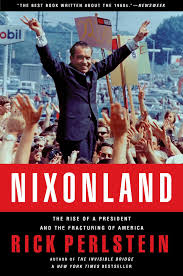
Nixonland

Richard Nixon died in 1994.  At his funeral, Senator Bob Dole prophesied that “the second half of the twentieth century will be known as the age of Nixon.”  In a sense he surely did not intend, I think Bob Dole was correct.  What Richard Nixon left behind was the very terms of our national self-image:  a notion that there are two kinds of Americans.  On one side, that “Silent Majority.” The “nonshouters.” The middle-class, middle American, suburban, exurban, and rural coalition who call themselves, now, “Values voters,” “people of faith,” “patriots,” or even, simply, “Republicans”–and who feel themselves condescended to by snobby opinion-making elites, and who rage about un-Americans, anti-Christians, amoralists, aliens.  On the other side are the “liberals,” the “cosmopolitans,” the “intellectuals,” the “professionals”–“Democrats.”  Who say they see shouting in opposition to injustice as a higher form of patriotism.  Or say “live and let live.” Who believe that to have “values”has more to do with a willingness to extend aid to the downtrodden than where, or if, you happen to worship–but who look down on the first category as unwitting dupes of  feckless elites who exploit sentimental pieties to aggrandize their wealth, start wars, ruin lives.  Both populations–to speak in ideal types–are equally, essentially, tragically American.  And both have learned to consider the other not quite American at all.  The argument over Richard Nixon, pro and con, gave us the language for this war. . . .

How did Nixonland end?  It has not ended yet.

Rick Perlstein, Nixonland:  The Rise of a President and the Fracturing of America (New York, 2008), p.748.  And Perlstein’s work on the rise of modern political conservatism also has not ended yet.  See his Before the Storm:  Barry Goldwater and the Unmaking of the American Consensus (2001); and The Invisible Bridge:  The Fall of Nixon and the Rise of Reagan (2014).

* * * * *
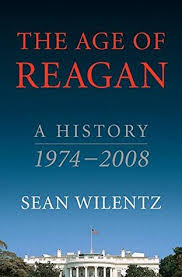
Age of Reagan

Finally, though, dissolving the Reagan myth by pointing out his presidency’s many failures, regressive policies, and dangerous legacies should not obscure his essential importance.  As Edward Kennedy observed, Reagan was an effective president because he took ideas seriously. . . . Although passionate–at times too passionate–in fighting for what he believed in, Reagan was a leader who understood American politics, and who, with the egregious exception of Iran-contra, practiced the art of compromise shrewdly.  If greatness in a president is measured in terms of affecting the temper of the times, whether you like it or not, Reagan stands second to none among the presidents of the second half of the twentieth century.  American history is filled with presidents who tried to build and consolidate a conservative reaction to previous eras of reform, including Andrew Johnson, Rutherford B. Hayes, and Calvin Coolidge.  None came close to matching Reagan in redefining the politics of his era and in reshaping the basic terms on which  politics and government would be conducted long after he left office.  Add in Reagan’s remarkable turnabout in helping to end the cold war, as well as his success, albeit easily exaggerated, in uplifting the country after the disaster in Vietnam and the Carter years, and his achievement actually looks more substantial than the claims invented by the Reaganite mythmakers. . . .

Sean Wilentz, The Age of Reagan:  A History, 1974-2008 (New York, 2008), p.286.

* * * * *

(amazon.com)

(amazon.com)

As a sort of response to the Wilentz volume, consider James Broussard’s friendlier assessment of Ronald Reagan’s legacy, which I summarized in an earlier post as follows:

Reagan deserves to be considered “the great American conservative champion” (179), . . . even if his actual views and actions on key issues are unacceptable (if done by someone not named Ronald Reagan) to today’s more frantic, ideologically lock-step GOP. . . . Reagan was the FDR of the Republicans, a strong leader who was not only good for the country but also revived his party’s fortunes.

. . . . Reagan was “the only president in a fifty-year period who was able, not merely to slow, but actually to reverse the rising tide of federal discretionary spending.  Conservatives praise this achievement and treasure it in future memory.  For liberals, it was a disgraceful abandonment of government’s duty to meet public needs.” (182). . . 

“Reagan’s greatest achievement by far . . . is the successful—indeed victorious—end of the Cold War.” (184)  There are those who award the lion’s share of credit for this development to Soviet Chairman Gorbachev; Broussard responds, “Even Reagan’s most fervent supporters cannot claim that he alone produced this change, but all except his most bitter critics agree that he had something to do with it.”  Moreover, “few would disagree that Reagan’s impact, both at home and abroad, was profound.” (188)

James H. Broussard, Ronald Reagan:  Champion of Conservative America (New York and London, 2015), pp. 179-188, passim.

* * * * *

Now, none of this is intended to “sell” a particular interpretation of either Richard Nixon or Ronald Reagan.  Rather, I’m arguing that it is possible–indeed, admirable–for a historian to strive for objectivity when evaluating a controversial contemporary figure, even if he or she does not always achieve it.  Alas, that, too, is one of the burdens of historical revisionism.

* * * * * *

For those interested in reading more of my reflections on history, here are links to my books on the subject:

REABP CoverRancorous Enmities and Blind Partialities:  Parties and Factions in Georgia, 1807-1845 (University Press of America, 2015)

Pursuit Cover

In Pursuit of Dead Georgians:  One Historian’s Excursions into the History of His Adopted State (iUniverse, 2015)

POTP Cover

Politics on the Periphery:  Factions and Parties in Georgia, 1783-1806 (University of Delaware Press, 1986)

Posted in American History, Books, Cold War, Dr. Martin Luther King, Historical Reflection, History, Martin Luther King, Research, Retirement, Richard Nixon, Ronald Reagan, Teaching, Uncategorized, Vietnam War | Tagged , , , , , | 6 Comments

American Republicanism, Part I—The Blueprint (History Lesson Plans, 8)

[NOTE: For a number of years, we had at my school a year-long elective course for seniors that combined elements of American history, American literature, and social outreach. In its last incarnation, this interdisciplinary offering was called “The School for the Common Good.” For several years, I dropped by this class for a week or so and lectured on the idea of the “common good,” which I located in the ideology of “republicanism,” tracing the concept, and republican ideology, through early American history while at the same time offering an overview of the formative years of new nation’s political development. What follows is the first of four posts revised from my notes for those lectures.]

* * * * *

“republic”—from Latin, res publica: public thing or matter.

Jefferson (History.com)

Jefferson (History.com)

Those who labor in the earth are the chosen people of God, if ever he had a chosen people, whose breasts he had made his peculiar deposit for substantial and genuine virtue. . . . Corruption of morals in the mass of cultivators is a phenomenon of which no age nor nation has furnished an example. . . . Dependence begets subservience and venality, suffocates the germ of virtue, and prepares fit tools for the designs of ambition. . . . [G]enerally speaking, the proportion which the aggregate of the other classes of citizens bears in any state to that of its husbandmen, is the proportion of its unsound to its healthy parts, and is a good-enough barometer whereby to measure its degree of corruption. (Thomas Jefferson, Notes on the State of Virginia [1785])

jefferson_notes

* * * * *

“Republicanism” was “in every way a radical ideology—as radical for the eighteenth century as Marxism was to be for the nineteenth century.” (Bailyn, et al., The Great Republic, I, 273—hereafter, GR) The roots of republicanism went back to ancient Greece and Rome, popped up again in the city-states of Renaissance Italy, then apparently reached a dead end in mid-seventeenth century England, during the time of the so-called “Puritan Commonwealth” under Oliver Cromwell (1649-1653). The Puritan Commonwealth died, even before Cromwell did, for he actually ruled as a sort of military dictator. Then, following Cromwell’s demise, the English monarchy was restored.

Sir Robert Walpole (amazon.com)

Sir Robert Walpole (amazon.com)

Yet, the ideas underlying England’s brief experiment with republicanism lived on, and again enjoyed a flurry of popularity in Great Britain during the 1720s and 1730s, when the first British “prime minister,” Sir Robert Walpole, presided over a regime that brought the nation stability and prosperity, but, according to his “republican” critics, at the cost of corruption. The ideas incorporated in these “republican” books and pamphlets crossed the Atlantic to Britain’s North American colonies, where they survived rather quietly for another generation. Then, after 1763, Britain’s efforts to tighten her imperial structure and impose a series of unpopular taxes on the Americans revived the republican “opposition ideas” from Walpole’s day.

Through the lenses of those earlier republican writers, colonial Americans in the 1760s and 1770s saw clearly a plot against their liberties being hatched by a “tyrannical” monarch and his “corrupt” ministers. In short, “republicanism” became the official ideology of the American Revolution. Thus, when the colonies decided to reorganize their governments as part of their break for independence, they naturally chose to transform themselves from “colonies” into “republics.”

* * * * *

What, exactly, did late-eighteenth-century Americans mean by “republicanism”?  Unhappy colonists (or “Whigs”) tended to agree on the political, and to some extent on the social, meaning of the term: there would be no monarch, nor an American “aristocracy”; instead, government would derive its authority from “the people” themselves. However, as widely understood among educated American colonists, true republicanism “added a moral, idealistic, and indeed utopian dimension to the political separation from Britain . . . that promised . . . a change in the very character of American society.” (GR, 273) And, on this issue, disagreement arose.

In general, intellectuals familiar with the ideals of republicanism (and, to a great extent, republicanism as an ideology was most fully comprehended by intellectuals thoroughly schooled in ancient Greek and Latin texts) envisioned it as something like an American version of the Roman Republic, a “world of simple farmer-citizens enjoying liberty and rural virtue,” (GR, 274) much as Thomas Jefferson did in the passage quoted at the head of this post. In other words, American “republics” would exist in a world that possessed none of the aspects of “modernity” that had so exercised “republican” thinkers since at least Robert Walpole’s time.

More specifically, republicanism would include three essential elements. American republicans traced the evils of the decadent Old World to powerful governments that used corruption to reward their supporters and keep “the people” in thrall.

* * * * *

The only way to prevent the rise of governmental corruption in republican America, these writers believed, was to create a society based upon the equality of independent citizens, “linked to one another in affection and harmony.” While it was true that the independence of these citizens grew out of their ownership of land, this society would not be narrowly selfish; rather, its members would be devoted to the “common good.” In fact, several of the American colonies (Massachusetts, Pennsylvania, and Virginia, for example) adopted the name of “commonwealth,” rather than “state,” to emphasize their commitment to the “public good.” (GR, 274)

Montesquieu (wikimedia.org)

Montesquieu (wikimedia.org)

Republican theorists were thoroughly familiar with ancient history, so they knew that republics were frail constructs,easily disrupted, or even destroyed, by factions and internal strife. To surmount this difficulty, students of republicanism argued, following the French theorist Montesquieu, republics needed to be small in size and homogeneous in character and population. (By the late eighteenth-century, the only remaining republics were the Netherlands and some Italian and Swiss city-states.) Obviously, this notion presented a real challenge to the new United States, which, even at the end of the Revolution, was geographically large and ethnically diverse, not the stuff of which classical republics were made.

* * * * *

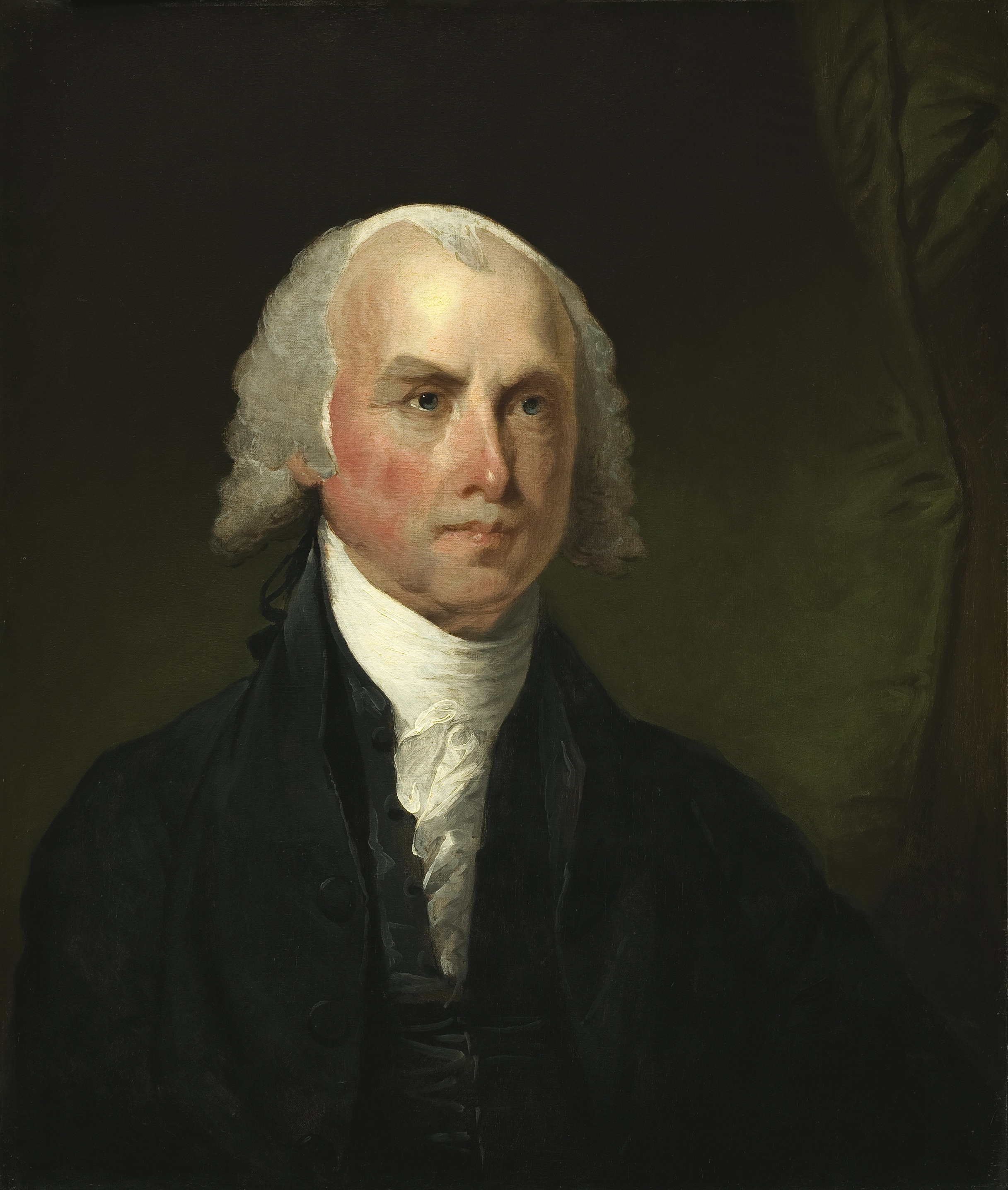
James Madison (en-wikipedia.org}

James Madison (en-wikipedia.org}

The “Father of the Constitution,” James Madison, tackled this problem head-on in the most famous of the Federalist Papers, written in support of the proposed Constitution in 1787 during the ratification contest. In Federalist #10, Madison turned Montesquieu on his head, arguing that a republic in America would survive only because the new nation was so large and diverse: its very size, he said, would make it difficult, if not impossible, for a sufficient number of factions to unite to threaten the existence of the state. (Note that Montesquieu’s theory, and Madison’s modification of it, reflected a rather gloomy view of human nature.) Still, whether a republic was large or small, it did not require a strong government.

What would hold it together was a second element of republicanism, the virtue of the people. Essentially, the radical nature of republicanism grew out of its reliance on the devotion of “the people” to achieve the public good. Republican citizens must be patriots who both loved their country and were free of the control of others.

In the late eighteenth century, this description seemed best to fit Thomas Jefferson’s yeoman farmers, “the chosen people of god.” Ownership of land by individuals supposedly furnished them with both independence and loyalty to the community. Moreover, because only free, white, adult males could own property in the late eighteenth century (and an extraordinarily large percentage of them did), all other Americans—slaves, Native Americans, and women, for example—could be denied the right to vote because they did not own property.

* * * * *

The final element of classical republicanism, as reinterpreted for citizens of the post-Revolutionary United States, was the emphasis on equality, “the most powerful and influential concept in American history.” (GR, I, 277)  Ability, not birth, was the key, but, according to Thomas Jefferson and John Adams, among others, republics would still have an aristocratic element, although a natural, not an artificial, one, essentially a nation of George Washingtons.  Yet, in this republican nirvana, only free, white, adult males were eligible for membership in this “natural aristocracy.”

So, this was the “republican” blueprint developed in the new United States after the American Revolution. It is against this template that we can measure the new nation’s success-or failure-in putting the theory of republicanism into practice. This will be the subject of later posts.

* * * * * *

For those interested in reading more of my reflections on history, here are links to my books on the subject:

REABP CoverRancorous Enmities and Blind Partialities:  Parties and Factions in Georgia, 1807-1845 (University Press of America, 2015)

Pursuit Cover

In Pursuit of Dead Georgians:  One Historian’s Excursions into the History of His Adopted State (iUniverse, 2015)

Politics on the Periphery:  Factions and Parties in Georgia, 1783-1806 (University of Delaware Press, 1986)

Posted in American "republicanism", American History, American Revolution, Education, Historical Reflection, History, History Curriculum, Interdisciplinary Work, Prep School, prep school teaching with a PhD, Research, Retirement, Southern History, Teaching, Uncategorized, WP Long Read | Tagged , , , , , , , , | 2 Comments

Read One for the Gipper

A Review of James H. Broussard,

Ronald Reagan:  Champion of Conservative America.

New York and London:  Routledge, 2015.

(amazon.com)

(amazon.com)

[NOTE: One of the joys—and curses—of being a professional historian is the lure of “revisionism.”  That’s when, every generation or so, the historical consensus about important events or individuals begins to shift.  George W. Bush, for example, can’t wait for this to happen, because historians’ contemporary opinions of his presidency were so negative.  And, deep in his San Clemente man-cave, I’m sure that Richard Nixon, even to his last breath, felt that “history” would vindicate him.

To historians, revisionism is as inevitable as death and taxes (because they’re not generally members of the 1%).  So, it’s natural, even for a historian who did not vote for Ronald Reagan, to realize that the old historical carousel keeps on a-turnin’.

Exhibit A is James Broussard’s concise biography of Ronald Reagan, a well-crafted, thoughtful attempt to burnish the late President’s historical reputation, especially if the reader has little first-hand knowledge of the Reagan years.  (And, yes, having lived through a historical period does make coming to terms with the inevitability of revisionism more than a little challenging!)]

* * * * *

James H. Broussard (Lebanon Valley College)

James H. Broussard (Lebanon Valley College)

Imagine trying to do justice to the life of any significant President of the United States (and even I will admit that Reagan qualifies) in under 200 pages, and select a representative group of ten “documents” to offer readers insight into the way that President’s mind worked.  Within the constraints of this format, James Broussard characterizes Ronald Reagan as a popular, telegenic leader with significant accomplishments, but also one whose flaws were real.

The picture of Reagan’s upbringing presented here is Horatio Alger-ish, but with the subject having acting “chops” in addition to the requisite grit and determination.  Reagan’s early life was difficult—his dad, Jack, was ambitious, but also had numerous problems, including alcoholism.  Son Ronald (who preferred the nickname “Dutch,” because he believed it sounded more “manly” than his given name) coped successfully with his father’s issues, but the experience made him a “very private person.” (8)

Young Dutch’s release valves included boys’ books emphasizing the triumph of good over evil; sports and extracurricular activities in high school, especially acting; and seven consecutive summers as a lifeguard in Dixon, Illinois.  When Jack Reagan was sober, he was a New Deal Democrat, as was his son.  Dutch, who clearly wanted to get the heck out of Dixon after graduating from Eureka College, managed to secure a radio announcing job in Iowa, a screen test in Hollywood, and a contract with Warner Brothers in 1937.

Reagan’s Hollywood career was generally undistinguished, but he did demonstrate considerable skill in politics, at least in his role as member—and eventually president—of the Screen Actors Guild.  In the 1940s, Reagan traversed the political spectrum from “Hollywood liberal” to “conservative.”  During the post-World War II “Red Scare,” he abandoned his opposition to anti-Communist “witch hunting” and became an advocate of “naming names,” something for which “liberals” in Hollywood never forgave him.

Reagan’s first marriage, to actress Jane Wyman, ended in divorce in 1948.  Within a year, he had taken up with actress Nancy Davis, whom he married in 1952 and who would remain the love of the rest of his life.

A turning point in his career came in the mid-1950s, when Reagan became associated with the General Electric Company.  Host of GE Theater, Reagan, coached by public relations maven Lemuel Boulware, traveled to factories and parroted the company’s line against the alleged threat of “big government” to private enterprise and individual liberty,  eventually adding the danger of Communist encroachment abroad to his list of perils.  Yet, while Reagan was beginning to sound like a grim-visaged conservative, Broussard insists that he maintained his optimism, a trait that ultimately proved decisive in his career.

Once the Technicolor western series Bonanza drove black-and-white GE Theater off the air, Reagan turned to politics.  He first achieved national recognition in 1964, thanks to his work on behalf of the overmatched Republican presidential candidate, Barry Goldwater.  Goldwater was trounced by incumbent Democrat Lyndon Johnson, but Reagan and his advisers managed to convert Reagan’s growing conservative “star power” into the governorship of California in 1966.

As Governor, Reagan emphasized a short list of pragmatic ideas, not a call for an ideological crusade.  Still, conservatives tended to listen to Reagan’s rhetoric and ignore his actions.  For example, the Governor hoped to achieve across-the-board budget cuts, but he ended up signing “the largest [tax increase] by any state ever until that time.” (68)  Already, we can see the “Great Communicator” at work.  In Broussard’s nifty summary, Reagan’s gubernatorial career “reflected his personal popularity and marked only a brief interruption in the state’s steady drift to the Democrats. . . .” (83)

His unsuccessful challenge to incumbent Republican President Gerald Ford in 1976 taught Reagan useful lessons, and in 1980 he ousted another incumbent, Democrat Jimmy Carter. Reviewing the details of the campaign, Broussard admits what, to those of us who lived through it, seems an accurate assessment:  “[N]either Ronald Reagan nor his conservative issues won the 1980 election.  Jimmy Carter lost it.” (101)

According to Broussard, President Reagan knew what he believed on certain “big” issues but was willing to leave “minor” issues to his subordinates.  His “big issues” included inflation, the economy, the Cold War, rebuilding the military, and eliminating nuclear weapons.  By the end of his eight years in office, Reagan had made his mark in most of these areas, for better or worse.  [On the “for worse” side, I remember trying to assure my own children, and my high school students, that, just because Reagan’s administration thundered doomsday scenarios when discussing nuclear war, that didn’t mean we’d incinerate humankind any time soon.  Not that I actually believed it, but still. . . .]

Reagan applied a “hands-off” management style to his presidency (111), spending lots of vacations at his California ranch and weekends at Camp David.  This lack of oversight created problems, allowing Cabinet members, including most famously Interior Secretary James Watt, to head off in controversial directions.  Still, the “Great Communicator” did pressure Congress on issues he felt were important.  For example, he pushed through the nomination of numerous conservative federal court justices, including Anthony Kennedy to the Supreme Court, the start of an important, and ongoing, trend.

In evaluating Reagan’s domestic programs, Professor Broussard credits him with slowing the growth of government, “aside from its responsibility for national defense.” (122)  Broussard believes Reagan’s “greatest domestic triumph” was to leave inflation “weaker, wounded and far less dangerous.”  And yet, he points out, “[T]he bad consequence of tighter money was a serious recession, the worst economic downturn—or at any rate the worst unemployment—since the Great Depression of the 1930s.” All of which, I imagine, sounds fairly ho-hum to readers in the twenty-first century–unless they lived through the period, as I did. (125)

According to Broussard, on foreign policy issues the Reagan Administration was split between pragmatists (including Reagan himself) and hardliners (who were “more Reagan than Reagan”), over dealing with the Soviet Union.  The President’s firm approach to the Communist giant seldom wavered, despite the occasional shakiness of public opinion; his sunny pronouncements seemed to allay popular misgivings.  One concrete, immediate outcome of this policy was the signing by Reagan and Soviet Chairman Gorbachev of the Intermediate Nuclear Forces Treaty in December 1987; a long-term result, Broussard argues, was the implosion of the Soviet Union, which occurred after Reagan had retired from office.

Broussard’s treatment of Reagan’s second term is painful to read, though perhaps not as painful as having lived through it.  There were high points—for example, tax reform in 1986.   But the President’s misstep regarding the ceremony at the Bitburg cemetery in 1985, where he praised the dedication of those buried there (including German SS troops)–and the news broke in the U.S. during Passover Week?  The “Iran-Contra” disaster, which began like a re-run of our slog into Vietnam and ended up a serio-comic screen test for “The Gang That Couldn’t Shoot Straight”?  In Broussard’s telling, those controversies were mostly the fault of Reagan’s advisers–Chief of Staff Don Regan; National Security Adviser Robert McFarlane; and the ever-popular conservative “hero,” Colonel Oliver North, who played Batman to his “Robin,” Fawn Hall.  (The thuggish, “anti-Communist” “Contras” as the “moral equivalent of our Founding Fathers”?  Really?)

A congressional committee reporting on the “Iran-Contra Affair” criticized “Reagan’s lax—almost nonexistent—management style but f[ound] no evidence of culpability in illegal activity”; special prosecutor Lawrence Walsh added that, “while numerous people broke the law, there was no evidence that Reagan approved or knew of the illegal diversion of money to the contras.” (169)  Obviously, admirers of Ronald Reagan will interpret those conclusions differently from people who don’t admire him, who might ask, “What about Truman’s belief that ‘The Buck Stops” at the President’s desk?

Among the “minor” domestic issues President Reagan didn’t seem to care much about was AIDS. Broussard argues that Reagan’s approach to the epidemic was “more complicated” than his critics admit:  “[H]e understood that AIDS was a terrible plague, sympathized with its victims, denounced discrimination against them, and spent billions on AIDS research.”  Yet, his biographer also acknowledges that Reagan was reluctant to lead on the issue (his speech on AIDS came only in 1987); his administration included “people who were vehemently hostile to homosexuality and who sometimes actually mocked the victims of AIDS”; and the President failed “to take up recommendations of his own federal commission” on AIDS, established in the wake of his 1987 speech. (170-171)

Broussard’s last chapter, “Ronald Reagan’s Legacy,” is masterful.  Reagan deserves to be considered “the great American conservative champion” (179), he maintains, even if his actual views and actions on key issues are unacceptable (if done by someone not named Ronald Reagan) to today’s more frantic, ideologically lock-step GOP.  To Broussard, Reagan was the FDR of the Republicans, a strong leader who was not only good for the country but also revived his party’s fortunes.

In Broussard’s view, Reagan was “the only president in a fifty-year period who was able, not merely to slow, but actually to reverse the rising tide of federal discretionary spending.  Conservatives praise this achievement and treasure it in future memory.  For liberals, it was a disgraceful abandonment of government’s duty to meet public needs.” (182)  And yet—once Reagan left the White House, Washington’s impact on American citizens revived and flourished, regardless of which party was in power.

To Professor Broussard, “Reagan’s greatest achievement by far . . . is the successful—indeed victorious—end of the Cold War.” (184)  There are those who award the lion’s share of credit for this development to Soviet Chairman Gorbachev; Broussard responds, “Even Reagan’s most fervent supporters cannot claim that he alone produced this change, but all except his most bitter critics agree that he had something to do with it.”  Moreover, “few would disagree that Reagan’s impact, both at home and abroad, was profound.” (188)

* * * * *

James Broussard’s study of Ronald Reagan argues that his legacy was, on balance, positive.  The biography is brief, readable, and even-handed, avoiding, for the most part, “triumphalism” in evaluating Reagan’s achievements.  Selections from ten of Reagan’s speeches amplify Broussard’s analysis, and a two-page “Note on Sources” (which can be supplemented by a more extensive bibliography at the book’s website) directs interested readers to more detailed accounts of the man and his era.

Reagan’s champions have been lauding him for a generation now; to the GOP, he remains “St. Ronald.” Yet, Ronald Reagan: Champion of Conservative America is not part of that echo chamber.  Broussard writes as a scholar, not a partisan. Intended for a college audience, the volume also could be used profitably in secondary school Advanced Placement U. S. History classes.  “Read this one for the Gipper” and decide for yourself.

* * * * * *

For those interested in reading more of my reflections on history, here are links to my books on the subject:

REABP CoverRancorous Enmities and Blind Partialities:  Parties and Factions in Georgia, 1807-1845 (University Press of America, 2015)

Pursuit Cover

In Pursuit of Dead Georgians:  One Historian’s Excursions into the History of His Adopted State (iUniverse, 2015)
Politics on the Periphery:  Factions and Parties in Georgia, 1783-1806 (University of Delaware Press, 1986)

Posted in American History, Books, Cold War, Current Events, Education, Historical Reflection, History, History Curriculum, Popular Culture, Prep School, Research, Teaching, Uncategorized, WP Long Read | Tagged , , , , , , | Leave a comment

Life in the Segregated South–Introduction to a A Panel Discussion,1991 (History Lesson Plans, 7)

[NOTE:  This is the third in a series of posts tracing the long road by which I finally arrived at one of my favorite courses, “The History of the Modern Civil Rights Movement.”  Previously, we have looked at an elective course offered in the late 1970s, “The South and the Sectional Image”; and at an introduction to a panel discussion about “Myth and Reality in Recent Southern History,” from 1978.  Today’s installment is another introduction, this one to a panel discussion featuring several of my Atlanta’s Finest Prep School (AFPS) colleagues, who drew on their own lives to offer, in our “Senior Lecture Series,” vignettes about life in the Jim Crow South (Spring 1991), from both black and white perspectives.  This session helped to convince me that, if I ever had the chance to teach a course on the Modern Civil Rights Movement, I would spend quite a bit of time looking at the so-called “Age of Jim Crow.”]

* * * * *

Hodding Carter III (nndb.com)

Hodding Carter III (nndb.com)

In a speech at a recent conference on Southern history, Hodding Carter III, Mississippi journalist and commentator on PBS, complained that young people in the South know less about southern history than they used to and that most white college students today are more familiar with MTV than with the struggle of blacks in the South for civil rights.  I hope that is not the case here.  Because this school is located in the region’s most vibrant city and because all of us, students and teachers alike, are southerners by birth or adoption, we have never stinted on our coverage of southern history.

In Atlanta, which takes pride in both Margaret Mitchell and The Rev. Dr. Martin Luther King, Jr., how could we in good conscience ignore slavery, the Civil War, and the modern civil rights movement?  Still, there is one area where I have long felt we could do more, the era before the passage of meaningful civil rights legislation, when “Jim Crow” laws, rigidly segregating all aspects of southern life on the basis of race, were in force.

ebay.com

ebay.com

What the noted Southern historian, C. Vann Woodward, has called “the strange career of Jim Crow” is far from over, but we can say that the nation has at least turned a corner in the long struggle to ensure equal treatment for all its citizens.  This morning we would like to take you back to the days of the segregated South.  It was an era of contradictions:  a person’s worth was measured, by others if not by him or herself, by skin color; and, at the same time, the era of Jim Crow bred both the modern civil rights movement and its most determined, tenacious opponents.

I’d like to begin with a brief sketch of the rise and fall of the segregated South.  Then the other members of the panel will take over.  I have asked each of them to use personal and family experiences to try to give you some idea what life was like, for blacks and whites, in the heyday of “Jim Crow.”

* * * * *

Before 1860, racial segregation was more characteristic of the North and West than of the South, where the “peculiar institution” of slavery required constant contact between the races.  Attempts to establish rigid racial segregation in the South during Reconstruction were disallowed by the victorious North.  While some extra-legal segregation developed in various parts of the region and some local and state laws tried to institute the practice, passage by Congress of the 1867 Reconstruction Act and, especially, the 1875 Civil Rights Act, led to demonstrations by southern blacks against incipient “Jim-Crowism.”

Conservative southern whites, known as “Redeemers,” had regained control of their states by 1877, but there was no immediate move to extend segregation.  Instead, blacks became pawns in a power struggle among various groups of white southerners.  A very small band of white “liberals” argued for racial equality; upper-class white conservative “Redeemers” tried with some success to use support for black suffrage to lull the federal government into ignoring southern race relations, woo northern investors, and, most importantly, offset the anger of southern poor whites who were trying to wrest control of state governments from the Redeemers.

The South finally adopted full-blown racial segregation in the late 19th and early 20th centuries, not because of a sudden mass conversion to racism but because, for various reasons, northern liberals, southern conservatives, and southern liberals relaxed their opposition to Jim Crow policies.  Reflecting this mood, the U.S. Supreme Court, in a series of important decisions, chipped away at laws protecting blacks from segregation and, more significantly, validated southern measures imposing a Jim Crow system.

In 1883, in the Civil Rights Cases, the Court ruled parts of the 1875 Civil Rights Act unconstitutional, arguing that the 14th Amendment could not be stretched to protect blacks from private acts of discrimination, only from public (governmental) ones.  In 1896, the Court ruled, in Plessy v. Ferguson, that segregation in public facilities was acceptable if facilities provided for blacks were equal to those used by whites.  Two years later, inWilliams v. Mississippi, the Court approved Mississippi’s plan to deprive blacks of the right to vote.

One southern state after another fell into line behind Jim Crow, so that, by World War I, racial politics in the South were strikingly similar to those employed by the white rulers of South Africa.  The system was enforced by law but also by violence when necessary.  For example, lynching increasingly became a southern pastime, and the Ku Klux Klan, dissolved during Reconstruction, was reborn atop Georgia’s Stone Mountain on Thanksgiving night, 1915.

C. Vann Woodward (amazon.com)

C. Vann Woodward (amazon.com)

Jim Crow laws kept pace with changing times:  segregation was extended to taxi cabs, buses, and airports as those became important modes of transportation in the 1920s and 1930s.  No area of southern life was considered too insignificant to need the tender touch of Jim Crow.  As C. Vann Woodward pointed out, “A Birmingham [Alabama] ordinance got down to particulars in 1930 by making it ‘unlawful for a Negro and a white person to play together or in company with each other’ at dominoes or checkers.” (Strange Career, p.118)

Again for a variety of reasons, the tide began to turn against Jim Crow in the 1940s.  Until the mid-1950s, the lead in this first phase of what Woodward calls the “Second Reconstruction” was taken by the executive and judicial branches of the national government, while Congress and the public remained unresponsive.  The culmination of this phase was the Supreme Court’s landmark 1954 decision in Brown v. Board of Education of Topeka, overturning Plessy v. Ferguson and outlawing segregation in public schools.  For the next decade, Congress, pushed and prodded by public sympathy for the suffering of heroic, non-violent civil rights demonstrators at the hands of angry southern whites, in graphic scenes televised each night on national news programs, assumed leadership of the “Second Reconstruction.”  The result was laws intended to restore the civil rights (1964) and voting rights (1965) that had been stolen from blacks over the previous century.

[NOTE:  African slaves first appeared in Britain’s American colonies in 1619; slaves were legally freed (by the 13th Amendment) in 1865.  Between 1865 and about 1900, the freedmen and freedwomen lost their newly-won rights to the forces of “Jim Crow.”  The Supreme Court began the process of desegregating public schools after 1954.  If you do the math, you will see that between 1619 and 1991, blacks have been in America for 372 years, but they have only been legally “free and equal” for about 70 of those years (1865-1900; 1954-1991), and, even during those years, “free and equal” depended upon where they lived.]

* * * * * *

For those interested in reading more of my reflections on history, here are links to my books on the subject:

REABP CoverRancorous Enmities and Blind Partialities:  Parties and Factions in Georgia, 1807-1845 (University Press of America, 2015)

Pursuit Cover

In Pursuit of Dead Georgians:  One Historian’s Excursions into the History of His Adopted State (iUniverse, 2015)
Politics on the Periphery:  Factions and Parties in Georgia, 1783-1806 (University of Delaware Press, 1986)

Posted in Age of Jim Crow, American History, Civil Rights Movement, Dr. Martin Luther King, Education, Georgia History, Historical Reflection, History, History Curriculum, Martin Luther King, Popular Culture, Prep School, prep school teaching with a PhD, Southern (Georgia) History, Southern History, Teaching, Uncategorized, WP Long Read | Tagged , , , , , , , , , | Leave a comment

My Vietnam War–and Welcome to It

I’ve got a long shelf of books about my generation’s war, but none of them presents it as I experienced it.  I served in the Army from 1966 to 1968, but I never left the U.S., so my war was very different from the one recounted in those books.  Following the basic officer’s course and an advanced course in “open mess management,” both at Ft. Lee, Va., I wound up running an officers club–or trying to–at Aberdeen Proving Ground (APG), north of Baltimore, one of only two lieutenants in my class–out of 28, I think–who did not go to Nam upon graduation.  And, for the last six of my eighteen months at APG, I moved to a contract procurement job in the (mostly civilian) post quartermaster’s office.

Quartermaster Corps insignia

Quartermaster Corps insignia

The “highlights” of my Vietnam War?  The post commander threatened to send me to Vietnam because he did not like the arrangement of a cigar case in the club I ran—and, to be fair, because he believed I was flippant in responding to his critique–which I  was.

The club’s retired Army cook made wonderful chili, but seasoned it according to how cold it was outside.  This meant that on really cold days (of which we had a few along the shores of the Chesapeake Bay), I saw sweating, red-faced diners fleeing after only a couple of tastes of chili, because our cook had made it way too spicy for their liking–but just right for his. And, yes, they complained, which meant that I had to summon all of my diplomatic skills in dealing with our proud cook, who did not suffer fools–or lieutenants–gladly.

APGOOM (In The Mind Field Blog)

APGOOM
(In The Mind Field Blog)

I’ll never forget the night I discovered that the morose senior officer hanging over the end of the club bar was a one-star general who had made the mistake of taking a reporter along with him when he went up in a helicopter for some target practice—and using a Vietnamese peasant and his water buffalo as targets.  His next stop:  APG.

I also should mention the day I visited the club’s “annex” in the Bachelor Officers Quarters (think of a McDonald’s, with beer) at lunchtime and witnessed a roomful of angry lieutenants screaming and cursing at the television screen as President Lyndon Johnson announced yet another increase in American troop strength in Vietnam.  These youngsters, as well as some older officers I encountered at the club, were convinced that LBJ was not doing nearly enough to ensure that we would “win” in Nam.

The most worthwhile thing I did during my time on active duty was serve as “Survivor Assistance Officer” to a local family, one of whose members had been killed by a sniper in Saigon during the Tet Offensive.  I arranged for his military funeral at Arlington, escorted the family there, and spent the last six months of my tour making sure that his widow and six year-old son received government benefits to which they were entitled because of his sacrifice—and helping fend off con-men trying to take financial advantage of their loss.

Finally, there was the unforgettable night a sergeant and I sat in the post headquarters waiting for a phone call that might send our “headquarters company” to Baltimore for “riot control,” in the wake of the assassination of The Reverend Dr. Martin Luther King, Jr.

In some ways, I viewed the real war–you know, the one in Southeast Asia–through the lens of TV news, like other Americans who did not travel to Nam to fight, but my job required long hours, so I didn’t have much time to ponder the conflict and its impact.

There were few “heroes” on my post, at least among the officers.  We did what we were expected to do, while trying to hold bureaucratic excesses at bay as best we could. I am grateful for all that I learned while on active duty–lessons in “leadership” that I was later able to apply in a “real world” setting; and the sure and certain knowledge that my future career would not include being an Army officer, restaurant manager, or government bureaucrat. Once again, negative lessons were at least as powerful as positive ones.

* * * * *

Short, by James H. Krefft

Centennial, Colorado:  Military Writers Press, 2014

Short cover

In 1966-1968, when I was stationed there, APG was the home of the Army’s Ordnance Center and School, where new weapons were developed, and young soldiers taught to repair and maintain them. I could not help but be struck by the influence of officers and enlisted men who had already been to Vietnam and were now training recruits.  These experienced soldiers were either waiting for their next overseas postings (another tour in Nam for many) or counting down the days until their active duty was over and they could rejoin “the world.”  Soldiers in this latter category were referred to as “short-timers,” or, simply as “short,” the title of a new novel by James Krefft.

In Krefft’s pages, I finally recognized my war.  His re-creation of life at “Ft. Pershing” in the early 1970s, where recruits just out of basic training were schooled in various “combat support” specialties, then sent to Vietnam, is pitch-perfect in most respects, as, for example, when he examines the layers of military bureaucracy, and the reams of procedures–and accompanying jargon–used to ensure a constant supply of troops for duty in Vietnam.  Trust me, he’s right on—you had to be there!

The relationship Krefft sketches between the main characters, Lieutenants Dan Waytes and Mike Stvrski, and their non-commissioned officers (NCOs) is exactly right, at least in my recollection.  One of the first lessons we future officers learned was that, while a second lieutenant “outranked” even a first sergeant, the lieutenant had better stay on his sergeant’s good side, because NCOs ran the Army on a daily basis, “knew where all the bodies were buried,” and could make life miserable for officers they did not respect.

As Krefft’s sergeants say numerous times in the novel, NCOs really did want to “make officers out of” their young, inexperienced “superiors.”  And most of us were grateful they did. Moreover, as First Sergeant Dave Roy’s mantra had it, “Paperwork don’t get young soldiers ready for war,” another lesson NCOs were determined to teach lieutenants, who initially were hung up on the Army’s awesome–and befuddling–bureaucratic  “paper trail,” no matter how long training took or how little sense rules sometimes made.

Several sections in Short are just laugh-out-loud funny:  when Lt. Dan accompanies a supply sergeant on a “scrounging” mission, trying to fill, by hook or by crook, gaps in the supplies they were issued (been there, done that, got the t-shirt!); and, especially, when Lt. Dan is forced to attend a course he should have ‘checked off” a year earlier and decides, for his required “project,” to give a lecture on the dangers posed to the Army by defecating pigeons.

Although Krefft seems to want Short to be an anti-war novel, there is one big hurdle:  It is set for the most part in the good old USA, where the only “combat” was in “war games,” the only deaths in training accidents.  The few out-of-country scenes are in Bolivia, not Vietnam. There are some stark flashback scenes of World War II combat that could be taken as anti-war,  yet that conflict is still considered by many as perhaps the last “good” American war.

James Krefft is on to something in Short, though it might not be obvious to someone who did not spend a long stretch in a stateside military setting during the Vietnam War, when “thank you for your service” was seldom heard but “Catch-22” was always in season. The “anti-war” stuff in the novel grows out of the impersonal, almost soulless process created to train soldiers for Nam, a system sometimes fueled by corruption (as a major sub-plot eventually reveals), and run, in part anyway, by ambitious officers who just wanted to have their “tickets punched” so they could avoid being “riffed” (essentially, shown the door once the war wound down).

Krefft gets this, and he shows it throughout the novel, but there aren’t a lot of “blood-and- guts” episodes to drive the point home, because of the stateside setting.  Again, it resonated with me–Krefft could be describing APG during my time there a few years earlier.  But, I wonder whether those unfamiliar with the Vietnam War era–or military service in general–will catch on.  This is not Krefft’s fault, except that it took him so long to publish the book.

Short is well-plotted, though not deftly so.  Eventually, the significance of several episodes that occurred earlier becomes clear, thanks to a raucous visit to New Orleans and a momentous temporary duty trip by the young lieutenants to Bolivia.

The strongest character in this hefty novel is probably First Sergeant (AKA, “top”) Dave Roy.  I knew several NCOs just like him–OK, perhaps not quite as “country,” but still. . . . As the novel evolves, “top” comes to play an increasingly important role. In fact, he’s so strongly portrayed in the second half of the book that, when it appears Krefft has dropped the ball by not explicitly resolving Lt. Dan’s relationship with “leggy librarian” Faye McBride, we find that “top” has been working his magic on her. So, for those who want more of a resolution to that sub-plot, it seems clear that Faye will probably “see the light” and marry Dan. Why?  Because that’s what “top” wants her to do—and no one in his–or her–right mind messes with a “top sergeant” on a mission!

Short, a labor of love, is at least a hundred pages too long, featuring a lot of repetition that Krefft uses to suggest how boring daily life at Ft. Pershing could be.  If Krefft had asked me, I could have contributed several additional examples from my time at APG, but I still think he doth protest too much.

The language Krefft employs for his characters seems much too mild, at least if my Army experience was typical.  Lt. Dan’s strongest expletive is “criminy.”  Instead of using the real f-word, even irate characters tend to say “frickin’.”  Believe me, at Ft. Lee and at APG both officers and enlisted men frequently explored their inner Anglo-Saxon in much more profane depth than Krefft does at Ft. Pershing.

Finally, Krefft portrays his major characters as patriotic “nice guys.”  I certainly believe that was true of most of the men I knew at Ft. Lee and APG, yet my experience also suggests that at least some were willing to do anything to rise in the ranks and ensure their futures in the Army, or, if they failed–and wound up at a post like APG– take their frustrations out on their subordinates.

Short, is a credible effort to describe an aspect of the nation’s Vietnam experience often overlooked in the search for “heroes” on the battlefield and villains in the realm of policy: the grindingly bureaucratic system devised to ensure that what some have called the “Vietnam Death Machine” had enough cogs–and sufficient “raw materials”–to continue operating.  Today, when the mandatory military draft is a thing of the distant past, and “volunteers” have the unenviable “opportunity” to visit—and revisit–exotic battlefields in pursuit of unclear, sometimes non-existent American foreign policy goals, Short offers a perspective worth pondering.

* * * * * *

For those interested in reading more of my reflections on history, here are links to my books on the subject:

REABP CoverRancorous Enmities and Blind Partialities:  Parties and Factions in Georgia, 1807-1845 (University Press of America, 2015)

Pursuit Cover

In Pursuit of Dead Georgians:  One Historian’s Excursions into the History of His Adopted State (iUniverse, 2015)

Politics on the Periphery:  Factions and Parties in Georgia, 1783-1806 (University of Delaware Press, 1986)


Posted in Books, Cold War, Historical Reflection, History, Research, Teaching, Uncategorized, Vietnam War, WP Long Read | Tagged , , , , , , , | 6 Comments

Factions and Parties in Georgia, 1783-1806 (In Pursuit of Dead Georgians, 17)

[NOTE:  This post carries the story of political factions and parties in Georgia from the end of the American Revolution through the death of the state’s first “party boss,” James Jackson, in 1806 [for earlier posts in the series, see here, here, here, here, and here].  Spoiler Alert:  It also basically summarizes the book that came from my doctoral dissertation.  But, for die-hard fans, that book, Politics on the Periphery:  Factions and Parties in Georgia, 1783-1806 (University of Delaware Press, 1986), last time I looked was still available on amazon.com., though at a price that makes mere mortals–including the author–blanch!]

* * * * *

During the American Revolution in Georgia, the new state’s Whigs devoted at least as much time to fighting among themselves as they did to waging war against Great Britain. [Go here.]  Issues abounded, of course, but, more often than not, they were used by factional leaders as weapons to discredit members of the opposing clique. In short, men, not measures, early formed the basis for political divisions in Georgia.

The conclusion of hostilities certainly did not bring an end to political differences among the victors.  There was the question of how to treat defeated Loyalists and dispose of their property; the war had shattered the state’s economy; and, while Georgia’s frame of government during the Revolution, the Constitution of 1777, had survived,  there was no guarantee it would be adaptable to postwar conditions, especially considering opposing views of conservative and radical Whigs about the document.

Many of Georgia’s factional leaders either did not survive the Revolution or else became politically inactive after 1783, but tactics devised during the war would be passed on to a new generation of Georgia politicians. One such weapon was the appeal to sectionalism, pitting the “upcountry” against the “coast.”  Postwar political contests also featured the use of labels like “Tory” or “Radical” to discredit the opposition. Both the state militia and the grand jury system continued to be manipulated for partisan purposes. And, as a last resort, political opponents still repaired to the so-called “field of honor” to settle matters with pistols.

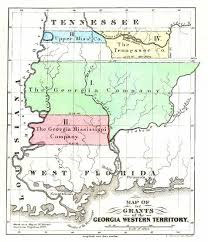
At the end of the American Revolution, Georgia claimed nearly 100,000,000 acres of public lands, including 62,000,000 acres of “western lands” in present-day Alabama and Mississippi. This legacy of the Revolution was sure to attract immigrants from throughout the new nation. By the same token, policies adopted by Georgia to dispose of the public domain touched off a frenzy of land speculation.

Speculators were especially attracted to the state’s “western lands,” and the legislature was eager to dispose of them, because the state’s claims to the territory were disputed by the Creek Indians, the Spaniards in Florida, and the Continental Congress; and because Georgia was too weak to defend her right of possession. Better to get rid of the lands quickly, then let the chips fall where they might.

In 1788, Georgia attempted to cede her western lands to  Congress, but the deal foundered over terms. The following year, the legislature sold the western territory to several private companies of speculators, in the first of two controversial “Yazoo sales.” (Georgia’s western territory was referred to as the “Yazoo lands” because the Yazoo River flowed through part of it.)  Yet, no sooner had the state agreed to sell the Yazoo lands than legislators had a change of heart. The price suddenly seemed too low, and the purchasing companies tried to pay with worthless paper currency from the Revolutionary era rather than specie. As a result, the legislature refused to accept the proffered paper, torpedoing the sale.

Under the Constitution of 1777, post-Revolutionary politics in Georgia amounted to a rough approximation of the style usually termed “deferential.” A handful of leaders directed state affairs from positions in an all-powerful one-house legislature. Legislators were re-elected regularly, with minimum effort on their part. A number of them were “versatile Georgians” who served their constituents in other capacities, including justice of the peace and militia officer.

Throughout the 1780s, strong-willed factional leaders were almost continually embroiled in controversy, so the end of the war brought no real calm to the state.  Georgia’s weak and exposed position on the southern frontier led Georgians to welcome the Federal Constitution produced by the Philadelphia Convention in the summer of 1787. The new national government also served as a model for a stronger state constitution adopted in 1789, which reduced the number of seats for each county in the legislature.  This forced politically ambitious Georgians to campaign more actively for office.

* * * * *

The Federalist consensus in Georgia was short-lived, but for reasons unrelated to the schism developing in Congress during the 1790s between supporters of Alexander Hamilton and  Thomas Jefferson. George Washington’s Administration alienated Georgians by adopting policies in two areas of vital interest to the state. First, the President and Congress claimed that Georgia had had no right to dispose of the state’s western territory in 1789. Yet, although Georgians had disagreed over the terms of the 1789 sale, even opponents of the transaction believed that the state had the authority to sell the lands without first asking permission in the nation’s capital.

The President’s Indian policy, as embodied in the 1790 Treaty of New York with the Creeks, also angered Georgians, especially those living in the back country. President Washington probably shared with most white Americans the belief that various Indian tribes must eventually give way before the advance of “superior” white settlements; his major concern was to ensure that this process was peaceful and orderly. Georgians, attracted by lands beyond the state’s temporary boundary line, took the terms of the Treaty of New York at face value and assumed that the pact would permanently bar expansion to the west.

So, by 1793, Georgians were firmly anti-Federalist, though they had not yet become rabid Jeffersonians. The partisan divisions developing in Congress between followers of Hamilton and Jefferson still seemed to mean little in the state. Between 1789 and 1794, the motive force in Georgia politics remained faction, not party.

Ambitious Georgians battled to gain or to keep control of a town or a county, and, once that objective had been achieved, they trooped off to the legislature, where they forged alliances, either with Jeffersonian Congressman James Jackson or with Federalist U.S. Senator James Gunn, and divided state patronage among their adherents. Still, a crude form of party rivalry was beginning to evolve out of Georgia’s incessant factional strife. By 1794, the only aspect of a party system missing in the state was ideology, which would be injected, not by national issues, but by the concern uppermost in the mind of many Georgians, the fate of the western territory.

The Federalist Party never secured a firm foothold anywhere in the South, and in Georgia its supporters were doomed from the outset because of the unpopularity of President Washington’s Indian policy and his opinion that Georgia did not have the right to dispose of its western territory.  Administration supporters in Georgia were dealt a blow from which they never recovered by the second “Yazoo sale” (1794-1795). The sale’s chief strategist was Georgia’s highest-ranking Federalist, Senator James Gunn.

Yazoo Lands (aboutnorthgeorgia.com)

To avoid a repetition of the legislative change of mind that had doomed the 1789 Yazoo sale, Gunn and his associates made available to members of the state legislature shares in the purchasing companies, and also distributed tracts among other influential Georgians, counting on the power of “deference” to tamp down popular hostility to the sale. The real significance of the latter Yazoo sale lay not in its effects on Georgia’s Federalists; rather, it marked the beginning of the end of the habit of “deference” among Georgia voters.

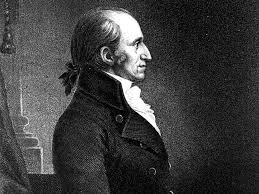
Despite careful preparations, the Yazoo purchasers had underestimated the ability of Congressman James Jackson, who exploited anti-Yazoo sentiment so adroitly that, after he had spearheaded a successful effort to rescind the sale, he stood pre-eminent in the state, though not unchallenged. To ensure that speculators did not make a new attempt to rob Georgians of their “birthright,” Jackson perfected the political organization he had created to destroy the Yazoo sale.

James Jackson (New Georgia Encyclopedia)

James Jackson (New Georgia Encyclopedia)

Jackson’s task was made easier because Georgians felt betrayed by those in whom they had reposed their confidence. Beginning in 1796, voters were less interested in the demonstrated ability of candidates for public office than in their opposition to land speculation. Moreover, as party lines became more clearly defined in the nation’s capital, Georgians also insisted that their public servants support Thomas Jefferson.

And yet—James Jackson’s political organization was beset by internal contradictions. Most of his followers were opposed to large-scale speculation, but many, especially those in the upcountry, had an insatiable hunger for land.  Jackson’s low country supporters, unable to forget that their region had been forced to relinquish control of the state to the upcountry in 1786, frequently worked uneasily with their supposed upcountry allies. Jackson’s foes attempted to exploit these weaknesses at every opportunity, and only his forceful, able leadership kept the anti-Yazoo coalition from disintegrating.

Jackson’s opponents attacked him both for his campaign against Yazoo and his role as Georgia’s leading supporter of Thomas Jefferson; by 1798, his fiery Republicanism was the more inviting target. Following Jefferson’s victory in the election of 1800, anti-Jackson forces abandoned Yazoo altogether and espoused a bitter, last-ditch defense of Federalism.

* * * * *

Public expressions of political partisanship in Georgia were more frequent after 1801, with militia units, public celebrations, and newspapers becoming either Federalist or Republican. Yet, this did not mean that a true two-party system had emerged in the new nation’s southernmost state.

No matter how many Georgians attacked James Jackson in print or drank toasts to his enemies on the Fourth of July, few were willing to contest at the polls the right of Jeffersonians to monopolize public offices. A more accurate description of Georgia politics is that there was but a single “party,” the Jeffersonian-Republicans, with the opposition provided by a loud and vindictive, but politically impotent, Federalist faction.

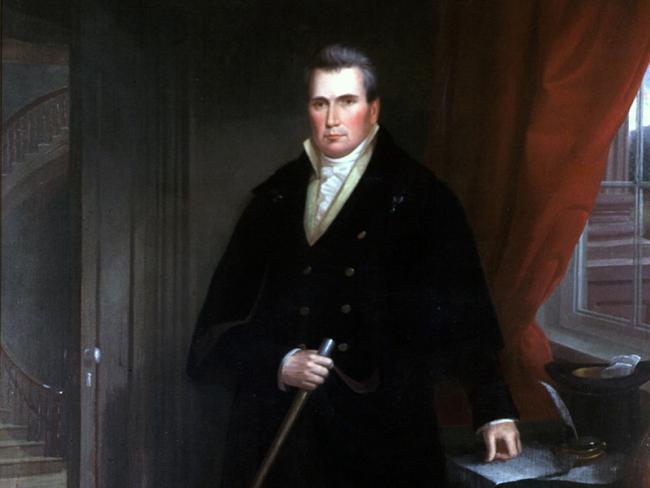
John Clark (New Georgia Encyclopedia)

John Clark (New Georgia Encyclopedia)

Ironically, the unchallenged supremacy of the Jacksonian coalition evetually proved its undoing.  Lack of a serious threat from the Federalists bred complacency and fostered decentralization of party machinery. The land lottery system, adopted as the “final solution” to the problem of disposing of the public domain, split the Republicans between those who wanted land sold to raise revenue and those who wished it widely dispersed at a nominal fee to encourage “independence” and “republicanism.”  Ultimately, Jackson’s opponents found a new leader, John Clark, who was cast in the mold of deferential politics, unhampered by ideology, and unwilling to play second fiddle to anyone, even James Jackson.

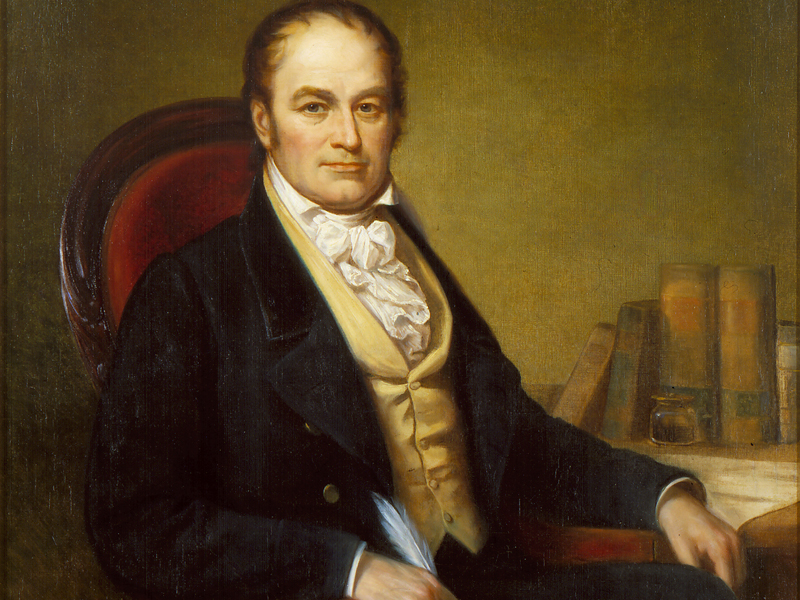
William Harris Crawford (New Georgia Encyclopedia)

William Harris Crawford (New Georgia Encyclopedia)

Had Jackson lived, none of these developments might have proved fatal to Georgia’s first political party. Unfortunately, he died in 1806, worn out by dissipation and by wounds from duels, in his fiftieth year. In the aftermath of Jackson’s demise, factionalism quickly reasserted itself, with some Republicans following Jackson’s handpicked successors, William Harris Crawford and George M. Troup, and others aligning themselves with General John Clark.

George M. Troup (New Georgia Encyclopedia)

George M. Troup (New Georgia Encyclopedia)

* * * * *

Between 1783 and 1806, personalities, not issues were primarily responsible for shaping the contours of Georgia politics. Issues were not completely irrelevant, but until 1801, Georgians were more interested in the fate of their western territory than in debates in the national capital. The political system in Georgia, therefore, bore little resemblance to those that had emerged in other states, at least initially. A two-party system would take root there only when each camp had a leader as forceful and as politically astute as James Jackson had been. In 1806, that time had not yet come.

SOURCE: 

Lamplugh, George R.  Politics on the Periphery:  Factions and Parties in Georgia, 1783-1806.  Newark, Del.:  University of Delaware Press, 1986.

_________________________

For those interested in reading more about Georgia History, here are links to my books on the subject:

REABP CoverRancorous Enmities and Blind Partialities:  Parties and Factions in Georgia, 1807-1845 (University Press of America, 2015)

Pursuit Cover

In Pursuit of Dead Georgians:  One Historian’s Excursions into the History of His Adopted State (iUniverse, 2015)
Politics on the Periphery:  Factions and Parties in Georgia, 1783-1806 (University of Delaware Press, 1986)

Posted in American History, Georgia History, Historical Reflection, History, History Curriculum, James Gunn, John Clark, Research, Retirement, Southern (Georgia) History, Southern History, Teaching, Uncategorized, WP Long Read | Tagged , , , , , , , , , , | Leave a comment

“New South”? What “New South”?–Introduction to a Panel Discussion (1978) [History Lesson Plans, 6]

[NOTE: The previous post in this series looked at an early step on the road to my course on the modern Civil Rights Movement:  a one-term elective, “The South and the Sectional Image,” which we offered at Atlanta’s Finest Prep School (AFPS) for a few years in the late 1970s.  This post looks at another early influence, the introduction to a panel discussion, “Is It True What They Say About Dixie?  Myth and Reality in Recent Southern History.”  If you’ve read the previous post, you will recognize the similarity in approach to this panel.

I organized the discussion for a meeting of a regional independent schools organization in Atlanta (Spring 1978), around the time the article in the previous post was originally published.  The panelists included a Morehouse College history professor; a veteran Southern bureau chief for a major national news magazine; and the author of a new, well-received biography of eccentric racist Georgia politico Eugene Talmadge.]

* * * * *

Jimmy Carter first rose to prominence in 1970 as one of a group of young, racially moderate Southern governors whom the press dubbed spokesmen for a “New South.”  What exactly was this “New South”?  To try to answer this question, let’s consult the influential multi-volume History of the South series from Louisiana State University Press.

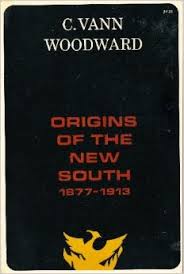
CVW Origins

In Volume IX, C. Vann Woodward takes nearly five hundred pages to discuss the “origins” of the New South, between 1877 and 1913.  George B. Tindall requires over seven hundred pages in Volume X to analyze the “emergence” of the New South, which he places between 1913 and 1945.

TindallEmergence

So, after twelve hundred pages treating in detail almost seventy years of history, the New South finally “emerges,” but we are still a quarter of a century away from the election of Jimmy Carter and the other so-called “New South Governors.”  That is a mighty long gestation period for the birth of a “New South,” even if Southerners are, so some historians tell us, congenitally slow and lazy!

[Historiographical Note, 2015:  It wasn’t until 1995, nearly two decades after the panel discussion, that Numan V. Bartley, in Volume XI, The New South, 1945-1980, used over four hundred and fifty more pages to carry the story to 1980; Carter and the other moderate “New South Governors” finally show up, in chapter eleven (of twelve).

BartleySo, to review, we now have almost seventeen hundred pages, in three hefty volumes, to cover the story of the “New South” between the end of Reconstruction and the presidency of former “New South Governor” Jimmy Carter!  Got that?  Now back to 1978. . . .]

Nevertheless, the New South, whatever it is, goes on, and so does the search for it.  Most of us treat the recent history of this region in the context of the American History survey course, which means we rely heavily on generalizations.  Yet, as I tried to show in my homily on the “New South Governors,” generalizing about Southern history can be a tricky business.

okefenokee.com

okefenokee.com

In fact, one student of the region, Pat Watters, has compared trying to understand the South to the search for solid ground in the Okefenokee Swamp:

An Indian word meaning “Land of the Trembling Earth,” [Okefenokee] stands for the islands of floating vegetation that comprise much of the swamp; these islands are called by swamp people “houses,” and some are large enough to support trees with roots trailing in the water below.  To step from a boat onto one of the “houses” is a dismaying experience; the land does literally shake and bob underfoot.  If you don’t know how to walk this land, your feet quickly sink into the muck and the cold water below.  The swamp people walk it with quick jerking steps, barely letting a foot touch down before lifting it, moving in a hopping lope.  So it is, with contemplation of the South.  If one jumps to what seems an obvious conclusion, likely as not the solid-seeming fact that ought to be supporting it will give way underneath.  Better it is to hop from one point of fact or judgment to another with the tentativeness of the swamp people, distrusting the obvious but aware, always, that somewhere back through the jungle trails and across the trembling earth, solid truth will be found.  One of the real islands in the Okefenokee Swamp once supported a good-sized logging town, with a main street and even a picture show.  (Watters, The South and the Nation, pp.129-130)

Times change, as do historical interpretations, and this means that generalizations change also.  It is to generalizations about the recent South that we shall direct our attention today.  What can we say with some assurance to our students about the South’s continuing distinctiveness, or lack thereof; about the nature of modern Southern politics; about changes wrought in recent years on the region’s economic, social, and cultural life?

Our three distinguished panelists will try to aid us in this quest for the modern South.  Welcome to the Okefenokee Swamp, gentlemen!

flickr.com

flickr.com

* * * * * *

For those interested in reading more of my reflections on history, here are links to my books on the subject:

REABP CoverRancorous Enmities and Blind Partialities:  Parties and Factions in Georgia, 1807-1845 (University Press of America, 2015)

Pursuit Cover

In Pursuit of Dead Georgians:  One Historian’s Excursions into the History of His Adopted State (iUniverse, 2015)

Politics on the Periphery:  Factions and Parties in Georgia, 1783-1806 (University of Delaware Press, 1986)

Posted in Age of Jim Crow, American History, Books, Civil Rights Movement, Current Events, Education, Georgia History, Historical Reflection, History, History Curriculum, Popular Culture, prep school teaching with a PhD, Southern History, Teaching, WP Long Read | Tagged , , , , , , , , , , | Leave a comment

Civil Rights–and Wrongs: Reflections on The Rev. Dr. Martin Luther King, Jr., and His Legacy


[NOTE:  In the middle of last month, I began a series of posts tracing how, near the end of my teaching career, I came eagerly to embrace the opportunity to teach a one-semester elective course on the History of the Modern American Civil Rights Movement.  While this ongoing series will reveal something of my intellectual (or curricular) evolution on the subject of Civil Rights, I had already laid out, in an autobiographical piece that has become a popular post on “Retired But Not Shy,” how and why I came to see The Rev. Dr. Martin Luther King, Jr., as one of the most important figures in modern American History.  For 2015, when the King holiday will be observed Monday, January 19, I’d like to re-post that essay (a first for me), in a slightly revised and updated form.]

* * * * *

Dr. King (Bio. and AE)

Dr. King (Bio. and AE)

As my former American History students will tell you, I am a great admirer of the modern civil rights movement in the United States, and, especially, of The Rev. Dr. Martin Luther King, Jr., one of the greatest Americans of the twentieth century.  I wish I could say I came to this conclusion only after years of reading, study, and reflection on the Movement and on Dr. King’s role in it, and to some extent that’s true, as you’ll see a bit later.  However, I begin with the admission that I first “learned” about the African-American struggle for civil rights when I was growing up, and the “lessons” I learned were taught to me by–what else?–television.

The epochal Brown decision was handed down by the Supreme Court in May, 1954, three days before my tenth birthday; the legislative highlights of the “heroic phase” of the Civil Rights Movement, the Civil Rights Act of 1964 and the Voting Rights Act of 1965, were passed by Congress while I was in college.  And, until I entered college in the fall of 1962, my largest window on the world was our black and white  TV set, and the fuzzy images I saw every night on the newscasts we watched with dinner.

I was a very young “news junkie” in 1954–for instance, I still remember watching some of the Army-McCarthy hearings in the afternoon, postponing my homework so I could catch what I would later learn to call “great political theater.”  And, when those hearings eventually ran their course, and I had to find a new excuse to put off the night’s school assignments, the drama–and, thanks to television, the images–accompanying the Civil Rights Movement seemed never-ending.

I also must confess that I was quite naive about what I was watching.  To me, it all seemed very clear-cut, a matter of black-and-white, just like the TV I watched and the daily newspaper I read–but with the traditional symbolism of black-and-white reversed:  it was the (Southern) white folks who were the villains (in my mind) and the black people who were the heroes.  I also was certain that, as a resident of the great state of Maryland (and, later, of Delaware), did not live where there were any race problems, no sirree!  Although my view of the world has changed over the past five decades, with the clarity of black-and-white evolving into shades of gray, one aspect has not been altered by time–my conviction of the centrality of The Rev. Dr. Martin Luther King, Jr., to the successes–and the failures–of the modern civil rights movement.

I still recall vividly a Saturday afternoon, probably during the Little Rock crisis, standing outside my church, waiting for a ride, when suddenly my fascination with the on-going epic of the Movement collided with a burgeoning interest in the American Civil War, and I began to ponder, as only a white 13 year-old could, whether we were on the verge of a new Civil War, this one over the demands of an oppressed minority for the same basic civil rights and economic and social opportunities the rest of us took for granted.

* * * * *

Funeral (history.com)

Funeral (history.com)

On the afternoon of April 4, 1968, my wife and I emerged from a movie theater on a military post in Maryland to learn that Martin Luther King, Jr., had been shot in Memphis, Tennessee.  At the time, I was a first lieutenant in the U.S. Army finishing an undistinguished two-year tour of active duty.

We had gone to the matinee because that night I was scheduled to be the post’s Staff Duty Officer, which meant that a sergeant and I were to stay in the headquarters building overnight just in case important messages arrived for the post commander.  When my wife and I took our seats in the theater a couple of hours earlier, I had been looking forward to the assignment; by the time we drove home, I was no longer anticipating the night ahead.

At the headquarters building, I was told that, if things got out of hand in nearby Baltimore, as appeared likely, our headquarters company would be sent to the metropolis to assist in “riot control.”  The sergeant and I were then left alone in a small room equipped with a portable black-and-white television set and an increasingly ominous telephone.  My mood was not improved when I called home, and my wife told me that her boss, our landlord (we lived above his shop), planned to stay up all night, garden hose at the ready, in case “they” came marching down the main street of our little town and stopped to burn his business on the way.

With little to do unless the phone rang, I turned my attention to television news coverage of the roiling civil unrest in the wake of Dr. King’s assassination.  Two incidents from that coverage remain with me:  an African-American celebrity (exactly which one is beyond my recollection), against the backdrop of the smoke-filled Washington, D.C., skyline, pleading with viewers not to dishonor Dr. King’s memory by engaging in violence or looting; and the increasingly frantic voice of a frightened reporter phoning in details to his employers while an angry crowd rocked, and eventually overturned, the telephone booth in which he had taken refuge.

Evidently, the combined efforts of local law enforcement and the National Guard kept a lid on things in Baltimore, because the sergeant and I never got that telephone call.  I drove off the post the next morning relieved that the alert had not come but also feeling that somehow, with the death of Dr. King, the Civil Rights Movement and the nation had been irrevocably changed, though in ways none of us could yet fathom.

* * * * *

Although I became a “Southern historian” in graduate school, my dissertation topic was quite narrow: a study of one aspect of life in a single antebellum southern state, over a thirty-year period. That’s when fate took a hand:  unable to find a college teaching post but still determined to teach History, I eagerly sought, and finally landed, a job at a “prep school” in Atlanta.  (For more on this, look here)  Because I was teaching on the secondary level, I had neither the opportunity nor the incentive to become narrowly specialized, and this eventually brought me back to the Civil Rights Movement.

One of my bread-and-butter courses was the American History survey, and, while lecture notes from my days as a grad school teaching assistant stood me in good stead for many topics, they were quite sparse for the years following World War II.  Thus, I needed to teach the key events of more recent decades to myself before I could hope to impart them to others.  Not surprisingly, given my early “education” in the “school of television,” one of the themes I chose to focus on was the movement for African American civil rights.

An early product of this labor was an elective course on the “image” of the modern South in movies and television, an offering that lasted a few years before my school jettisoned most electives in order to scramble onto the “back-to-basics” bandwagon.  That course eventually was followed by a unit on the Civil Rights Movement each spring in my Advanced Placement U.S. History course. Finally, I inherited a one-semester elective course, the Modern Civil Rights Movement, which I taught several times before retirement.  This class necessitated a lot of additional reading on the Movement, reading I have continued to do since leaving the classroom almost five years ago.

* * * * *

Since 1968, those of us who remember Dr. King when he was alive have witnessed the making, unmaking, and remaking of his historical reputation.  Some scholars have confirmed his all too human flaws.  Then, too, efforts to understand how the civil rights revolution operated at the grass roots have to some extent lowered Dr. King’s historical profile by raising that of the previously anonymous “foot soldiers” of the movement.

Scholars also have recognized the work of those who struggled for equality before King and his Movement contemporaries.  Other  works have highlighted the “Great Migration” between World War I and about 1970, when thousands of African Americans abandoned the Jim Crow South for the siren song of other, supposedly less racist, parts of the nation.  (For a couple of examples of books in this area, go here.)

(amazon.com)

(amazon.com)

The Race Beat, by Gene Roberts and Hank Klibanoff, examines how–and how well–the Movement was covered by the increasingly important mass media in the 1950s and 1960s, a key development for understanding both the nation’s growing awareness of its racial problems and Dr. King’s role as the face–and voice–of the Movement.

In recent years, too, revisionism has begun to shine its light on the values and beliefs of Southern whites who opposed King’s efforts, and scholars are now taking the Black Power Movement more seriously than perhaps used to be the case. Finally, political scientists have examined the methods used to move racial politics from the realm of marches and national legislation to the creation of mundane state and local ordinances, through compromises and back room deals, measures that affect Americans, black and white, everyday.  (For a review of a pair of books on some of these topics, go here.)

(amazon.com)

(amazon.com)

While the resulting picture of the forces behind–and against–the Civil Rights Movement is fuller and more complex now, Martin Luther King, Jr., remains a key figure, especially in mediating between the Movement and the larger society of which it was a part.  Taylor Branch does an admirable job fitting Dr. King into the broader context of American history since the mid-1950s in his trilogy, America in the King Years, completed in 2006.  Branch balances coverage of the Movement in general, and King’s activities in particular, with treatment of the other issues facing the country during the years of King’s prominence.

In his final volume, At Canaan’s Edge, for example, the impact of the Vietnam War nearly swamps King’s efforts to push the nation along the rocky road to equality, just as it did in “real life,” at least in my memory. Overall, Branch keeps his hero at the center of things, carefully charting his course and the ways others, especially those in power, responded to King’s initiatives.  So successful is Branch in accomplishing this difficult task, that, when King is finally cut down on that motel balcony in Memphis, and Branch concludes his massive work with an epilogue of less than five pages, the reader finds himself wondering how the history of the nation might have been different had King not been assassinated. There is no question that, in Branch’s capable hands, King becomes one of those rare figures whose life–and death–made a significant difference in the history of the United States.

* * * * *

(history.com)

(history.com)

Today, Dr. King has a national holiday and a memorial statue on the Mall in Washington.  He and his legacy are now “monumental” in every sense of the word.  Meanwhile, his children try to “protect” his image and his words, but they do so in a way that makes them seem mercenary.

And, as if that isn’t enough, those still opposed to government support for Civil Rights use Dr. King’s “content of their character” mantra to criticize efforts to advance the cause, claiming that those efforts are somehow “racist.” I watch their antics with a mixture of bemusement, cynicism, and an occasional flash of anger. In quieter moments, though, I think of that thirteen year-old waiting outside his church, pondering the possibility of a new Civil War over the issue of Civil Rights.  There was never any question, then, whose side he was on. . . .  And there still isn’t.

* * * * * *

For those interested in reading more of my reflections on history, here are links to my books on the subject:

REABP CoverRancorous Enmities and Blind Partialities:  Parties and Factions in Georgia, 1807-1845 (University Press of America, 2015)

Pursuit Cover

In Pursuit of Dead Georgians:  One Historian’s Excursions into the History of His Adopted State (iUniverse, 2015)

Politics on the Periphery:  Factions and Parties in Georgia, 1783-1806 (University of Delaware Press, 1986)


Posted in "The Race Beat", Books, Civil Rights Movement, Current Events, Dr. Martin Luther King, Education, Gene Roberts and Hank Klibanoff, Georgia History, Historical Reflection, History, History Curriculum, History graduate school, Popular Culture, Prep School, prep school teaching with a PhD, Research, Retirement, Southern (Georgia) History, Southern History, Taylor Branch, Teaching, Uncategorized, WP Long Read | Tagged , , , , , , , | 10 Comments

From those wonderful folks at WordPress.com, a look back at 2014.

The WordPress.com stats helper monkeys prepared a 2014 annual report for this blog.

Here’s an excerpt:

A San Francisco cable car holds 60 people. This blog was viewed about 3,500 times in 2014. If it were a cable car, it would take about 58 trips to carry that many people.

Click here to see the complete report.

* * * * * *

For those interested in reading more of my reflections on history, here are links to my books on the subject:

REABP CoverRancorous Enmities and Blind Partialities:  Parties and Factions in Georgia, 1807-1845 (University Press of America, 2015)

Pursuit Cover

In Pursuit of Dead Georgians:  One Historian’s Excursions into the History of His Adopted State (iUniverse, 2015)
Politics on the Periphery:  Factions and Parties in Georgia, 1783-1806 (University of Delaware Press, 1986)

Posted in "The Race Beat", Age of Jim Crow, American History, Civil Rights Movement, Current Events, Dr. Martin Luther King, Education, Episcopal Church, Gene Roberts and Hank Klibanoff, Historical Reflection, History, Martin Luther King, Popular Culture, Prep School, prep school teaching with a PhD, Research, Retirement, Southern (Georgia) History, Southern History, Taylor Branch, Teaching, The Blues, Uncategorized, WP Long Read | Tagged , | Leave a comment

Secondary School Students and The Changing Face of the South (History Lesson Plans, 5)

[NOTE: One of the most popular posts at this blog is “Teaching History Backwards,” probably more for the provocative title than for the course it describes, The History of the Modern American Civil Rights Movement.  And yet, I believe that the Civil Rights course was one of the best things with which I was associated during my career at “Atlanta’s Finest Prep School” (AFPS).  With the next several posts in this series, I hope to highlight several points along the road to the Civil Rights course.

When I began teaching at AFPS, I was required to take two “Education” courses a year for five years in order to earn state certification.  One was “Curriculum Trends”; an assignment in that course was to devise a curricular offering of my own.  The result:  “The South and the Sectional Image,” a hypothetical course outline and a list of books I had used to prepare it.

In the world of professional education, the curricular merry-go-round does just that–goes round and round.  A few years after I signed on at AFPS, the powers that be decided that we should include a few elective, one-semester courses among our offerings.  Learning this, and remembering the outline I’d devised for “The South and the Sectional Image,” I proposed it as an elective; the proposal was approved; two sections were created; and I enlisted a  departmental colleague to teach one of them.

What follows is the revised version of an article about this course, from the Georgia Association of Historians Newsletter, IV (Spring, 1978):  20-21.]

* * * * *

When we reduced our graduation requirement in History from three years to two, we also decided to inaugurate several one-term, upper-level electives in hopes of attracting students who had fulfilled that new requirement but wished to pursue History further.  As our contribution to this undertaking, a colleague and I offered a course in recent Southern history, “The South and the Sectional Image.”  We hoped to encourage students to examine critically ways in which the image of the South perceived by Southerners and by the rest of the nation had changed over the last century.

A major stumbling block in developing this course was the selection of texts.  We eschewed the traditional survey approach firmly grounded in one textbook, opting instead for several paperbacks.  Publishers’ catalogues and advertisements revealed, however, that the pickings were slim.  Eventually, we settled, with some reluctance, on Patrick Gerster and Nicholas Cords, eds., Myth and Southern History, Vol. II: The New South, an anthology of interpretive essays; C. Vann Woodward, The Strange Career of Jim Crow; and George B. Tindall, The Emergence of the New South, 1913-1945, at that time the final volume in LSU Press’s series on the history of the South.

To further a departmental objective that students be taught to view films critically, we supplemented the texts with several documentary and theatrical productions purporting to depict the “South” and the “Southerner.”  Films we chose ran the gamut from “The Autobiography of Miss Jane Pittman” to a study of sharecropping in modern Alabama, “Lay My Burden Down.”  Most of the films were borrowed through the Atlanta Public Library.

Because we felt that an elective course should be both interesting and rigorous, we included a term paper as one requirement.  We offered our students five options for their term project:  a traditional paper exploring in detail some aspect of recent Southern history; an essay placing in the context of the course a work of fiction set in the South since the end of Reconstruction; and three choices exploring other approaches to the study of the past—family history; oral history; and local history.

This course was conducted primarily through discussions of assigned readings and films; occasional lectures filled chronological gaps created by our choice of texts.  To aid in refining the course, we also employed a detailed, anonymous critique as the final assignment.

Evaluating the course critiques the first time we taught the course, we reached several conclusions.  First, we had blundered in our selection of texts; only Woodward’s volume had held the interest of our students.  The idea of using films to supplement the texts was received enthusiastically, though perhaps more because viewing them got us away from the assigned reading than because of any inherent merit in this approach to the image of the South.  Despite the groans that initially greeted the assignment of term papers, our students took the project seriously, and most seemed to find it a worthwhile component of the course.

In preparing to offer the course a second time, we jettisoned all of the original texts.  As luck would have it, three volumes that we had wanted to use the first year but did not, because they were then available only in hardback, appeared in paper.  These works, Paul Gaston’s The New South Creed: A Study in Southern Mythmaking; William Anderson’s The Wild Man from Sugar Creek: The Political Career of Eugene Talmadge; and, especially, Charles Roland’s The Improbable Era: The South Since World War II, proved so popular with our students that we plan to use them again this spring.

To assuage our own misgivings about our reliance on films in this course, we also added a one to two-page critique of each film.  In preparing the critiques, students were to concentrate on several questions:  What image(s) of the South and the Southerner were portrayed in the film?  How did the film maker create this image?  How convincing was this portrayal?  Our students groused about these assignments constantly, but we found that discussions were more lively and that the classes viewed the films more critically because of them.

“The South and the Sectional Image” has become a popular elective.  Those enrolled have responded positively to its  requirements, despite the manifold distractions of Atlanta’s balmy springtime.  More idealistically, we hope that our approach to the recent history of the South will play some small part in producing more thoughtful Southerners, and Americans, but of this we cannot, and may never, be sure.

[NOTE: Ironically, just a year or so after this article appeared, the curricular merry-go-round at my school lurched once again:  we jettisoned many of our elective courses, including “The South and the Sectional Image,” and returned to year-long survey offerings. The next time I would have the chance to teach a course in the modern South would be the Civil Rights course, two decades or so in the future.  In the interim, however, I was able to keep my hand in the study of the modern South, as you’ll see in the next two posts in the series.]

* * * * * *

For those interested in reading more of my reflections on history, here are links to my books on the subject:

REABP CoverRancorous Enmities and Blind Partialities:  Parties and Factions in Georgia, 1807-1845 (University Press of America, 2015)

Pursuit Cover

In Pursuit of Dead Georgians:  One Historian’s Excursions into the History of His Adopted State (iUniverse, 2015)

Politics on the Periphery:  Factions and Parties in Georgia, 1783-1806 (University of Delaware Press, 1986)

Posted in "Education Courses", American History, Books, Civil Rights Movement, Education, Historical Reflection, History, History Curriculum, Popular Culture, Prep School, prep school teaching with a PhD, Research, Retirement, Southern History, Teaching, Uncategorized | Tagged , , , , , , | Leave a comment