Religion and Politics in a Memoir About Life in Antebellum Georgia (In Pursuit of Dead Georgians, 22)

[NOTE:  Among the delights of historical research are the obscure sources unearthed that prove interesting to the historian, if not immediately useful to the topic being investigated.  I’d like to offer an example:  George Washington Paschal’s memoir of his parents, Agnes and George, and their lives together in Lexington, Georgia, Oglethorpe County, in the east central part of the state, early in the nineteenth century.  The book, Ninety-Four Years Agnes Paschal, was originally published in Washington, D.C., in 1871 and is still available as an on-demand publication from the Reprint Company Publishers, Spartanburg, S.C.

Paschal book

G.W. Paschal (1812-1878) seems to have led a rich, full life, much of it in Texas.  However, what I hoped to learn from his family memoir was about life in a small town in antebellum Georgia, and, while I was able to do that, I did not, in the end, use this information in my recently-published book on antebellum Georgia political history.  Yet, while looking into a different project the other day, I came across my notes on Paschal’s book and decided they might be of interest to readers of “Retired But Not Shy.”]

* * * * *

George W. Paschal

George W. Paschal

G.W. Paschal’s father George was 41 years old in 1802, when he married the 26 year-old Agnes.  In discussing his father’s lack of religion at the time of their marriage, G.W. Paschal writes that

. . . From the pulpit of middle Georgia at that day little could be learned.  The prevalent churches were the primitive Baptists and the itinerant Methodists.  The former were of the “hard-shell, iron-jacket order,” who literally swallowed the whole Calvinistic creed, and so strongly believed in the total depravity of man that they would have denied all religion but for this comforting faith. . . . One side preached election, special calls, miraculous gifts, the final perseverance of the saints, and the certain condemnation of the non-elected reprobates.  The other side frightened with a terrific devil, a lake of fire and brimstone, and the individual responsibility of those who did not flee from the wrath to come and escape the great gulf of perdition by immediate conversion. . . . (37-38)

George Paschal established a combination store and tavern on the square in Lexington, Georgia, became postmaster and jailer, and entered local politics–talk about your varied career:  storekeeper, bartender, postmaster, jailer, politician, all apparently at the same time!  During the heady days of the never-ending feud between supporters of William Harris Crawford (and his successor, George M. Troup) and John Clark, most men in Lexington supported Crawford and Troup, but the elder Paschal was a staunch supporter of John Clark and, later, of Andrew Jackson and the national Democratic Party. (G.W. Paschal mentions, for instance, that, while on his way to his celebrated duel with Crawford in 1806, John Clark stayed the night in the Paschal tavern.)

According to his son, George Paschal’s career as a merchant did not survive the economic vicissitudes of the years around the War of 1812; he sold out and moved to Greene Country, where he opened a paper mill that soon failed.  So, it was back to Oglethorpe County for the Paschal family, where George initially returned to a former profession, schoolteacher, before buying a small farm near Lexington.
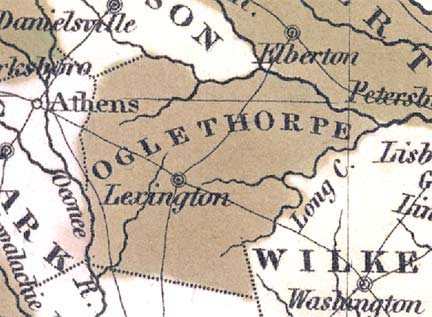
Oglethorpe County , Ga.

Oglethorpe County , Ga.

Describing the middle Georgia society in which he and his parents lived, G.W. Paschal notes that

. . . The Baptist and Methodist Churches were its chief features.  Theological disputations and acrimonious quarrels, between the Clark and Troup parties, were its polemics. . . . Our political literature was chiefly the Richmond [Virginia]Enquirer; the [Milledgeville] Georgia Journal, Georgia Patriot, and Southern Recorder; with occasional papers, speeches, and franked documents from [Georgia congressmen in] Washington. 

. . . There were few causes for dissension in the community.  No disputes which did not grow out of the too free use of the home-manufactured peach and apple-brandy or party politics, and these were generally soon settled, either by a knock-down [fight] on [militia] muster day, or [by] the interposition of friends. . . . (138-139) 

G.W. Paschal also dates to 1828 “a great awakening in Lexington–a revival during which more than half the young men were gathered into the Church.” (164)  By about 1829, Paschal notes, Methodist, Baptist, and Presbyterian congregations had built chapels in Lexington, and, sure enough, the more firmly established the churches’ presence became, the more local controversies sparked theological disputes.  The younger Paschal also remarks that, when his own Baptist congregation split, he “sometimes suspect[ed] that [the controversy] was a little political.  For I remember that our side was chiefly of the Clark party, while the leaders on the other side were of the Troup party.” (184)

I was also pleased to learn from Paschal a few things about one of William Harris Crawford’s most energetic, excitable political acolytes, Thomas W. Cobb, who does show up in my new volume.  According to family lore, Thomas Cobb “had been rather a wild youth and the student of Crawford [who had begun his career as a schoolteacher].” One local cynic remarked about Cobb that “It takes a heap of ignorance and a deal of impudence to make a lawyer.  Cobb has both.”  Paschal’s father George attributed Cobb’s eventual legal success to his rivalry with New England expatriate Stephen Upson, who opened a law office in Lexington and, through dint of constant effort, won himself numerous clients.   Consequently, Thomas Cobb “found it necessary to read [law more widely] in order to be prepared to oppose [Upson].” (174-175)

G.W. Paschal also regales the reader with anecdotes about the heated rivalry between George Troup and John Clark.  For example, in 1825 Governor Troup used his cousin, Creek chief William McIntosh, to arrange a corrupt treaty at Indian Springs by which the Creeks surrendered their remaining lands in Georgia and agreed to move west of the Mississippi.  When the nation’s newly-elected President, John Quincy Adams, learned of the corruption that had accompanied the removal treaty, he disavowed it.  His administration negotiated a “New Treaty” in Washington, D.C., wherein the Creeks ceded most of the lands Georgia desired, without the fetid odor of greased palms and the clink of money changing hands.  Georgia Governor George Troup was not happy; indeed, he threatened to enforce the Indian Springs agreement (magically transformed by the passage of a few months into the “Old Treaty”), using the militia if necessary.

It was against this stormy background that Troup and Clark faced off for the governorship for the third time (Clark had been elected over Troup twice, in 1819 and 1821; in 1823, Troup had narrowly defeated one of Clark’s lieutenants, Mathew Talbot.  All of these contests occurred when the chief magistrate was chosen by the legislature.)  In 1825, however, the election would be decided for the first time by popular vote.  Clark reportedly was a  past master at electioneering, while Troup supposedly had disdained the practice during his previous gubernatorial runs.  Here, G.W. Paschal picks up the story:

[T]he issue was, “Troup and the old treaty,” and “Clark and the new treaty.”  And although the latter [treaty supposedly] gave the most land [though it didn’t], the former [treaty] had promised it earlier . . . and, as both parties expressed the determination, afterwards fully redeemed, to support General [Andrew] Jackson for the presidency [in 1828], Troup succeeded in carrying the popular vote.  (218-219)

When both Troup and Clark had passed from the political scene, the Paschal family continued to support the Clark party, now led by Wilson Lumpkin, over Troup’s successor, George R. Gilmer, who had grown up in their hometown of Lexington.  According to the younger Paschal, his mother Agnes had been raised in the same part of Georgia as Lumpkin; they had been baptized in the same Baptist church; and Lumpkin was a friend of the Paschal family.  So, the Paschals continued to support Lumpkin, despite the closer local ties of George Gilmer.

For both Gilmer and Lumpkin, the major issue during their governorships was the long-running question of Cherokee removal.  G.W. Paschal states that his family opposed  cruelty to Native Americans, but they also supported the distribution of Cherokee lands to white Georgians.  Gilmer’s and Lumpkin’s approaches to Indian removal were almost indistinguishable, but George and Agnes Paschal still managed to convince themselves that Lumpkin was sounder on the “Cherokee question.”

* * * * *

So, what can the reader learn from G.W. Paschal’s memoir about life in the antebellum Georgia upcountry?

  1.  An obvious lesson is the importance of religion.  The denominations prevalent in antebellum Georgia might look strange to some twenty-first century readers, but they obviously answered the needs of early nineteenth-century farmers, planters, and professional men.
  2. Related to the importance of religion (in Georgia in general and Lexington in particular) was the impact of the bitter political division between followers of William Crawford and George Troup, on one side, and John Clark on the other.  If Paschal’s picture is anywhere near accurate, political infighting became so divisive within some church congregations that they split over the question of which candidate to support. Again, none of this is news to Georgia historians of the period, but to see it in the small compass of Lexington and environs is arresting.
  3. I wish G.W. Paschal had said more about the Cherokees, because he was an aide to General John Wool, who supervised the removal of the tribe from Georgia along the Trail of Tears.  Moreover, Paschal married Sarah, the daughter of John Ridge, one of the minority of Cherokee leaders who signed the Treaty of New Echota in 1835, yet all we learn from the memoir is that Paschal’s parents sympathized with removal, while opposing “cruelty” to the Cherokees.
  4. Harder to see, but still important, is the  role that memory plays in primary sources like this one. For instance, G.W. Paschal spoke confidently about some episodes in his family’s history that occurred either before he was born or before he was old enough to be fully aware of the social, religious, or political world around him.  Obviously, then, to some extent he relied on family lore, filtered through his memory sixty years later, rather than readily verifiable facts in telling his tale.
  5. Moreover, the Paschals’ political loyalties to John Clark and Wilson Lumpkin in Georgia, and to the Jacksonian Democrats in the nation at large, also colored Paschal’s recollections.  I found it especially interesting how effortlessly Paschal’s parents shifted their loyalty to Wilson Lumpkin, because of Agnes Paschal’s long acquaintance with him, rather than move into the camp of Lexington’s favorite son, George Gilmer, the head of the other party.

* * * * *

In describing life in antebellum Georgia, then, Paschal presents a vivid picture of the religious and political divisions in his hometown, and how they affected the lives of local residents.  He makes fascinating use of family stories, but employs them in an uncritical way.  94 Years Agnes Paschal, while usually interesting–and sometimes fascinating– must be used with care.  While  this is hardly news to people who spend much of their time doing historical research, neophytes to the pursuit of dead Georgians need to be wary.

_______________

For those interested in reading more about Georgia History, here are links to my books on the subject:

REABP CoverRancorous Enmities and Blind Partialities:  Parties and Factions in Georgia, 1807-1845 (University Press of America, 2015)

Pursuit Cover

In Pursuit of Dead Georgians:  One Historian’s Excursions into the History of His Adopted State (iUniverse, 2015)

Politics on the Periphery:  Factions and Parties in Georgia, 1783-1806 (University of Delaware Press, 1986)

Posted in "Cherokee Phoenix" (newspaper), American History, Books, Cherokee Indians, Chief John Ross (Cherokees), Elias Boudinot, George M. Troup, George R. Gilmer, Georgia History, Historical Reflection, History, John Clark, Research, Retirement, Southern (Georgia) History, Southern History, Uncategorized, Wilson Lumpkin | Tagged , , , , | 1 Comment

A Tale of Three Books

john-quincy-adams-picture[Note: At this point in my career, I have published three books, two of which came out this summer.  I figured that at least a few of my faithful readers might be interested in where the ideas for those volumes came from.]

* * * * *

Politics on the Periphery: Factions and Parties in Georgia, 1783-1806 (University of Delaware Press, 1986)

When I entered graduate school in the fall of 1968, the path ahead seemed pretty clear. I would be at Emory University for about four years, write a doctoral dissertation, be awarded my degree, and then, of course, line up a college teaching post. I was told that, once I got the first college job, I would need to prepare my dissertation for publication, so that I could earn tenure, a promotion, and a career of distinction as a historian.

What actually happened was that my career didn’t quite pan out that way.  I spent five years at Emory, completing my doctorate and earning a PhD. in American History, but, when I was finishing, in 1973, there were no college jobs available. Still determined to teach history in some fashion, I began to investigate the possibility of working on the secondary level. And, as luck would have it, I wound up getting a job at a “prep school” across town from Emory, The Westminster Schools, where I would spend the next thirty-seven years, retiring in 2010.

Still, my Emory mentors had taught me well. I continued, at least for the first years in my new job, to hope that “something better” might come along, on the college or university level.  While waiting for this to happen, I reviewed books for historical journals, even gave occasional public lectures (this was, after all, the decade of the American Revolutionary Bicentennial, and the first chapter in the dissertation examined political factionalism in Georgia during the War for Independence).  Eventually, I returned to the idea of revising the dissertation for publication  As part of this process, I began reworking selections from that hefty tome as articles, in hopes of shortening the prospective book manuscript

No academic publisher in Georgia was interested in the manuscript, but eventually I was able to publish it through the University of Delaware Press—and, to this day, I don’t know why a small press in Delaware accepted for publication a book on Georgia history! (OK, in the interest of full disclosure, perhaps the fact that I was a Delaware alum helped, but still. . . .)

Politics on the Periphery, while hardly a best-seller, did fill a niche in the historiography of post-Revolutionary Georgia. It was well reviewed in professional journals and, over the years, cited in a number of historical monographs.

By the time I published it, I’d pretty much written off the possibility of moving on to a college position, even if the opportunity arose (which, realistically, wasn’t likely). My wife had a job that she loved at the same school where I worked; our sons also attended that pricey academy tuition-free; and I was a member of a top-notch faculty.

And yet, back in 1970, when I had offered the prospectus for my dissertation, I proposed studying the evolution of factions and parties in Georgia from the American Revolution through about 1825. This goal proved unrealistic for a variety of reasons, so I cut off the study in 1806, when the state’s first “party boss,” James Jackson, died.

As I burrowed into my life at Westminster, I kept hearing the voices of my grad school professors advising me to publish, publish, publish! And, of course, I had not yet been able to fulfill the terms of my prospectus, which gave me a target to shoot at.

By the early 1990s, I was anxious to begin a sequel to Politics on the Periphery, just in case that “college job” suddenly came calling; and Westminster awarded me a sabbatical that allowed me to start the research.

* * * * *

REABP Cover

Rancorous Enmities and Blind Partialities: Factions and Parties in Georgia, 1807-1845 (University Press of America, 2015)

In Atlanta’s “Olympic Summer” of 1996, I launched that research, which I hoped would carry the story of political party development in Georgia from 1807 to the point when the state’s parties resembled those active on the national level. Given the demands of my  day job, however, research was pretty much limited to summers, so things went slowly. By the time I retired, fourteen years later, I had certainly made progress, but not enough to warrant publication in the near future.

Once I left Westminster, though, I had “all the time in the world” to work on the book–and I needed it.  At first, I thought I’d be able to answer all of the big questions I’d originally asked in my prospectus if I carried the story of political party development in Georgia through about 1836, when Democrat Martin Van Buren was elected President as Andrew Jackson’s successor.  Yet, I found myself adding years to the scope of the book.

Moreover, since I’d begun research in 1996, there had been an Internet-enabled explosion in available primary sources for the decades after 1806, especially of digitized antebellum Georgia newspapers (thanks to the “Digital Library of Georgia,” at the University of Georgia’s marvelous “Galileo” website), presidential papers, and congressional records.  In short, I had lots more grist available for my research mill this time round, and much of it was accessible from home.

This second book was a huge undertaking, not only because of the number of primary sources available, but also because of the increasing importance–and complexity–in the later period of issues like the protective tariff and Nullification; slavery and the Abolition movement; and Indian removal.

By the time the story reached the year 1845, I felt I had finally tied up as many of the loose ends as I could.  Yet, the manuscript had swelled in size over the past five years, and I realized that, if it were ever to be published, I would have to cut it ruthlessly. So I did–again, and again, and again. Finally, still over 400 pages in length, this “slimmed down” version appeared between covers.

* * * * *

Pursuit Cover

In Pursuit of Dead Georgians: One Historian’s Excursions into the History of His Adopted State (iUniverse, 2015)
While trying to keep my attention focused on cutting and editing the work that became Rancorous Enmities and Blind Partialities, I had an idea that ultimately produced a third book.  Over the years, I had written a number of articles on Georgia history for professional journals, and I began to consider the possibility of gathering them into a single book.

Obviously, I was not a noted historian, so few people would probably want to spend money on a collection of my historical essays.  Yet, I thought that at least some Georgia historians, friends, and family members, might be interested in such a compilation.

So, this became the organizing principle of In Pursuit of Dead Georgians.  I opened the collection with an overview of my career, placed in the context of “contingency” (i.e., what I like to think the Rolling Stones meant when they sang that “you can’t always get what you want, but you get what you need”).  Thereafter, the volume included revised versions of my previously published essays in Georgia history, each introduced by a paragraph or two placing it in the context of my career.

In some cases, I updated information in the essays; in others, I corrected errors, either mine or those of the editors of the journals that had published the original articles.  The format also enabled me to combine three essays on John Wereat, and two on Georgia United States Senator James Gunn, into unified biographical accounts of each man.

Several other chapters included essays published for the first time.  One was a revision of the first chapter in my doctoral dissertation, which the University of Delaware Press had decided covered a topic “too well known” to be included in the book version (largely because a few of my scholarly acquaintances and I had published articles on political factionalism in Revolutionary Georgia during the Bicentennial celebration).  Some chapters grew out of talks at historical meetings; others were byproducts of research on Rancorous Enmities and Blind Partialities; and a couple originated in this blog.   As an epilogue, I presented a thoroughly revised piece on Howell Cobb and the Compromise of 1850, originally prepared for an Emory class in the history of the Old South, carrying the story of political party development in Georgia to the mid-1850s.

* * * * *

Perhaps, for some of you, the question remains:  Why spend all the time and effort writing and publishing these volumes?

I never intended any of these publications to be money-making ventures.  I earned no royalties for Politics on the Periphery, a situation I don’t expect will change with the more recent volumes.  And that’s OK, because I am, after all, “retired but not shy”!

I come back to the lessons instilled in me by those Emory professors about the importance of publishing.  Not, mind you, “publish or perish,” which was definitely not a concern on the prep school level.  Rather, the message was, publish to “keep your hand in your field of study”; and to hone your craft as a writer, thus showing potential employers that you “had what it takes” to translate graduate training in History into something useful.

Finally, I also seem to have had some sort of inner drive that pushed me to write history in myriad forms, regardless of whether those efforts would ever see the light of day.  Genetics?  Fate?  Plain, dumb luck?  You decide. . . .


Posted in American History, Books, Education, Georgia History, Historical Reflection, History, History graduate school, Prep School, prep school teaching with a PhD, Research, Retirement, Southern (Georgia) History, Southern History, Teaching, Uncategorized | Tagged , , , , , , | 2 Comments

An Anti-Slave Trade Movement in Middle Georgia, 1816-1826? (In Pursuit of Dead Georgians, 21 )

john-quincy-adams-picture[Note:  Historical research is not always cut and dried.  For example, in investigating Georgia politics after the War of 1812, I came upon a movement mounted in Middle Georgia against certain aspects of the legal domestic slave trade, targeting  traders who brought slaves into the state for the purpose of speculating on their sale.  This campaign was so influential that the state’s penal code was changed, not once but twice, and yet. . . .  Things are not always what they seem, or at least not for as long as one might think.  But I digress.

Newspaper coverage of this legal aspect of the slave trade, moving slaves from one part of the South to another for domestic use, and the speculative prices slave traders charged, kept those unlovely aspects of the South’s peculiar institution before the people of Georgia. Yet, this effort, while initially successful, did not exist in isolation from events outside the state, which, in the end, made it problematic.]

* * * * *

In the fall of 1816, Georgia was embroiled in the controversy over congressional passage of the Compensation Act, which many Georgians viewed as a congressional “salary grab,” but grand jurors in Putnam County, just north of the state capital of Milledgeville, had other things on their minds.  They presented as a grievance “the repeated infractions of the act intended to prevent the introduction of slaves into this state by Negro traders,” terming the practice both demoralizing and dangerous:  Blacks brought into Georgia by slave traders supposedly corrupted slaves already in the state and were “ready at all times for insurrection and crime.”  The Putnam panel urged revision of state law so Georgia would not have to witness “bloody scenes” like those in the black republic of “St. Domingo.”

The editors of the Milledgeville Georgia Journal began publishing a series of essays by “Philanthropist” supporting the Putnam presentment and urging stronger laws against Negro traders.  Those same editors also discussed a recent South Carolina law barring introduction into that state of all slaves except those belonging to immigrants.  At least a few white Georgians even demanded an end to the further introduction of all Blacks and urged passage of a law that would free any imported slaves after a term of years.

The Putnam grand jurors must have struck a nerve, for the legislature promptly revised the penal code to prohibit the introduction into Georgia of slaves by traders for purposes of speculation, setting the punishment at a $1000 fine and a prison term of up to five years.  The revision did not, however, affect immigrants bringing slave property into Georgia, or legal residents of the state who imported slaves for their own use.  Yet, by the following summer, the Georgia Journal reported that Negro traders were already evading the law, terming themselves “emigrants” [from other states and, thus, “immigrants” into Georgia] and claiming that they had “hired” the Negroes in their possession for periods ranging from 50 to 100 years!

An Augusta newspaper reported in the autumn of 1817 that a group of slaves had recently arrived, organized as a sort of military unit, with sticks, drums and other instruments, and had offered to sell themselves to local residents.  Several persons reportedly purchased some of the slaves.  The trader accompanying the group, when accused of illegally importing slaves into Georgia for speculative purposes, denied that he had violated the law, claiming that “the negroes [sic] are my property, but they are not for sale.”  The Augusta editors saw this incident as proof that the legislature needed to amend the recently-passed law.

Reacting to these reports, the Putnam Grand Jury at its September 1817 session called upon the legislature to revise sections of the penal code covering the introduction of slaves into the state yet again, in order to close loopholes.  The grand jurors recommended that officers be appointed to enforce the law and empowered to require slave importers to prove they had been brought into the state legally; that purchasing slaves that had been introduced illegally into Georgia be made a crime; and that the ban on that crime be extended for five years.

A committee in the state house introduced “an act to more effectually prohibit the introduction of slaves into the state of Georgia,” while the senate adopted several amendments to the state’s penal code requiring “all officers civil and military” to enforce the ban against traders who imported slaves into the state for sale.  An irate contributor to the Augusta Chronicle even proposed that slaves illegally imported into the state be freed after a specified time. (But it is important to distinguish between the legal, domestic slave trade, the target of the Putnam movement, and American participation in the illegal, international slave trade, of which the Chronicle’s contributor complained.)

By early 1818, William Turner, a member of the Putnam grand jury that two years earlier had raised the issue of slaves imported legally into Georgia, but for speculative purposes, had joined five like-minded men to form the Putnam Associates.  In a letter to the Milledgeville Reflector, the Associates called for stronger measures against the practice, promising to enforce the law themselves if state officials refused to do so, and inviting residents of other counties to join them.

The views of the Putnam Associates received broad exposure in the Jeffersonian Republicans’ Washington organ, the National Intelligencer.  The Savannah Republican chimed in with a long piece on the slave trade, arguing that the recent American seizure of Amelia Island in Florida was worthwhile, if only because it put a stop to the island’s use as a port of entry for slaves from Africa.  The writer also asserted that “a regular chain of posts” from St. Marys through Creek territory to the upper country allowed illegally imported slaves to be carried “to every part of the country.”  (But, again, the reference here was to the illegal participation of Americans in the international slave trade in smuggled Africans.)

William Harris Crawford (NGE)

A letter from “a distinguished gentleman in Washington” praised the new law prohibiting the legal importation of domestic slaves for speculative purposes as “of the first consequence to our state.”  He hoped that both the people of Georgia and their legislature would oppose a “traffic no less odious to justice and humanity, than pernicious to the true and substantial welfare of the state,” until the practice was “completely extinguished.” This correspondent, perhaps Treasury Secretary–and longtime Georgia political leader–William Harris Crawford (also a vice-president of the newly-formed American Colonization Society), claimed to have heard the pledge of the Putnam Associates praised in several states outside the South.

That this issue was part of a broader trend in the state was suggested by two other items in the same issue of the Georgia Journal.  First, the paper announced the formation of “The Auxiliary Society of Milledgeville for colonizing the free people of color of the United States,” with none other than General—and future Governor—John Clark, a long-time political opponent of Secretary Crawford and his party in Georgia, as president.  Moreover, a writer signing himself “Aristides” commented on a law, passed by the most recent session of the legislature, prohibiting the immigration of free blacks into Georgia.

In the late summer and early fall of 1818, the Georgia Journal published additional letters from “Philanthropist,” who argued that, in view of the picture of slave smuggling included in the Savannah Republican, it also was difficult to keep such horrors out of the domestic (i.e., legal) slave trade.  Implicitly supporting the Putnam Associates’ demand that the penal code be strengthened to close loopholes, “Philanthropist” pleaded that readers not abandon opposition to the legal introduction of slaves into Georgia.  The number of Blacks was reaching a “formidable” level, he asserted, and the legislature must prohibit the practice; allowing it to continue would “deteriorate the morals of our citizens.”

The Journal also featured installments from a series in Niles’ Register in Baltimore seemingly intended to convince southern slaveholders that only colonizing their slaves in Africa would prevent an explosion from pressures building on the “peculiar institution.”

* * * * *

The campaign against both the legal and illegal introduction of slaves into Georgia kept those accusations before the public, as did initial public support in Georgia for the work of the American Colonization Society (ACS), which hoped to transport slaves voluntarily freed by their masters to their “homes” in Africa.  However, both would become casualties of the angry, divisive debate in Congress over the status of slavery in the territory of Missouri.

The first shot attempting to link a proposed ban on slavery in Missouri to the work of the ACS was fired in the Georgia Journal in January 1820, when a writer implied that the real goal of the Colonization Society was abolition.  He claimed that the ACS was part of “an organized conspiracy against the [slave] property of the southern country” and that, if the current debate over Missouri were any indication, Congress was about to join the conspirators.  This letter induced another writer to defend the ACS and, later in the year, to support at length the merits of a colonization policy.

In May 1820, the ACS’s Putnam County auxiliary, against the background of the Missouri controversy, published a long piece promising that its members would “proceed with the Parent Society, no longer than [the Colonization Society’s] proceedings are prudent and justifiable.”  “Aristides” joined the debate in a letter on “Free Persons of Color.”  Though his main purpose was to criticize recent legislation, including strict penalties to force registration of free blacks in Georgia, he closed with vaguely worded support for colonization.

Missouri Compromise

Missouri Compromise

In 1823, the Georgia Journal published a report from the managers of the Putnam Auxiliary Society for colonizing free blacks, who tacitly admitted that the Missouri crisis, and the financial embarrassments accompanying the Panic of 1819, had led to a drop in support for their activities.  They also mentioned that, if the state won custody of “certain Africans [illegally imported into Georgia by former Creek Agent–and Crawford ally–David Mitchell and his associate William Bowen, but apprehended by the state],” in a case still wending its way through the courts, the ACS would transport them back to their homeland, after reimbursing Georgia for any expenses.

* * * * *

Most people learn American–and Georgia–history from textbooks, which are of course colorless and dull, as a rule.  Only a few such amateur historians take the opportunity to examine textbook generalizations in detail.  And, if they do, they realize that the controversy over slavery in Missouri was indeed a turning point in both Georgia’s and the nation’s history before the Civil War, just as the textbooks had always insisted.

No longer was it considered wise, or safe, to debate the institution of slavery in the southern press; to do so might give aid and comfort to the “peculiar institution’s” enemies. So, what some historians refer to as an “intellectual iron curtain” began to descend across the South.  To criticize the region’s “party line” on slavery and Abolition became increasingly unhealthy.

Likewise, the African colonization movement, which certainly drew some white Georgians into its orbit in the early nineteenth-century, gradually became unpopular, then positively dangerous, in an era when the South’s “peculiar institution” of slavery was coming under constant attack from forces outside the region, especially the Abolitionists.

Finally, in 1826, the Georgia legislature returned the remaining “Africans” smuggled into Georgia, by David Mitchell and William Bowen, to Bowen.  As the case crept through the state judicial system, legislators, stung by hostile popular reaction to the Missouri Compromise and by growing attacks on the colonization movement, had begun to look at Bowen in a different light.

William Bowen was magically transformed by successive sessions of the Georgia legislature from a heartless importer of smuggled African slaves into a beleaguered owner of the South’s “peculiar” form of “property.”  To deprive Bowen of his “right” to his “property” would set an unfortunate precedent for other southern slaveholders.  So, the only possible answer was to validate Bowen’s ownership of the smuggled Africans, and that’s what the legislature did in 1826.

_______________

For those interested in reading more about Georgia History, here are links to my books on the subject:

REABP CoverRancorous Enmities and Blind Partialities:  Parties and Factions in Georgia, 1807-1845 (University Press of America, 2015)

Pursuit Cover

In Pursuit of Dead Georgians:  One Historian’s Excursions into the History of His Adopted State (iUniverse, 2015)

Politics on the Periphery:  Factions and Parties in Georgia, 1783-1806 (University of Delaware Press, 1986)

Posted in American History, Education, Georgia History, Historical Reflection, History, History Curriculum, Popular Culture, Research, Retirement, Southern (Georgia) History, Southern History, Teaching, Uncategorized, WP Long Read | Tagged , , , , , | 2 Comments

In [Digital] Pursuit of Dead Georgians, 20: Some Online Sources

john-quincy-adams-picture[NOTE:  With the new school year upon us, I thought I would offer a post in the “In Pursuit of Dead Georgians” series that is a bit different.  This one is for my fellow teachers  of American and Georgia history out there (high school and college) who are looking for primary sources about antebellum Georgia online to supplement their textbooks, as well as for “history buffs” who can’t get enough of first-hand sources that are free.

* * * * *

When I was in grad school, researching Georgia history between the American Revolution and the early nineteenth century, I relied on Georgia newspapers as key sources.  After all, the state’s legislative records were incomplete and there weren’t very many large manuscript collections from significant Georgia movers and shakers.  Call it the “Gone With the Wind” effect:  “The War” destroyed efforts to preserve Georgia’s historical memory, and the situation was further complicated by a combination of natural disasters and archival inertia.

Fortunately, My Old Graduate School (Emory University) had in its research library a number of Georgia newspapers, in either hard copy or microfilm, that, when supplemented by newspaper collections at the Georgia Archives, the Georgia Historical Society in Savannah, and the Library of Congress, carried me through my dissertation research. The strength of Emory’s holdings in antebellum Georgia history was probably owing to “suggestions” from my major professor, Dr. James Z. Rabun, who had been engaged for years on a joint biography of three important antebellum Georgia politicians, Howell Cobb, Alexander Stephens, and Robert Toombs.

Years later, when I began research on what would become my second book, the sequel to the book version of my doctoral dissertation, I noticed that, thanks to the Internet, the number of relevant newspaper and governmental sources readily available to students of Georgia’s antebellum history had grown significantly.  So, for the next, oh, twenty years or so, I spent lots of time at the computer tracking down Georgia newspapers, Congressional documents, manuscript collections, and other helpful sources online.

Many antebellum Georgia newspapers are conveniently available today through the “Digital Library of Georgia,” (DLG) part of the University of Georgia’s splendid “Galileo” website. You may log into the site using a password obtained from your local public library, or simply log into “Galileo” as a “guest.” To view the newspapers available through the DLG, you need a plug-in called DejaVu.  If you don’t currently have that item installed, there is a link at the site that will allow you to download a free version.

Information found at the DLG may be supplemented by congressional speeches by Georgians, thanks to the Library of Congress’s wonderful “American Memory” site, and by letters in some presidential papers collections also available through that website. Finally, I have added sites dedicated to several “national” publications that include information on antebellum Georgia, most of them courtesy of Professor Michael Gagnon, Georgia Gwinnett College.  I thank Professor Gagnon for his willingness to share these resources.

* * * * *

In 2015, we seem to be looking at the eventual demise of the “hard copy” of the daily local newspaper, but, for those interested in the history of antebellum America, newspapers remain an important resource.  And, for anyone studying Georgia history, these online sources are absolutely essential.   Let me suggest several possible avenues of approach to these sources that might work with high school or college students:

  1. The most obvious is simply to allow your students to become familiar with the layout of antebellum newspapers–usually four pages, with the “guts” of each issue on pages 2-3. Discuss differences between straight “news stories,” editorials, and pseudonymous essays.  (NOTE:  The pseudonymous essays seem to me to be equivalents of either “op-eds” or “blogs” before those terms were cool.)
  2.  Make the leap from the weekly news coverage in antebellum America to today’s 24/7 information overload.  What are the advantages/disadvantages of each type of coverage of “current events”?  Just because we have more information available today, does that mean that we are better informed than folks living in the first half of the nineteenth century?
  3. Pick a generalization from your textbook (e.g., the impact of debates over the Missouri Compromise on the public discussion in the South of slavery; Nat Turner’s Revolt; or the annexation of Texas) and have students study how one or more of those issues were covered by Georgia’s antebellum press.  Does contemporary newspaper coverage square with the textbook treatment of the topic, or is it more complicated?
  4. In trying to make sense of antebellum political parties, have your students look at different papers in the same town (e.g., Savannah, Milledgeville, or Athens).  Can they determine which paper supported which political party, how, and why?  Once again, does their understanding of these parties and their principles derived from newspapers line up with the descriptions of antebellum parties in textbooks, or is it not nearly so cut and dried?
  5. You might also focus on a single newspaper over a longer period of time.  What can your students learn about the nature of antebellum Georgia journalism; about the editor(s) of the paper; or about the evolution of that paper’s political stance?  Several really good examples for this assignment include the Southern Banner in Athens, which made the transition from a Troup party paper to a Democratic one in a surprisingly short time; the Macon Telegraph, which remained loyal to the Clark party and the Democrats; and the Columbus Enquirer, which, despite numerous financial and personnel problems, followed a fairly straight course from the Crawford/Troup party to the Whigs.
  6. Another interesting exercise is to compare and contrast the editorial position of a particular Georgia newspaper on a single issue with speeches by that party’s congressmen in Washington.  Try, for instance, to have your students discuss the audience for each form of communication.  Does that audience make a difference?

Please let me know if you decide to include at least some of these primary sources in your courses this year, and, if so, how the assignments turned out.

Georgia Historical Newspapers:

Digital Library of Georgia

http://dlg.galileo.usg.edu/Topics/Media.html

 1. Athens Historic Newspapers Archive, 1827-1928 [I list only antebellum papers here]:

  http://athnewspapers.galileo.usg.edu/athnewspapers/search

 Athenian, 1827-1832

Southern Banner, 1832-1882

Southern Watchman, 1855-1882

Southern Whig/Southern Herald, 1838-1850

2. Atlanta Historic Newspapers Archive, 1847-1922 [I list only antebellum papers here]:

 http://atlnewspapers.galileo.usg.edu/atlnewspapers/search

 Atlanta Daily Examiner, 1857

Atlanta Intelligencer, 1851, 1854-1871

Gate City Guardian, 1861

Georgia Literary and Temperance Crusader, 1860-1861

Southern Confederacy, 1861-1864

Southern Miscellany, and Upper Georgia Whig, 1847

3. Columbus Enquirer: Georgia Historic Newspapers, 1828-1890:

 http://enquirer.galileo.usg.edu/enquirer/search

 4. Cherokee Phoenix, 1828-1834:

http://metis.galib.uga.edu/ssp/cgi-bin/ftaccess.cgi?galileo_server=andromeda.galib.uga.edu&galileo_server_port=80&galileo_server_id=8&instcode=publ&instname=Guest&helpuserid=&style=&_id=8acdec74-1e52176a20-4406&dbs=ZLGN

 5. Macon Telegraph: Georgia Historic Newspapers, 1826-1908:

http://telegraph.galileo.usg.edu/telegraph/search

 6. Milledgeville Historic Newspapers Archive, 1808-1920 [I list only antebellum papers here]:

http://milledgeville.galileo.usg.edu/milledgeville/search

 Federal Union,  1830-1872 

Georgia Argus, 1810, 1812, 1815

Georgia Journal, 1809-1845

Milledgeville Intelligencer, 1808

Reflector, 1817-1819

Southern Recorder, 1820-1872

Southron, 1828

Standard of Union, 1836, 1837, 1839, 1840, 1841

7. Savannah Historic Newspapers Archives, 1809-1880 [I list only antebellum papers here]:

http://savnewspapers.galileo.usg.edu/savnewspapers-j2k/search

Daily Georgian, 1835-1847

Daily Morning News, 1850-1864

Daily Republican, 1839-1840

Daily Savannah Republican, 1829-1839

Georgian, 1819-1823, 1829-1835

Republican and Savannah Evening Ledger, 1809-1816

 Savannah Daily Georgian, 1853-1856

Savannah Daily Republican, 1818-1824, 1840-1852, 1855-1858,

Savannah Georgian, 1825-1829, 1847-1849

Savannah Georgian and Journal, 1856

Savannah Republican, 1816-1818, 1824-1828, 1853-1855, 1858-1865

Weekly Georgian, 1839-1841

 8. South Georgia Historic Newspapers Archive, 1845-1922 [only one of the papers in this collection was published before the Civil War]:

http://sgnewspapers.galileo.usg.edu/sgnewspapers/search

 Albany Patriot, 1845-1866

9. Library of Congress–American Memory site:

http://lcweb2.loc.gov/ammem/amlaw/lwac.html

The Annals of Congress (1789-1824)–Covering the 1st Congress through the first session of the 18th Congress.  According to the website, these proceedings “were not published contemporaneously, but were compiled between 1834 and 1856, using the best records available, primarily newspaper accounts.  Speeches are paraphrased rather than presented verbatim, but the record of debates is nonetheless fuller than that available from the House and Senate  Journals.

http://lcweb2.loc.gov/ammem/amlaw/lwrd.html

 Register of Debates (1824-1837)–covers 2nd Session, 18th Congress through 1st Session, 25th Congress.  According to the web site, “The Register of Debates is not a verbatim account of the proceedings, but rather a summary of the ‘leading debates and incidents” of the period.  It was published contemporaneously with the proceedings by a commercial printer, Gales and Seaton.”

http://lcweb2.loc.gov/ammem/amlaw/lwcg.html

 Congressional Globe (1833-1873)–covers 23rd-42nd Congresses.  According to the web site, “The first five volumes of the Globe (23rd Congress, 1st Session through 25th Congress, 1st Session, 1833-1837) overlap with the Register of Debates.  Initially the Globe contained a “condensed report” or abstract rather than a verbatim report of the debates and proceedings.  With the 32nd Congress (1851), however, the Globe began to provide something approaching  verbatim transcription.”

10. “National Publications” that include information on Georgia:

National Intelligencer–http://repositories.lib.utexas.edu/handle/2152/13227  (1805-1814) .  (Courtesy, Professor Michael Gagnon, Georgia Gwinnett College).

Niles’ Register–http://earlyushistory.net/niles-register/  (1812-1849). (Courtesy, Professor Michael Gagnon, Georgia Gwinnett College).

American Annual Register–http://earlyushistory.net/american-annual-register/ (1827-1835).  (Courtesy, Professor Michael Gagnon, Georgia Gwinnett College)

11. Georgia Census Population Schedules, 1820-1930–http://earlyushistory.net/census-documents/georgia-population-schedules-manuscript-censuses/ (Courtesy, Professor Michael Gagnon, Georgia Gwinnett College).

[NOTE:  As a shortcut to the various items from Professor Gagnon included in numbers 10 and 11 above, you might wish to see an article about him and his research in a local online newspaper: http://www.gwinnettforum.com/2015/05/15-14-family-history-grad/]

_______________

For those interested in reading more about Georgia History, here are links to my books on the subject:

REABP CoverRancorous Enmities and Blind Partialities:  Parties and Factions in Georgia, 1807-1845 (University Press of America, 2015)

Pursuit Cover

In Pursuit of Dead Georgians:  One Historian’s Excursions into the History of His Adopted State (iUniverse, 2015)

Politics on the Periphery:  Factions and Parties in Georgia, 1783-1806 (University of Delaware Press, 1986)

Posted in American History, Civil War, Georgia History, Historical Reflection, History, History Curriculum, History graduate school, Interdisciplinary Work, Prep School, prep school teaching with a PhD, Research, Retirement, Southern (Georgia) History, Southern History, Teaching, Uncategorized | Tagged , , , , | Leave a comment

Meanings of “Liberty” During the American Revolution (In Pursuit of Dead Georgians, 19 )

[NOTE:  During the years of the American Revolutionary Bicentennial, when I had just begun to teach at Atlanta’s Finest Prep School (AFPS), I found myself in demand as a speaker, to a modest degree anyhow.  My dissertation had included a hefty chapter detailing the ins and outs of factional infighting among Georgia’s Whigs during the conflict, and I actually got a few opportunities to hold forth on the topic before more or less interested audiences.  One of these occasions was at a small cable television in Augusta, Georgia, thanks to a scholarly acquaintance, Dr. Edward Cashin of Augusta College, who invited me to participate in a panel discussion of  “The Meaning of Liberty in Revolutionary Georgia.”  This post is based on skeletal notes I made to prepare for that appearance.  Note, though, that I have added an “s” to “Meaning” here.]

* * * * *

In thinking about the impact of the American Revolution, we should focus on the ideals for which the colonists claimed to be fighting, and the degree to which they were put into practice, not merely memorize those principles as though the “Founding Fathers” had somehow solved the Cosmic Riddle.  This is a large task, so let’s simplify it by looking at one of those principles, “liberty,” and at some of the ways that notion was understood in one rebellious colony, Georgia.

First, some background.  John Locke’s Two Treatises of Civil Government (1690) emphasized the importance of the ruler’s obligation to protect the “life, liberty, and property” of his subjects.  In Locke’s view, “liberty” and “property” were intimately connected.

In the Declaration of Independence (1776), Thomas Jefferson took Locke’s dictum one step further, enshrining “life, liberty, and the pursuit of happiness” as “inalienable rights” of citizens.  Jefferson’s substitution of “the pursuit of happiness” for “property” can be explained, at least in part, by the essentially propagandistic nature of the Declaration: Which would you rather fight and die for, “property” or the “pursuit of happiness”?

Yet, educated Americans living in Georgia, like those in other colonies, did not agree on what constituted “liberty” during the Revolutionary era; their debate still resonates today.

* * * * *

Sir JamesWright, Colonial Governor of Georgia (Wikipedia)

Sir James Wright (1716-1785)

Commenting on the confiscation measures passed by Georgia’s Whig government, Georgia’s former royal governor, Sir James Wright, who re-established his rule in the colony following the fall of Savannah to the British in late 1778, emphasized the closely-related rights to liberty and property.  Wright charged that patriots had seized lands and estates from Tories “for no other reason, than [the Tories] endeavoured [sic] to discharge their duty with integrity, and to support the good people of this province in peace and the enjoyment of their rights, their liberties and properties. . . .”

In Governor Wright’s opinion, the Revolution was being promoted “principally by a few individuals of little or no property, but whose pride and ambition prompted them to mislead and hurry the people into rebellion, without any cause whatever but merely to aggrandize themselves. . . .”

* * * * *

JHabersham

James Habersham (1715-1775)

James Habersham, the son of an English dyer and innkeeper, arrived in Georgia in 1738, only six years after the colony’s founding.  Over the next generation, he was able to rise from his humble beginnings to become a member of Georgia’s elite, prospering first as a merchant, then as a planter.  He served as a member of the Governor’s Council and even as acting Governor of the colony.  For Habersham, “liberty” and “property” also were intimately related.  He believed that the British colonial system had furnished him with “liberty” sufficient to acquire a sizable amount of property.  This helped to determine his response to British colonial policy after 1763.

As it did in other colonies, the Stamp Act (1765) created a furor in Georgia.  Initially, James Habersham opposed the measure, though not because he felt that Parliament had no right to tax the colonies.  Rather, he believed that the Stamp tax would ruin Georgia financially, and that Parliament had enacted the measure without taking the interests of the American colonies into consideration.

Yet, as a member of Governor Sir James Wright’s Council, and, in the early 1770s, as acting Governor, James Habersham had a responsibility to see that Britain’s various colonial taxation measures were enforced in Georgia, and he was appalled by the popular demonstrations against them.  In the case of the Stamp Act, for example, Habersham’s belief that colonial resistance could not secure its repeal meant that he was forced to defend a measure with which he disagreed.  His stance made him extremely unpopular among certain elements in the colony, especially the Sons of Liberty, who had been organized to oppose the Stamp Act and other British taxes and intimidate those who supported them.

Habersham’s response suggested that his view of “liberty” differed drastically from that held by the growing opposition.  He admitted that his stance made him unpopular:  “[A] Man that will dare deliver his free Sentiments for Moderate Measures is threatened to be mobbed. . . . Thus are we almost deprived of thinking, by those who call, or rather miscall, themselves the Sons of Liberty. . . .”  In another letter, Habersham wailed that “Dreadfull [sic] it is to find one’s Person and Property at the disposal of a giddy multitude. . . .”

To James Habersham, then, the tactics adopted by Georgia’s Sons of Liberty and their ilk threatened the very existence of “liberty”:   “O Liberty whither art thou fled?  Surely we can no longer be said to have a Shadow of [liberty], than while the Law can freely operate to protect us. . . .”  Thus, those who espoused “liberty” but opposed the Mother Country’s taxes were hypocrites.

* * * * *

Naturally, Georgia patriots disagreed with James Habersham, yet they also argued among themselves over the meaning of that “liberty” they were trying to gain and protect.  There were at least two distinct views on the question:  radical and conservative.

Gwinnett NGE

Button Gwinnett (1735-1777)

Early in 1775, a hitherto obscure Georgian, Button Gwinnett, organized the “Liberty Society,” hoping to seize control of the revolutionary movement from more moderate patriots around Savannah.  Gwinnett soon came to believe that Georgians were only at “liberty” to agree with his radical views of the nature and purposes of colonial resistance to British policy.  He and his allies labeled fellow patriots who refused to follow Gwinnett’s lead as “Tories,” or supporters of the Crown.

Yet, it would perhaps be unfair to be too harsh on Button Gwinnett.  He was largely responsible, for example, for drawing up the Constitution of 1777, one of the most “democratic” of the new state frames of government.  The right to vote was widely distributed; and the legislative, or popularly-elected, branch of state government was dominant.  In one sense, then, to radicals like Gwinnett, “liberty” presupposed an active role for “the people” in government.

Moreover, Gwinnett and his successors as leaders of Georgia’s more radical patriots also helped assure that residents of the upcountry (frontier) region would at last play an active (and, eventually, a dominant) role in governing the state, seizing power from more moderate Whigs in Savannah and Augusta. Yet, it was also true that the radicals were embarrassingly eager to confiscate the property of real or alleged “Tories.”

* * * * *

John Wereat (New Georgia Encyclopedia)

John Wereat (1733-1799)

Although conservative patriots agreed with radicals like Gwinnett on the end they were seeking, independence, they disagreed over the means necessary to attain it.  The most articulate spokesman for conservative Georgia Whigs, John Wereat, shared the belief of Loyalists like James Habersham and Governor Sir James Wright that liberty and property were closely linked.

To such men, the amount of property they held established the degree of respect to which they were entitled.  In their view, the liberty of every Georgian depended on the continued control of the government by men of property, or the “better sort,” like themselves.  Propertied Whigs like John Wereat, who opposed British measures and who,until 1777 at least, directed the revolutionary movement in Georgia, fully expected to take over leadership positions once royal officials were displaced.

On the other hand, radical Whigs like Button Gwinnett contested the right of conservative patriots to rule and controlled the new state government between 1777 and 1779.  During this period, Georgia’s very “democratic” constitution was written, and the Liberty Society emerged once more after Gwinnett’s death to direct affairs of state. The Liberty Society labeled Wereat and his conservative Whig allies as “Tories” and attempted to remove from command of the state’s Continental troops Wereat’s good friend, General Lachlan McIntosh, who had killed Button Gwinnett in a duel in 1777.

John Wereat denounced what he saw as the high-handed tactics of the Liberty Society’s leaders, asserting that radical patriots seemed “to be void of every sentiment of honour [sic], & truth is a stranger to their proceedings, they bellow Liberty, but take every method in their power, to deprive the best part of the community of even the Shadow of it.”

Thus, like James Habersham more than a decade earlier, Wereat viewed with suspicion those who wrapped themselves in the mantle of “liberty.”  He believed that, at best, they were misguided; at worst, hypocritical.  They were motivated not by patriotism but by greed, a lust to possess the property of the “better sort.”

In John Wereat’s eyes, the Revolution in Georgia was fought to win independence, but an “independence” characterized by the concept of “ordered liberty,” where each man would be secure in the possession of his property, whether that property was threatened by a tyrannical central government or by greedy fellow citizens.

* * * * *

All in all, this is not exactly a soul-stirring portrait of those who led Georgia during the American Revolution, on both sides.  “Liberty” was a key idea that Georgians seemed prepared to fight and to die for, even if they frequently differed among themselves and sometimes perished at the hands of either their reputed allies or their enemies.

The passage of almost 250 years probably has made the fears of James Habersham and John Wereat about how “liberty” could be used to deprive men of their property seem exaggerated.  Moreover, many Americans today might agree with Button Gwinnett that “liberty” must be firmly rooted in the “control of the government by the people.”  And yet, each generation of Americans necessarily redefines “liberty” to fit its own values and perceived needs.

Modern-day issues might seem to bear little resemblance to those confronting the Founding Fathers, but they still have to be faced.  Whether, in facing these modern challenges, one chooses to follow the forthright path of James Habersham; the skeptical approach of Royal Governor Sir James Wright; the zealous one of Button Gwinnett; or the grimly determined conservative strategy of John Wereat, Americans today are not free of their ambiguous legacy.

_______________

For those interested in reading more about Georgia History, here are links to my books on the subject:

REABP CoverRancorous Enmities and Blind Partialities:  Parties and Factions in Georgia, 1807-1845 (University Press of America, 2015)

Pursuit Cover

In Pursuit of Dead Georgians:  One Historian’s Excursions into the History of His Adopted State (iUniverse, 2015)


Politics on the Periphery:  Factions and Parties in Georgia, 1783-1806 (University of Delaware Press, 1986)

Posted in American History, American Revolution, Colonial Georgia, Education, Georgia History, Historical Reflection, History, History Curriculum, Prep School, prep school teaching with a PhD, Research, Retirement, Southern (Georgia) History, Southern History, Teaching, Uncategorized, WP Long Read | Tagged , , , , , | 2 Comments

American Republicanism, Part IV: The Republic between a Rock and a Hard Place, 1801-1815 (History Lesson Plans, 11)

john-quincy-adams-picture[This is the final post in the series on the early history of American “republicanism.”  (For earlier posts see here, here, and here.)]

* * * * *

During the tumultuous presidential election campaign of 1800, fearful Federalists predicted that victory for the Republican candidate, Thomas Jefferson, would destroy the constructive gains of twelve years of Federalist rule: power would be returned to the states; commerce  suffer; the judicial power lessened; Alexander Hamilton’s financial system dismantled; the army and the navy ruined in the guise of economy in government; and Jefferson’s pro-French attitude might mean war with Great Britain, the nation’s leading trading partner. In his first inaugural address, Jefferson tried to calm these Federalist fears while at the same time attempting to put the genie of party politics back into the republican bottle of the “common good”: “We are all Republicans—we are all Federalists,” the new President asserted.

Jefferson (History.com)

Jefferson (History.com)

Jefferson’s conciliatory address probably won few converts; most Federalists continued to regard the new President with suspicion.  Moreover, it is doubtful whether many of Jefferson’s ardent Republican followers, exhilarated by their triumph in the bruising campaign, took his words very seriously.  Once Jefferson turned to the task of governing, it became clear that his vision of a simple, agrarian American republic had little room in it for the elements of Alexander Hamilton’s grand economic design.

So what, in the new President’s opinion, was the “common good” for the young nation? First of all, the Alien and Sedition Acts were allowed to lapse. Jefferson also told his Treasury Secretary, Albert Gallatin, to work toward liquidating the public debt that had been at the heart of Hamilton’s financial scheme. The internal taxes so beloved by the Federalists, like the excise tax on whiskey, were either abolished or reduced; the new Republican-controlled government would rely on tariffs for its primary source of income. Frugality and economy in government became watchwords of the new regime:  despite the unwillingness of France and Britain to accept American claims to neutrality in their contest to control Europe, Jefferson’s administration also reduced the army and navy to a skeletal size.

A number of lower-ranking Federalist office-holders were removed and replaced by good Republicans, which of course delighted Jefferson’s supporters and infuriated the Federalists. To the surprise of some Republicans, the new President did not immediately set out to destroy the Bank of the United States. The Bank continued to prove so useful, even to a Republican administration, that, when its charter came up for renewal in 1811, during the first administration of Jefferson’s successor, James Madison, a move to prolong its life came very close to winning the support of the Republican-controlled Congress. (This refusal to renew the charter of the Bank of the United States would return to haunt Republicans—and the nation—during the War of 1812.)

TJ and La Purchase

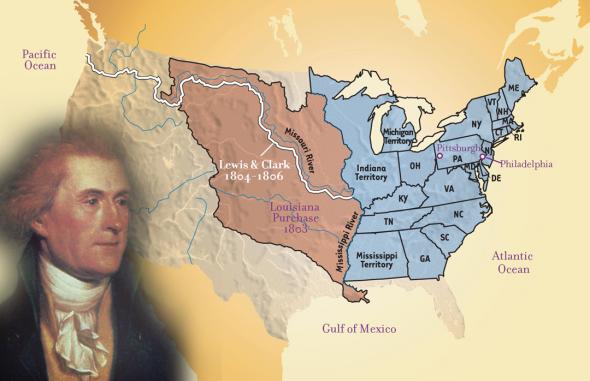
Surely the new President’s most sincere effort to enact a measure for the “common good” of the agrarian republic he envisioned came in 1803, when he asked Congress to authorize the purchase from Napoleon of Louisiana, despite the silence of the United States Constitution on the question of acquiring foreign territory. For the bargain basement price of $12,000,000, Jefferson’s administration doubled the size of the country, providing what must have seemed to the President at the time an inexhaustible supply of land for his beloved “yeoman farmers,” while, not coincidentally one suspects, offering those agrarian republicans a strong incentive to continue supporting the party of Jefferson.

Unfortunately for this grand Jeffersonian domestic vision, although Britain and France had shared an uneasy peace between 1801 and 1803, they renewed their hostilities for supremacy in Europe. Once again, the world’s leading neutral trader found itself in a dilemma:  both great powers were willing to trade with the United States, but neither wanted the United States to trade with the other.

Britain, which controlled the sea, issued a series of “orders in council” permitting the Royal Navy to seize American ships destined for France or those parts of the Continent under French control. The British further enraged American opinion with another practice, the “impressment” of the nation’s seamen. British captains stopped American vessels and took onto their own ships American crewmen they believed to be British subjects. The attitude and actions of France were little better. Napoleon, whose armies dominated Europe, issued several decrees authorizing the seizure of American ships reaching areas he controlled if they had called at British ports on the way.

A crisis arose in 1807, when a British warship, the Leopard, disabled an American naval vessel, the Chesapeake, and impressed several of its crew members within sight of the American coast. President Jefferson attempted to resolve the dispute by employing economic coercion rather than military force, just as the American colonies had done in the years before 1775 when confronted with British tax measures. Boycotts had worked then, Jefferson reasoned, so why not now? Besides, the President did not believe war with Britain was inevitable, and his policy of strict economy in government had rendered both the army and the navy inadequate for fighting a war with either of the world’s most powerful nations, let alone with both of them.

Jefferson's Embargo

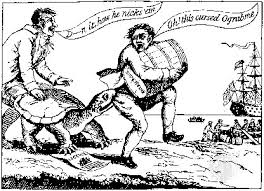
The result was “Jefferson’s Embargo” (1807-1809), which forbade American vessels from engaging in foreign trade, prohibited all American exports, and denied entry to certain British manufactured goods. The embargo depressed the country’s agriculture and devastated foreign trade, while stimulating American manufacturing. Evasion of the embargo was rife, especially in New England, which both depended upon trade and shipping and was the home of most of the nation’s remaining Federalists, who were pro-British. The Administration responded with the Force Act of 1809, which reminded some people of the policies pursued in the 1770s by George III and Lord North against the “freedom-loving” American colonists.

In the end, Congress passed, and President Jefferson signed, the repeal of the Embargo. Jefferson had overestimated the dependence of the British economy on the United States. The President also had counted too much on the willingness of Americans to cooperate in the Embargo (or, as he might have said, on the willingness of “virtuous republicans” to make sacrifices for the “common good”). New England saw the Embargo as a sectional and partisan conspiracy, even going so far as to quote the Virginia and Kentucky Resolutions against the President’s policy. Southern planters also were hurt by the Embargo, especially those growing cotton, as were western farmers who raised other crops for export.

James Madison (en-wikipedia.org}

James Madison (en-wikipedia.org}

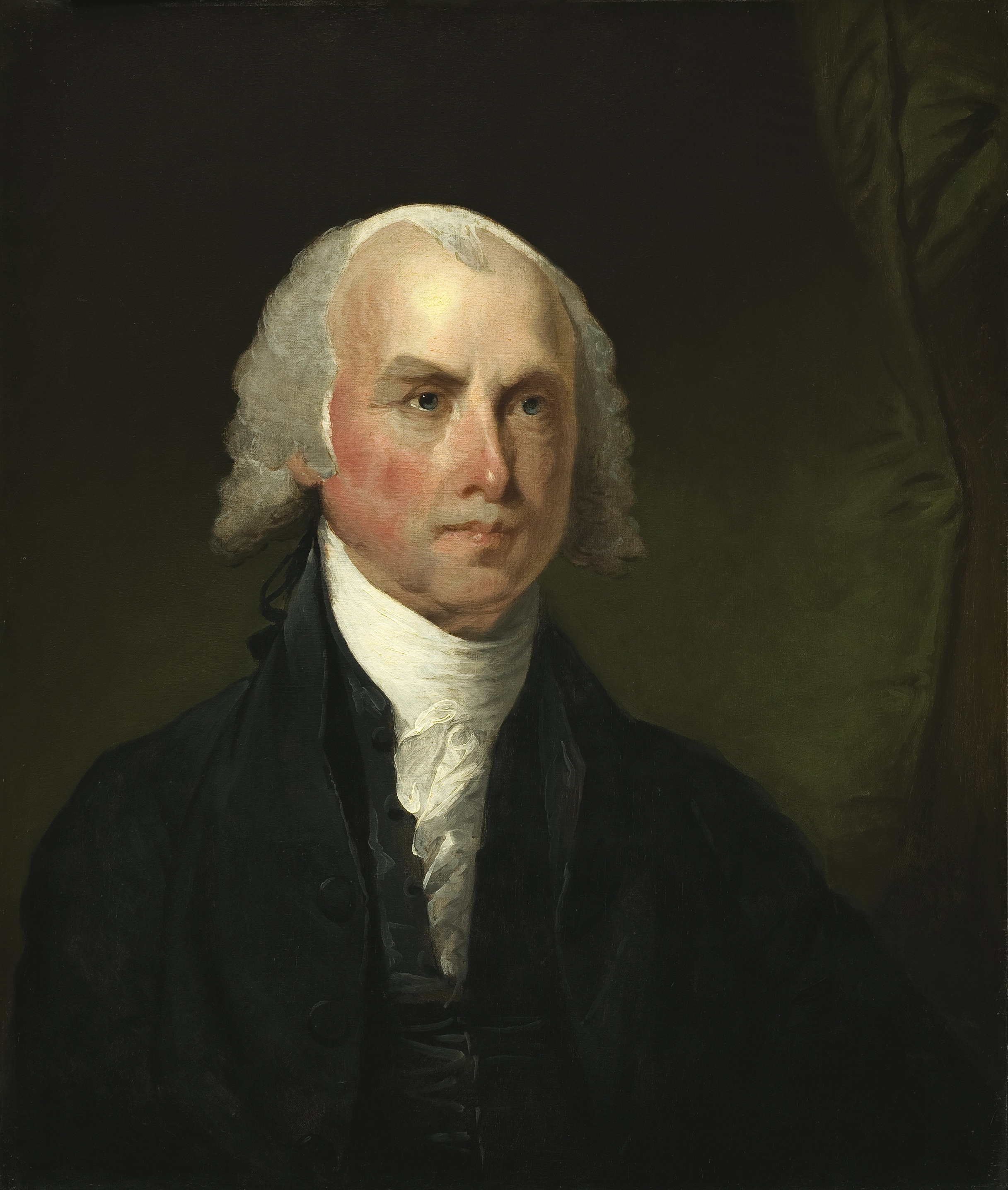
Despite the failure of the Embargo, Jefferson’s Republican successor, James Madison, also was unwilling to abandon economic coercion. For the next three years, the President and the Republican-controlled Congress tried through both legislation and diplomacy to induce Britain and France to recognize America’s rights to trade as a neutral, but with scant success. In 1810, Congress passed a law restoring trade with both Britain and France, promising that when one of them recognized our neutral trading rights we would cut off trade with the other. When Napoleon indicated that he was prepared to recognize America’s neutrality (even though France continued to seize American shipping), the United States, in March 1811, cut commercial relations with Great Britain.

The remaining economic sanctions against Britain finally forced the British to repeal her offensive orders in council, on June 16, 1812, but word of the repeal did not reach the United States in time to prevent Congress, in response to a message from President Madison, from declaring war on Great Britain.  Stonewalled by Britain, bamboozled by Napoleon, Madison decided that the nation’s honor, and the fate of republicanism, demanded a firm response.

The resulting conflict, the War of 1812, “Mr. Madison’s War,” was rife with irony. Our military and naval forces were woefully unprepared; our victories few and far between; and, if the Republicans were behind the war effort, at least in public, the New England Federalists were not, so the nation was badly divided. Despite this, we did not lose the war, but neither did we win it, though many Americans apparently thought we had.

Battle of New Orleans (history.com)

Battle of New Orleans (history.com)

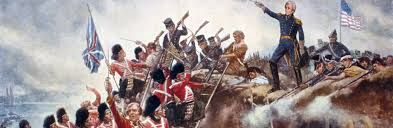
The Treaty of Ghent, ending the war, settled none of the issues growing out of British violations of American rights that had brought on the war, though, with Britain’s victory over Napoleon in Europe, the issue of our neutrality became unimportant. Moreover, Andrew Jackson’s decisive victory over the British army at New Orleans in 1815, which led many Americans to overlook earlier humiliating defeats and to believe we had triumphed in the conflict, was actually fought after the peace treaty had been signed but before word of the Ghent agreement reached Washington.

Hartford Convention (britannica.com)

Hartford Convention (britannica.com)

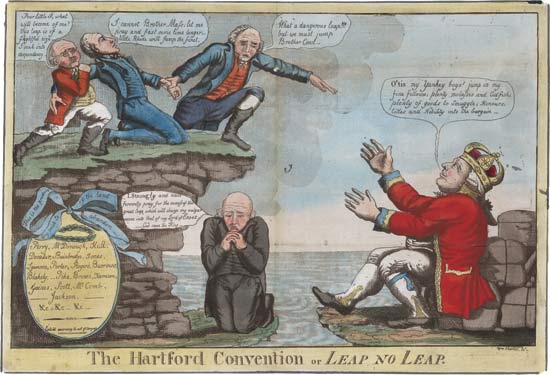
And, most ironic of all perhaps, the Federalists, who had led the nation during the first twelve years of its existence under the Constitution, resisted going to war with Britain and did everything they could to hamstring Republican conduct of the conflict, committing suicide as a political party in the process. They organized a convention at Hartford, Connecticut, to try to win concessions for New England from the beleaguered President Madison. The emissaries from Hartford did not reach Washington, D.C., until after news of Jackson’s victory at New Orleans arrived in the capital, which led both Madison and Congress to ignore Federalist demands for concessions and thoroughly discredited the party of Washington, Hamilton, and Adams by making them appear disloyal during wartime. Within a very few years, it would almost have been possible to rephrase Jefferson’s first inaugural to read, “We are all Republicans—there are no more Federalists.”

One scholarly survey of the presidencies of Jefferson and Madison sums up the gains of the War of 1812 as “economic independence, acceptance as a member of the family of nations, and recognition that republicanism was here to stay. . . . Independence had been corroborated, vindicated, confirmed.” (Marshall Smelser, The Democratic Republic, 1801-1815 [New York, 1968], p.324)  Thanks especially to Andrew Jackson’s triumph at New Orleans, Americans emerged from the war with a spread-eagle sense of national—and republican—triumph. We were still, at least on the surface, an agrarian republic, and, thanks to Jefferson’s Louisiana Purchase, the nation had twice as much room for future generations of “yeoman farmers.”

Era of Good Feelings (glogster.com)

Era of Good Feelings (glogster.com)

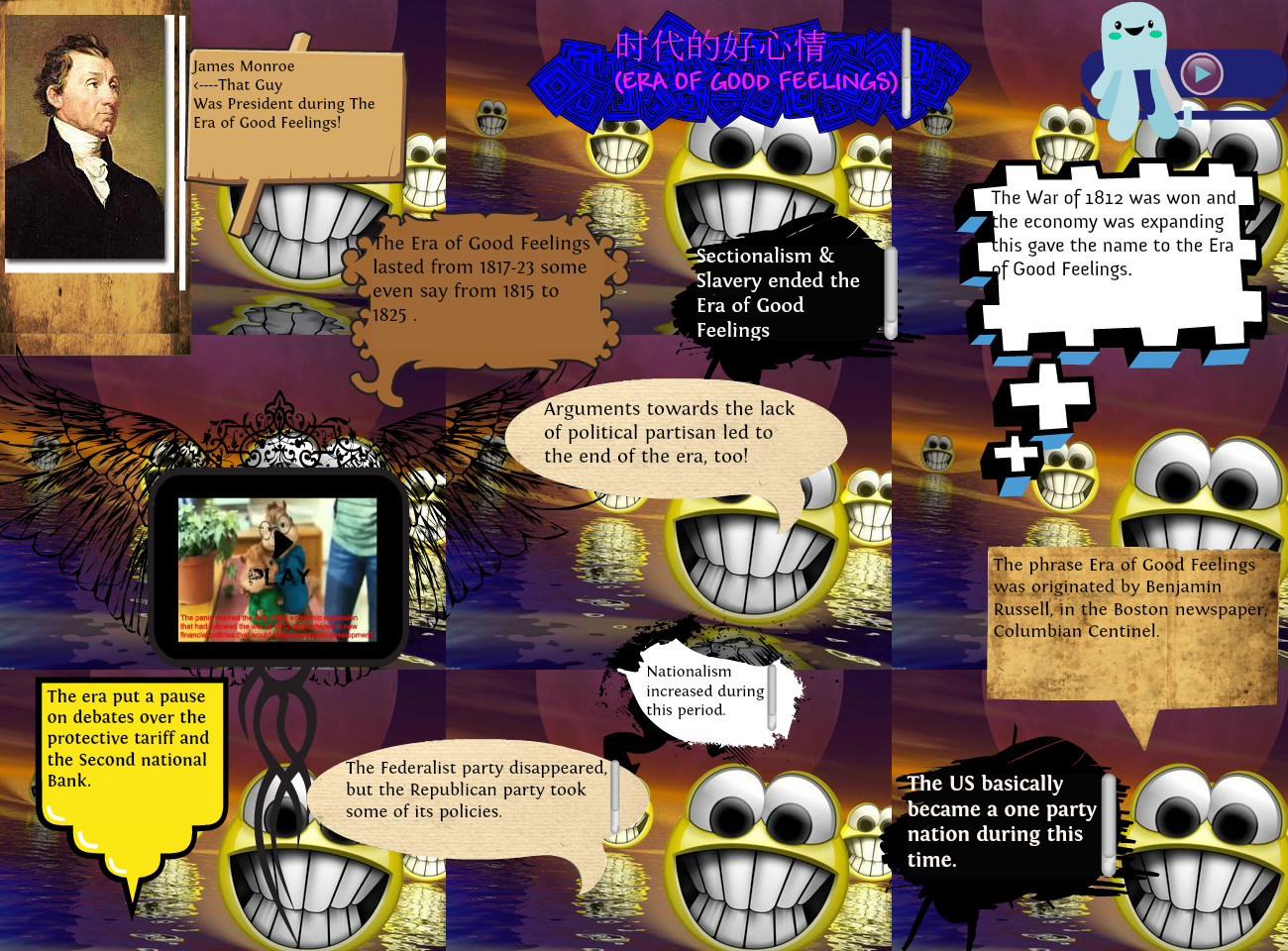
The collapse of the Federalist Party in the wake of the Hartford Convention, the Battle of New Orleans, and the Treaty of Ghent seemed to vindicate a central tenet of republicanism: there could be only one way to attain the “common good,” which meant that there was no place for “factions” or “parties” in the young American republic. And, sure enough, James Madison’s Republican presidential successor, James Monroe, would usher the United States into what was called the “Era of Good Feelings,” where, at least superficially, everyone seemed to be a Republican. Within a very few years, however, all of those claims of “good feelings” and “we are all Republican” chest-beating would become doubts; the fate of the Republic—and republicanism—seemed to hang in the balance again.

____________

For those interested in reading more about Georgia History, here are links to my books on the subject:

REABP CoverRancorous Enmities and Blind Partialities:  Parties and Factions in Georgia, 1807-1845 (University Press of America, 2015)

Pursuit Cover

In Pursuit of Dead Georgians:  One Historian’s Excursions into the History of His Adopted State (iUniverse, 2015)

Politics on the Periphery:  Factions and Parties in Georgia, 1783-1806 (University of Delaware Press, 1986)

Posted in American History, Education, Historical Reflection, History, History Curriculum, Interdisciplinary Work, Research, Retirement, Southern (Georgia) History, Southern History, Teaching, Uncategorized, WP Long Read | Tagged , , , , , | 2 Comments

A Scrappy Fourth of July! (In Pursuit of Dead Georgians, 18)

john-quincy-adams-picture

[NOTE: John Adams predicted that the colonial declaration of independence in the summer of 1776 “would be celebrated, by succeeding Generations, as the great anniversary Festival. . . . It ought to be solemnized with Pomp and Parades, with Shews [sic], Games, Sports, Guns, Bells, Bonfires and Illuminations from one End of this Continent to the other from this Time forward forever more.”  And that was what happened, more or less, at least for a while.]

* * * * *

John Adams (wikipedia)

At the center of these celebrations throughout the United States was the Declaration of Independence.  In antebellum Georgia, the state I know best, from early June onward local newspapers mobilized citizens to organize communal commemorations of American independence.  Editors often published the Declaration a day or two before the holiday, and they also wrote essays analyzing the significance of the event for the nation and the state since 1776.

A committee in each town tapped an up-and-coming politician to read the Declaration aloud and a more seasoned local political figure to deliver an oration affirming the glories of American liberty and progress.  No Fourth of July celebration was complete without a parade of militiamen in full uniform.  Following the parade, the reading of the Declaration, and the oration, citizens continued celebrating, with meals, ample liquid refreshment, numerous toasts to heroic figures in the struggle for freedom–and to the ideal of freedom itself.

Once the political scene became increasingly polarized, towns and cities across Georgia continued to celebrate the Fourth, but at an ever-growing distance, chronologically, ideologically, and emotionally, from the American Revolution.  In other words, precisely what sort of freedom was being celebrated became unclear.  In this brave new world of American politics, what was definitely lost was the notion of the “common good” that was supposed to be at the heart of “republicanism” (for a series of posts on this topic, see hereherehere, and here).

* * * * *

Even before the organization of political parties in Georgia, the potent mixture of patriotism and alcohol could lead to trouble on the Fourth.  For instance, in 1787 Colonel James Gunn tangled at a holiday dinner in Savannah with friends of James Jackson, who already had clashed with Gunn over a number of issues related to the Georgia militia.

After a lot of eating and drinking, a Jackson ally, Joseph Welscher, who was also one of Gunn’s militia subordinates, was asked to sing a song for the gathering.  His choice angered Gunn and others  because it was “an old English song made before the [Revolutionary] war.”  When Gunn objected, Welscher apologized, only to have Gunn retort, “Damn the song and you too, you damned stinking puppy.”  The two men nearly came to blows, but were separated, and the still irate Gunn left in disgust.  A drunken Welscher finally stumbled homeward a few hours later, past the house of Colonel Gunn, who was waiting for him.  The two men grappled, with Gunn snatching Welscher’s sword away, then assaulting him with a whip.  Only the arrival of a neighbor, summoned by Gunn’s anxious wife, defused the situation.

* * * * *

As political factions and parties formed in the major towns of Georgia in the mid-to late 1790s, first over Treasury Secretary Alexander Hamilton’s plan to restore the nation’s credit and later over the Yazoo land fraud, it was not unusual for militia units to include members of only one faction or party.

In 1796, for example, Colonel Jesse Sanders, commander of the Columbia County militia regiment, enlivened a Fourth of July muster with a heated oration denouncing land speculators for their opposition to the Rescinding Act, which had negated the corrupt Yazoo sale. Subsequent events helped to polarize militia units further.

James Jackson (NGE)

Even if local militiamen still paraded together through town, they now usually celebrated the Fourth separately once the parade had finished. In Savannah, for instance, “Democratic Republicans” and “Federal Republicans” normally held separate dinners. When, as in 1803, the port’s “friends of government [i.e., Federalists]” failed to meet in a body, the editor of the local Federalist paper reassured readers that only the required muster of the town’s “Volunteer Corps,” dominated by the Federalists, explained “why no Federal Republican Dinner was given by those of our citizens, who still feel an honest pride in revering the political maxims of WASHINGTON, and who will ever practice his precepts.”

The following year in Savannah, the Chatham Artillery, led by three aides-de-camp of General James Jackson, fired a cannon in honor of President Jefferson and pledged their Republican faith over drinks under Jackson’s satisfied gaze

In this later period, newspaper editorials, celebratory speeches, and toasts still addressed the general topic of American liberty, but the real excitement on the Fourth came during the second phase of the celebration, when members of factions, parties, militia units, or other groups gathered to offer toasts interpreting local, state, or national issues so that their own particular views were presented as the logical outgrowth of the principles embodied in the Declaration of Independence and, thus, as examples of the nation’s founding ideals; while the political opposition was portrayed as having abandoned those things that had made the nation great, in pursuit of greed and corruption.

* * * * *

George M. Troup (New Georgia Encyclopedia)

As had been the case on earlier occasions, alcohol and patriotism, transmuted now by increasingly rabid political partisanship,  made for a combustible combination.  In 1825, for example, George Troup and John Clark, the leaders of  Georgia’s eponymous political parties, opposed each other for the governorship in an exciting, highly emotional campaign.  To celebrate the Fourth, planners in the Monroe County town of Forsyth attempted to organize a non-partisan gathering, promising that no one would offer toasts on “party” topics.

John Clark (georgiaencyclopedia.org)

John Clark (georgiaencyclopedia.org)

However, on the day itself, General Elias Beall, a zealous Trouper, made a strongly pro-Troup “volunteer” toast (offered late in the celebration, after the “regular” toasts had been made, the dinner’s president and other prominent guests had retired, and the remaining celebrants had had additional time to imbibe).  In response, an equally avid member of the Clark party, John Cuthbert, proposed a blatantly pro-Clark toast, then left the table, fearing that the rest of the volunteer toasts would become even more overtly political, which, he later claimed, they did.

* * * * *

John C. Calhoun (georgiainfo.galileo)

John C. Calhoun (georgiainfo.galileo)

Seven years later, lines were being drawn in Georgia and elsewhere over the efficacy–and constitutionality–of John C. Calhoun’s doctrine of Nullification, the idea that a state unhappy with a federal law, in this case the protective tariff, could vote to “nullify” it, rendering it unenforceable within the borders of that state.

The 1832 Fourth of July celebration in Milledgeville, the state capital, began when local citizens, led to the Methodist church by the “Georgia Guards,” listened to a reading of the Declaration of Independence and to a rather generic oration, a throwback to the “good ol’ days” before the rise of parties.

After this well-attended ritual ended, the crowd broke up.  Members of the Troup party, avid supporters of “state rights” and/or Nullification, held a celebration featuring the usual patriotic toasts, as well as more partisan ones, such as, “The Cholera [then raging in parts of the state and nation] and Tariff for protection: May they both speedily become extinct; and thus the Union of our country and its families remain unbroken.”

The men of the “Georgia Guards” militia unit, on the other hand, made their way to a site just outside the capital for a festive barbecue, presided over by Captain John Cuthbert, the man who had answered Elias Beall’s pro-Troup toast in Forsyth seven years before and was now an editor of the state’s leading Clark party paper, the Milledgeville Federal Union.  The “volunteer toasts” during the Guards’ celebration, like those at the Troup party conclave, were more partisan than the “regular” ones.  For instance, one of the Guard officers proposed “The union of the States, and the sovereignty of the States:  clear heads and honest hearts for the defense of both.”

Meanwhile, in the Harris County village of Hamilton, Fourth of July orator Marshall J. Wellborn denounced the protective tariff, the “American System” of Henry Clay, and the federal judiciary, warning that southerners must “adhere inflexibly to the tattered fragments of our violated constitution wherever we can find them.” And, in John Cuthbert’s former hometown of Forsyth, a festive gathering toasted–and roasted–Nullification as “an unconstitutional remedy for a constitutional but oppressive law.”

* * * * *

Jefferson (History.com)

Thomas Jefferson (History.com)

Nowadays, our young people generally learn of the Declaration and its ideals in an American History course.  One hopes that this requires, at a minimum, that each student actually reads the document, and that the class discusses both what it says and, just as importantly, what it does not say.

Do our children learn, for example, about Jefferson’s famous (or infamous) “philippic against slavery,” charging the King of England with “forcing” slavery upon the southern colonies, a charge that was removed from Jefferson’s draft by the Continental Congress, whose members realized all too well how explosive the slavery issue was (and, just maybe, how silly Jefferson’s assertion was)?

To call the Declaration “American scripture,” as some historians do, plays into the literal mindset of many Americans.  Rather, Jefferson’s “Great Declaration” became a kind of national “to-do list,” a collection of inspiring ideals to which the new nation committed itself in 1776, but which even some who heard the Declaration read that summer probably realized did not yet even approximate reality.

One way to understand our national history, and the Declaration’s place in it, then, is to see it as “the story of American Freedom” (Eric Foner), a still-evolving saga wherein the very definition of “American Freedom” has been contested, stubbornly and persistently, with “progress” measured by which groups enjoy “the blessings of liberty,” and which remain outside the “sacred circle,” at any given time.  And, make no mistake about it, even today, some groups still remain outsiders, looking in.

_______________

For those interested in reading more about Georgia History, here are links to my books on the subject:

REABP CoverRancorous Enmities and Blind Partialities:  Parties and Factions in Georgia, 1807-1845 (University Press of America, 2015)

Pursuit Cover

In Pursuit of Dead Georgians:  One Historian’s Excursions into the History of His Adopted State (iUniverse, 2015)

Politics on the Periphery:  Factions and Parties in Georgia, 1783-1806 (University of Delaware Press, 1986)


Posted in 4th of July, American History, Education, George M. Troup, Georgia History, Historical Reflection, History, James Gunn, John Clark, John Cuthbert, Nullification, Research, Retirement, Southern (Georgia) History, Southern History, Teaching, Uncategorized, WP Long Read | Tagged , , , , , , , | 7 Comments

Early Blues Divas (Blues Stories, 19)

[NOTE:  A different take on an earlier post, “20th –Century Blues Women,” this time emphasizing the decade of the 1920s.]

* * * * *

2003 was designated by Congress as “The Year of the Blues” to commemorate W.C. Handy’s first encounter with that music, in a railroad station in Tutwiler, Mississippi, in 1903. Yet, it turns out that one of the “Blues divas” of the 1920s, Gertrude “Ma” Rainey, had a similar experience a year before Handy’s epiphany.  According to folklorist John Work, Rainey was performing in a tent show in a small Missouri town in 1902, when “a girl from the town . . . came to the tent one morning and began to sing about the ‘man’ who had left her.”  Ma Rainey was so taken by the “strange and poignant” song that she learned it and incorporated it into her act, usually as an encore.  Work reported that “Many times [Rainey] was asked what kind of song it was, and, one day she replied, in a moment of inspiration, ‘It’s the Blues.’”  (Francis Davis, The History of the Blues, p.28)

Ma Rainey

Ma Rainey

For most Blues fans, the stereotypical early Blues performer is a black man, playing and singing in a rural setting, perhaps the Mississippi Delta, yet the first Blues song ever recorded was “Crazy Blues,” by Mamie Smith and Her Jazz Hounds, in 1920.


Mamie Smith and Her Jazz Hounds


In fact, the 1920s, the “classic era” of recorded Blues, was dominated by women who lived, performed, and recorded in the cities, even if, like Ma Rainey, they brought a country feel to their music. Sippie Wallace and Victoria Spivey also combined a country style and an urban perspective, with more emphasis on the “urban” than Ma Rainey, while Bessie Smith specialized in the “city blues.”

Sippie Wallace

Sippie Wallace

Alberta Hunter and Edith Wilson took the blues into cabarets, with whites in the audience, to produce music that was “more cosmopolitan, less emotional.” (Daphne Duval Harrison, Black Pearls:  Blues Queens of the 1920s , 10-12)

Alberta Hunter

Alberta Hunter

The “Great Migration” sent large numbers of African Americans out of the South—fleeing Jim Crow and looking for economic opportunity—into the cities of the industrial Midwest and Northeast.  When it came to giving those new urban residents something to do in their spare time, “Toby”  (TOBA—the Theatre Owners Booking Association, a forerunner of the “Chitlin’ Circuit“) played a major role.  Despite primitive conditions and rampant dishonesty on the part of some promoters, the “Toby circuit” gave aspiring Blues singers, especially women, the opportunity to launch careers as entertainers in the proliferating theaters in cities providing new homes for the fugitives of the Great Migration.

TOBA had been organized in Memphis in 1909. (Harrison, 23)  Only those at the top of the bill were treated well; the rest pretty much had to fend for themselves—complaining did little good, because whites were TOBA stockholders; owned or managed the theaters; and even controlled some living facilities. (Harrison, 26)  The decline of the black population in the South, and its concomitant growth in the North, gave whites a chance to capture a share of the African American entertainment market for their own theaters and circuits.   TOBA, in the early years, provided black vaudeville and tent shows to sixty-seven theaters across the South and Midwest.  Blues singers were included, and hearing them led audience members to demand recordings by their favorties. (Harrison, 17)

The Great Migration, with Chicago at its epicenter, was full of problems for those who moved, but it did provide increased economic opportunity.  Pushed into areas segregated from whites, blacks developed their own social and cultural institutions, including music and theaters.  Ambitious, talented young black women saw their chance—and took it.

The queen of the TOBA circuit, Ma Rainey, was known for her country blues but also for her willingness to support, advise, and nurture younger performers.  When “discovered” by Paramount in 1923, Ma had already been performing on the “Toby circuit” for years, which of course meant that Paramount didn’t really “discover” her; rather, the company “merely preserved on wax a voice that would serve as a striking example of the diversity of the black experience.” (Harrison, 39)

Yet, while the “Toby circuit” gave many female Blues singers a chance to hone their skills, what enabled them to earn money was the recording industry, as Mamie Smith and “Crazy Blues” showed. Mamie Smith found that her stage show benefited her recording career, and vice versa, and her live performances enabled her to set the standard for future “blues queens,” when it came to costumes and scenery.  Any number of aspiring Blues divas were willing and able to follow in Mamie Smith’s wake, in hopes of earning a recording contract.

Another Smith, Bessie, through her recordings, raised the Blues “to an art form that was to be the hallmark for every woman blues singer who recorded during the 1920s.”  She was simply a much better performer than most of her contemporaries, and she could still sing songs that showed she identified “with the anxieties, alienation, and disaffection of the urban black woman.” (Harrison, 52-53)

Bessie Smith (bbc.co.uk)

Bessie Smith (bbc.co.uk)

These Blues divas joined numerous others to build the foundation upon which the “race record” industry flourished.  Most of the singers from that era came from a vaudeville or cabaret background; since few could play instruments, their backup bands tended to be made up of jazz musicians (e.g., Mamie Smith and Her Jazz Hounds).  The line between jazz and the Blues was fuzzy at best in this era.

In the larger black community, many residents were concerned about the morals of female Blues performers, as a modern scholar points out:  “In the 1920s, . . . women blues singers had been extremely successful, but many people had regarded them simply as popular entertainers and had associated them with sexuality and working-class urban vices more than with technical skill or acquired artistry.”  (Ruth Feldstein, “‘I Don’t Trust You Anymore’:  Nina Simone, Culture, and Black Activism in the 1960s,” Journal of American History 91 [March, 2005]: 1356) 

Ida Cox

Ida Cox

According to Ida Cox’s song “Wild Women Don’t Have the Blues,” unless black women were “wild,” they were in a bad place in northern industrial cities.  So, Ida and her compeers set out to rally the troops with songs that were “paradoxical,” because they “contain the expression of the agony and pain of life as experienced by blacks in America; yet, the very act and mode of articulation demonstrates a toughness that releases, exhilarates, and renews.” (Harrison, 66)

Women’s blues lyrics generally emphasized the same conditions as men’s—“infidelity, alienation, loneliness, despondency, death, poverty, injustice, love, and sex.  But women responded to these concerns differently and dealt with certain themes more or less frequently.” Problems caused by natural disasters were frequent topics in women’s blues songs, as were unemployment, poverty, and disease.  (Harrison, 70)

The era of the “Classic Blues”—and of most of the early “Blues divas”—ended in 1929, when the Stock Market Crash and the ensuing Great Depression dealt a devastating one-two punch to record labels and recording contracts.  As the demand for the Blues dried up in the 1930s, some Blues women returned to southern tent shows, small northern clubs, or began to sing jazz, swing, or big band music.

Memphis Minnie

Memphis Minnie

A few women, like early 1930s icon Memphis Minnie, began to perform with combos in cities like Chicago, “which would sow the seeds for the electric-blues-band revolution of the 1950s.”  (Peter Guralnick, et al., eds., Martin Scorsese Presents the Blues: A Musical Journey, p.24)  Some singers abandoned pure Blues for the more popular “rhythm ‘n’ blues” (R&B) in the 1940s and 1950s, while others got out of music altogether and into lines of work that, though perhaps less exciting, promised a more regular paycheck.

Ironically, a few elderly former “Blues divas,” not all from the 1920s, found themselves back in demand during the Blues revival of the 1960s, as covers of their old songs by performers like Janis Joplin (Big Mama Thornton) and Bonnie Raitt (Sippie Wallace) revived interest in their original work.

Big Mama Thornton

Big Mama Thornton

So, those who were able to, hit the performing and recording trails again.  To a great extent, this revival of interest in the Blues during the ’60s helped ensure its survival for the remainder of the twentieth century, as American rock ‘n’ roll and R&B performers joined “British invasion” bands like the Rolling Stones and the Animals in playing and singing the Blues.  And the surviving early “Blues divas” played a key role in making that happen.

SUGGESTED READING

  1. Davis, Francis.  The History of the Blues.  Hyperion, 1995.
  2. Feldstein, Ruth.  “‘I Don’t Trust You Anymore’:  Nina Simone, Culture, and Black Activism in the 1960s,” Journal of American History 91 (March, 2005), 1349-1379.
  3. Guralnick, Peter, et al., eds.  Martin Scorsese Presents the Blues:  A Musical Journey.  Amistad, 2003.
  4. Harrison, Daphne Duval.  Black Pearls:  Blues Queens of the 1920s.  Rutgers University Press, 1993.

* * * * * *

For those interested in reading more of my reflections on history, here are links to my books on the subject:

REABP CoverRancorous Enmities and Blind Partialities:  Parties and Factions in Georgia, 1807-1845 (University Press of America, 2015)

Pursuit Cover

In Pursuit of Dead Georgians:  One Historian’s Excursions into the History of His Adopted State (iUniverse, 2015)

Politics on the Periphery:  Factions and Parties in Georgia, 1783-1806 (University of Delaware Press, 1986)

Posted in American History, Bessie Smith, Big Mama Thornton, Blues Women, Books, Chicago Blues, Historical Reflection, History, Interdisciplinary Work, Ma Rainey, Mamie Smith, Memphis Minnie, Memphis Minnie, Popular Culture, Research, Retirement, Sippie Wallace and Bonnie Raitt, Southern History, Teaching, The Blues, Uncategorized, WP Long Form, WP Long Read | Tagged , , , , , , , , , , , , , , | 2 Comments

American Republicanism, III: Battle for the Soul of the Republic, 1789-1800 (History Lesson Plan, 10)

john-quincy-adams-picture[NOTE:  This is the penultimate post in the series on the history of Early American Republicanism.  For earlier posts, go here and here.]  

* * * * *

Whether the new government created by the Constitution of 1787 was in fact a republic, as Benjamin Franklin had claimed and as its supporters, who called themselves “Federalists,” believed, was an open question as the new presidential administration of George Washington began in 1789. Still, the signs were reassuring, for, with Washington as President, Alexander Hamilton at the Treasury, and Thomas Jefferson as Secretary of State , the new government had more sheer ability and what we would nowadays call “star power” than any American administration before or since.

On the other hand, once Washington and his Cabinet moved from the theory to the practice of “republicanism,” two disturbing tendencies became clear: first, there was no agreement on what constituted the “common good”; and, second, those who rejected the Administration’s measures seemed both willing and able to organize a “faction” or a “party” to oppose them. What made these developments particularly scary was that neither was supposed to occur in a republic, where, so theory held, there was only one “common good,” and all men of good will were supposed to discover, enact, and support it.

Alexander Hamilton (pbs.org)

Alexander Hamilton (pbs.org)

To Treasury Secretary Hamilton, who thought himself the “prime minister” under President Washington, the government’s most pressing task was to place the  republic on a firm financial footing. This would, he believed, both solidify the nation’s credit abroad and give monied men in the United States a reason to support the government created by the Constitution.

James Madison (en-wikipedia.org}

James Madison (en-wikipedia.org}

The key to Hamilton’s program was funding and assumption of the entire national debt, which was to be paid at face value, with no distinction made between the original purchasers and current holders of certificates of indebtedness. James Madison, “Father of the Constitution,” co-author with Hamilton and John Jay of the Federalist Papers, and now Congressman from Virginia and the Administration’s floor leader in Congress, split with the Treasury Secretary over the issue. Madison believed that Hamilton’s plan discriminated against the original purchasers of the debt, many of whom had been forced by circumstances to dispose of their certificates, at a fraction of their face value, to financial speculators. This marked the first major breach in the ranks of the nation’s original “Federalists,” those who had worked to ensure ratification of the Constitution.

Moreover, under Hamilton’s scheme, the national government would pay all state Revolutionary War debts that were still outstanding as of 1790. (It should be noted that one of the states that had already redeemed its Revolutionary War debt, and so would not benefit from the provision, was Virginia, home of Madison and Jefferson.) Finally, the combined national and state debt, both principal and interest, was to be “funded”; that is, the national government would call in old certificates of indebtedness and issue new negotiable bonds in their stead.

An integral part of Hamilton’s financial plan was creation of a Bank of the United States (BUS), modeled on the Bank of England. The United States government would be a minority stockholder in the BUS; the majority stockholders would be the wealthiest and most influential class in the new nation, who would support the new government in order to enhance their financial interest.  Jefferson and Madison claimed that the BUS was unconstitutional, arguing that the power to charter such a financial institution was not specifically granted to Congress in the Constitution.  Hamilton’s response was that, because the need for such a Bank was “necessary and proper” to the financial health of the new nation, the power to create it was implied in the Constitution.

Although much of the new government’s income would be from tariffs, Secretary Hamilton also recommended, and Congress enacted, a tax on whiskey, in order to secure additional funds to pay principal and interest on the combined national debt. This measure was not popular among small farmers, many of them Jefferson supporters, for whom turning grain into whiskey before shipping it eastward was, because of the nation’s primitive transportation routes, the most efficient method for marketing their crop.

The only one of Hamilton’s proposals that failed in Congress was his Report on Manufactures (1791) recommending a closed economic system for the new nation: the southern and western states were to produce raw materials, while the eastern states would manufacture them. This idea struck many Americans as too much like Britain’s policy of mercantilism; Congress rejected the report.

Jefferson (History.com)

Jefferson (History.com)

By the early 1790s, Secretary of State Jefferson, Congressman Madison, and a number of other members of Congress had begun to coalesce into an opposition bloc in Congress. According to the theory of republicanism, this was not supposed to happen, because it was believed that there was only one “common good.” By definition, then, those who opposed the “common good” identified by the ruling Federalists were considered members of a “faction” or “party” (the terms were used interchangeably), who were out for themselves, not for the welfare of the republic.

* * * * *

Even more decisive to this development than Hamilton’s financial program was the American response to the French Revolution, which began in 1789. France had been our most faithful ally during the American Revolution; moreover, at least at first, most Americans seemed to believe that the people of France were rebelling for the same reasons we had in 1775. When the French Revolution turned ugly and violent with the rise of Robespierre and the Jacobins, however, America’s strong support for the Revolution in France disappeared.

With Secretary Hamilton’s support, President Washington issued a Proclamation of Neutrality in 1793 designed to keep the new American republic out of the crossfire of the developing European war between France and Britain and their allies, and, not coincidentally, to allow us to trade with both sides in the conflict. Jefferson and his supporters opposed the Neutrality Proclamation, contending that it would only aid Britain, which controlled the seas. (And it is well to remember that the nation’s foreign trade policy, crafted by Hamilton, depended upon tariffs levied on trade for revenue, and most of this trade was with Britain.)

Between 1793 and 1795, public opinion in the United States was polarized on the question of support for the French Revolution. One was either for it or against it; there seemed no neutral ground. By that time also, opposition to the Washington Administration’s course in the French Revolution had solidified around Jefferson and Madison, in a “party” or “faction” increasingly referred to as the “Republicans.” Those who supported Hamilton’s financial plan and the Administration’s course in the French Revolution kept the “Federalist” label for themselves.

In 1794, following a rebellion in western Pennsylvania against Hamilton’s whiskey tax, an angry President Washington denounced the so-called “Democratic Societies,” groups that backed Jefferson, the Whiskey Rebels, and France, as “self-created societies.” By the mid-1790s, in other words, the new American republic was witnessing a development that should never have occurred in a classical republic, the formation of two “factions” or “parties,” each claiming that it represented the “common good” and that the opposing group represented a threat to the future of the republic.

John Adams (Wikipedia)

In 1797, the new American President, John Adams, sent a peace mission to France to try to end seizures of American shipping by the French revolutionary government. When three French emissaries (referred to as “X, Y, and Z”), tried to secure a bribe from the American delegation before allowing them to see the French foreign minister, the angry Americans refused and sent word of the attempted bribe back to the United States, where it became known as the “XYZ Affair.” Word of this insult to American diplomats touched off an undeclared naval war with France and led the Federalist-dominated Congress to pass the Alien and Sedition Acts (1798), in an effort to silence their Republican critics in Congress, the state legislatures, and the press.

Alien & Sedition Acts (ushistory.org)

Alien & Sedition Acts (ushistory.org)

The Alien and Sedition Acts sparked the first state rights movement under the new Constitution and, eventually, helped elect Thomas Jefferson President of the United States. Jefferson and Madison considered the Alien and Sedition Acts proof, if any were needed, that the Federalists were allied with Great Britain and intended to subvert the American Republic and replace it with a monarchy on the British model. The Federalists, of course, claimed only to be defending the republic against the threat posed to it by what they professed to see as an atheistic, radical, bloodthirsty Republican “faction.”

Madison and Jefferson responded to the Alien and Sedition Acts by having the legislatures of Kentucky (Jefferson) and Virginia (Madison) pass resolutions declaring the laws unconstitutional (1798-1799). (It should be noted that, at this early period in American history, the recently-created Supreme Court had not yet asserted its right to declare acts of Congress unconstitutional, so it was not at all clear where those who believed a federal law violated the Constitution could go for redress.)

This controversy, along with fistfights on the floor of Congress and rumbles, especially from the South, of a determination to resist the Alien and Sedition Acts, formed the bizarre backdrop for the presidential election of 1800. The candidates, chosen by party caucuses in Congress, were John Adams and Charles C. Pinckney for the Federalists and Thomas Jefferson and Aaron Burr for the Republicans. During the electoral votes, party unity gave Jefferson and Burr the same number of votes, while divisions among the Federalists split the vote unevenly between Adams and Pinckney, which threw the final choice of the new President into the House of Representatives, still controlled by the Federalists, who, ironically, would have to choose between two Republicans.

After more maneuvering, and additional rumors of armed Republicans set to march on the capital to make Thomas Jefferson President, enough Federalists were convinced, by Alexander Hamilton and other party leaders, to abstain that the “people’s choice,” measured by the popular vote, Thomas Jefferson, was named the nation’s third President, and the first non-Federalist. Simplifying an extremely complex situation, one can say that in 1800 the American people opted for the weak, agrarian republic promised by Jefferson over the strong, commercial republic envisioned by Hamilton. There is irony here, but like all irony, it is clearly visible only with hindsight: despite Jefferson’s victory in 1800, in the long run the Hamiltonian republic would triumph.

But that, of course, was not obvious in March 1801, when Thomas Jefferson took the oath of office and delivered his famous inaugural address in a soft voice that was inaudible beyond the first few rows of spectators. All that was evident  was that the American Republic endured, at least the version Jefferson believed in. The peaceful transfer of power from the Federalists to the Republicans showed the acceptance in the new nation of majority rule, the idea of the power of a majority of the people that was a central tenet of republicanism.

That the principle of majority rule had been validated only after a bitterly fought contest between rival “factions” or “parties,” each claiming to represent the “common good,” was a cause of concern for all good republicans. The larger question at issue in 1800, whether the nation would be able to keep its republican form of government, as Franklin had cautioned in 1787, would depend upon the challenges the new President faced and how successfully he dealt with them.

* * * * * *

For those interested in reading more of my reflections on history, here are links to my books on the subject:

REABP CoverRancorous Enmities and Blind Partialities:  Parties and Factions in Georgia, 1807-1845 (University Press of America, 2015)

Pursuit Cover

In Pursuit of Dead Georgians:  One Historian’s Excursions into the History of His Adopted State (iUniverse, 2015)
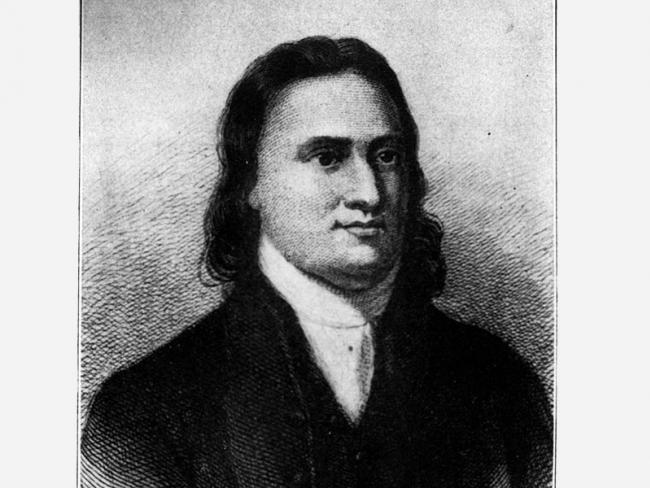
Politics on the Periphery:  Factions and Parties in Georgia, 1783-1806 (University of Delaware Press, 1986)

Posted in American "republicanism", American History, Constitution of 1787, Education, Historical Reflection, History, History Curriculum, Research, Retirement, Southern History, Teaching, Uncategorized, WP Long Form, WP Long Read | Tagged , , , , , | 2 Comments

American Republicanism, Part II: “A Republic, if you can keep it,” 1776-1788 (History Lesson Plans, 9)

john-quincy-adams-picture[This is the second in a series concerning the history of American “republicanism.”  For the previous post, go here.]

* * * * *

 When the Second Continental Congress assembled in Philadelphia in May, 1775, fighting had already broken out between British troops and colonial militia. So, the body that had originally been supposed to work out a peaceful settlement of the dispute with Great Britain now had to assert and defend the rights of the American colonies. A crucial part of this process was the organization of governments on the central and colonial levels.

The constitutions written by the new American states usually were brief outlines, with details to be filled in later by the legislatures. Seven included separate bills of rights, while others scattered such provisions throughout the document. All of the thirteen original states except Pennsylvania and Georgia provided for bicameral legislatures; the two exceptions, with their unicameral legislative bodies, were deemed to have the most “democratic” (or “radical”) constitutions. The impact of the pre-Revolutionary struggles with royal governors seemed to require that governors in the new states be closely watched by executive councils or other bodies elected by, and usually composed of, members of the legislatures. Finally, the state constitutions specified simple property requirements for voting.

Given the decade-long debate with Parliament over the question of sovereignty, some Americans were reluctant to create any sort of general government, but there was a war to be won, as well as several pressing issues among the states. So, while necessity required some kind of general government, pre-Revolutionary disputes and the ideology of republicanism dictated that it would be a loose union, a sort of “League of Nations” of sovereign republics. The first American national constitution, the Articles of Confederation, was submitted to the states in 1777, but disputes over rival state land claims prevented ratification until 1781.


en.wikipedia.org

en.wikipedia.org

The Articles government reflected “lessons” the colonists thought they had learned between 1763 and 1776, when they had struggled with royal governors who, they believed, were working hand in glove with King George III to impose a “tyranny” on North America. State representation in the Confederation Congress could be between two and seven delegates, but each state had only one vote, thus enforcing a kind of “congressional equality,” regardless of differences in geographical extent, population, or wealth among the states. Taxes, such as they were, were to be levied under a requisition system, based upon an estimate of the value of land and improvements in each state, but the Congress could not compel the states to contribute anything.

Under the Articles of Confederation, states retained their sovereignty and were to exercise their powers in conjunction with a weak central government. In deciding upon the powers of the Congress, the states once again applied “lessons” they believed they had learned during the Revolutionary era. Congress was granted the same powers the colonies had conceded to Parliament before the Revolution—over foreign affairs, war and peace, coining money, and the postal service, for example. But, the Articles retained in the hands of the states the crucial powers the colonies had denied Parliament, taxation and the regulation of trade.

Furthermore, nine of thirteen states had to approve measures allowing Congress to exercise any of its powers, and amendments to the Articles had to be approved unanimously. The government under the Articles had no single executive. While there was a “president” of Congress, he was simply the presiding officer. Measures approved by Congress were to be executed by a series of congressional committees, for war, foreign affairs, finance, and so forth. Finally, there was no permanent national court system.

Because we know what happened at the Philadelphia Convention in the summer of 1787 and because the new form of government created there has lasted, with amendments, to the present day, it is awfully easy to dismiss the Articles of Confederation as weak and ineffectual. It should be remembered, though, that the government of the Articles presided over the American victory in the Revolutionary War. Moreover, Congress under the Articles created the Northwest Ordinance of 1787, which both resolved the sticky issue of rival state land claims and established a “colonial policy” that has provided for the admission of new states to the Union, and placed them on an equal footing with the older states, ever since.

Still, the delegates to the Philadelphia Convention tossed aside the Articles of Confederation and replaced them with a much stronger, more centralized form of government under the new Constitution. Why? A brief answer to this important question is that the Philadelphia Convention believed that the Articles of Confederation had created the wrong sort of republic.

A number of factors brought the “Young Men of the Revolution” to Philadelphia in the summer of 1787. With independence won, they looked about the postwar world, did not like what they saw, and blamed everything on the perceived weaknesses in the Articles of Confederation. Some of their criticisms were on the mark, but others were not. In fact, it could be argued that things that led them to fear most strongly for the future of their nation were the products, not of the Articles, but of the ideology of republicanism.

Both the Congress and state governments had resorted to printing presses to finance the war. Together, they issued $400,000,000 in paper currency. By 1781, $167 of congressional paper money was worth only $1 in gold and silver, and depreciation of bills in the states was almost as bad. The result was inflation, which hurt creditors, wage earners, and those on fixed incomes, while allowing many of the farmers and merchants who were most active in the economy to profit, because they bought and sold rapidly.

A key element of republicanism, equality, sparked protests from resentful aspirants to the middle class, who blamed those above them in society for avaricious conduct. Yet, despite this growing insistence on equality, inequality was greater after the Revolution than it had been before. In other words, the simple, independent “yeoman farmer” populating the bucolic dreams of Thomas Jefferson and other “good republicans” was already an endangered species. To many Americans, it seemed that wealth, and not more “republican,” qualities, had become the main criterion for labeling or distinguishing people.

In their quest to enjoy the fruits of republican equality, according to this view, too many were rushing past natural distinctions essential to order in society. This was clearest in looking at state legislatures, where, according to critics, “democracy” had debased the quality of legislators. Legislative bodies were now made up of less educated men of humbler, more rural origins, who were, for example, more willing to listen to demands from debtors for the issuance of paper money.

The Congress was almost bankrupt. Once the war was over, many Americans saw no need for a general government, but, if they had to have one, they were determined to see that it did not have enough money to work any mischief. Congress tried in 1781 and again in 1783 to amend the Articles of Confederation so that the general government could levy a 5% levy on imports, and thus have a guaranteed source of income, but, each time, the amendment failed to secure the necessary unanimous approval.

It was also clear that the new nation lacked the respect of the great powers, even wartime allies like France and Spain. Moreover, the former mother country, Great Britain, refused to surrender her western military posts, as required by the Treaty of Paris ending the war, or to enter into a commercial treaty with the United States. In fact, one influential British writer, Lord Sheffield, in a work entitled Observations on American Commerce (1784), argued that it would be useless to make a commercial treaty with the former colonies because the Congress was too weak to force the states to abide by it.

The motives of the delegates to the Philadelphia Convention have been the subject of controversy and debate since the summer of 1787. Simplifying a complicated issue, consider that a number of the most famous of the so-called “Founding Fathers” (for example, Washington, Hamilton, Jefferson, and Madison) had served during the Revolutionary War in the Continental Army or the Continental Congress, or had represented “the United States in Congress assembled” abroad. In an era when even “good republicans” considered themselves New Yorkers, Virginians, Pennsylvanians, or Georgians, our “Founding Fathers” had a conception of the “common good” that transcended state boundaries and took in all Americans, wherever they lived.

Daniel Shays (www.historycentral.com)

Daniel Shays (www.historycentral.com)

By 1786, a number of these “continental-minded” Americans had proposed a general convention to strengthen the Articles of Confederation, but only a few states had responded, and the Congress tried to ignore their proposal. At this point, however, circumstances, in the form of Shays’ Rebellion (1786-1787), intervened. This was an uprising in western Massachusetts by debt-ridden farmers demanding the issuance of more paper money and passage of laws to prevent court-ordered foreclosures on their farms. Although the Massachusetts state government easily dispersed the rebels, Shays’ Rebellion was a conservative republican’s nightmare. Moreover, the Congress, which had just learned that New York had rejected the 1783 impost request, caved in to pressure for a convention in Philadelphia and asked the states to send delegates. All but one state (Rhode Island) did so.

Philadelphia Convention (en.wikipedia.org)

Philadelphia Convention (en.wikipedia.org)

The members of the Philadelphia Convention had learned different “lessons” from the 1780s than had the architects of the Articles of Confederation from the 1760s and 1770s, as a reading of the new Constitution suggests. The document produced by the Convention strengthened the central government, granting it the powers to tax and to regulate trade denied to Congress under the Articles, and limiting the powers of the states in significant ways. Then, too, the Constitution created a strong President, but, since the delegates were well aware that the Convention’s presiding officer, George Washington, would be the first President, this was not a matter of concern. To ensure that the new government would remain a republic, the Constitution included an elaborate system of separation of powers and checks and balances, including the creation of a national judiciary system, headed by a “supreme court.”

Benjamin Franklin (en-wikipedia.org)

Benjamin Franklin (en-wikipedia.org)

Legend has it that the senior delegate at Philadelphia, the almost mythical Benjamin Franklin, was approached as the Convention was breaking up by a woman who asked him what form of government the new Constitution provided. Franklin is supposed to have replied, “A republic, madam, if you can keep it.” Critics of the new Constitution doubted it had created a republic.  Some states, like Georgia, desired a stronger central authority to provide protection against Spaniards and Native American tribes, and were willing to ratify the new government almost without debate; others, like the crucial states of Virginia and New York, were enjoying life under the Articles of Confederation, doubted the proposed new government’s republican credentials, and were reluctant to approve it.

amazon.com

amazon.com

It was to secure the vote of New York that Alexander Hamilton, James Madison, and John Jay penned the Federalist Papers. By June 1788, the required nine states had ratified the Constitution, and the wheels had begun to turn that would lead to elections that fall. Still, many Americans probably did not believe that the new government would be a republic. Moreover, even those who supported the Constitution of 1787 could not be certain that they could “keep” the republic it supposedly had created.

* * * * * *

For those interested in reading more of my reflections on history, here are links to my books on the subject:

REABP CoverRancorous Enmities and Blind Partialities:  Parties and Factions in Georgia, 1807-1845 (University Press of America, 2015)

Pursuit Cover

In Pursuit of Dead Georgians:  One Historian’s Excursions into the History of His Adopted State (iUniverse, 2015)
Politics on the Periphery:  Factions and Parties in Georgia, 1783-1806 (University of Delaware Press, 1986)

Posted in American "republicanism", American History, American Revolution, Colonial Georgia, Constitution of 1787, Education, Historical Reflection, History, History Curriculum, Interdisciplinary Work, Philadelphia Convention (1787), Prep School, prep school teaching with a PhD, Research, Retirement, Southern History, Teaching, Uncategorized | Leave a comment