
 In the Fall of 1969, I took a grad school course on the Civil War. During a discussion of historiography, someone asked our professor his opinion of Shelby Foote’s history of the conflict, the first two volumes of which were then in print. Dr. Wiley allowed that, because Foote was a novelist by profession, his account of the War would undoubtedly be well-written, but he wondered whether it would be a work of which “real” historians would approve.
The final volume in Foote’s series appeared in 1974; the other day I finished reading it, and, thus, the trilogy. Foote did a fine job, on balance, even if the series lacks footnotes and a detailed bibliography. It “reads like a novel,” no mean feat considering its length. Structurally, especially in transitions from one perspective to another during a battle, it’s a marvel. Moreover, having watched Foote in Ken Burns’s epic “Civil War” documentary, for which he served as the principal on-camera narrator, I could hear his rich Southern voice as I read his words. Of course, the work is not perfect. Foote gives nicknames to major characters (usually generals), and, after a few repetitions, this begins to cloy. He is biased, but his bias is clear and doesn’t get in the way of his narrative very often.
What I found interesting was not his pro-Confederate leanings, which I expected, but rather his perspective on the war, which tends to be through the eyes of military and political leaders, rather than the common soldiers. Although Foote was a great admirer of Jefferson Davis, Stonewall Jackson, and Robert E. Lee, he also appreciated the manifold political contributions of Abraham Lincoln to the War’s outcome, as well as the martial virtues of Union generals Grant, Sherman, and Sheridan. Fascinated by the efforts of Presidents Davis and Lincoln to coax a victory out of the messy, costly conflict, Foote gives short shrift to non-military affairs. He very skillfully narrates events from the general’s perch above or behind the battlefront, and from the executive offices in Washington and Richmond. There are anecdotes reflecting the views of the men in the ranks, just not as many as I had expected to find. Maps in each volume help the reader navigate the terrain during major campaigns. Although the trilogy lacks photographs, Foote describes major actors with a skilled novelist’s ease and clarity. On balance, Shelby Foote’s The Civil War: A Narrative, is worth reading, even–perhaps especially–if you come to it a little fuzzy on the details of various military engagements.
* * * * *
Finishing Foote’s magnum opus got me thinking about my lifelong engagement with the conflict that has stood for decades at the center of the American History survey course, even, reluctantly, my own.
The Civil War Centennial got under way when I was in high school, and I was ready for it: as a youngster I had encountered a wonderful series of novels about the War by Joseph Altsheler (8 volumes, 1914-1916; now available online at http://www.online-literature.com/joseph-altsheler/). The stories concerned two cousins and their families in the border state of Kentucky and how the War split the clan asunder, taking the principal actors, one with the Union forces and the other the Confederates, to virtually every important campaign, from The Guns of Bull Run through The Tree of Appomattox.
During the Centennial, my appetite for reading about “the War” could accurately be described as voracious. First of all, I subscribed to a new magazine, Civil War Times, and read each issue from cover to cover. The Centennial occurred when the “paperback revolution” in publishing had begun to reach beyond the production of cheap mysteries and westerns to encompass more staid volumes, including reprints of what literary critic Edmund Wilson once memorably described as “Patriotic Gore,” autobiographies and memoirs produced by Civil War participants during the late nineteenth century. I bought a surprising number of these titles and read them all, even if the prose struck me as stodgy and romanticized, which a lot of it did. I began reading Bruce Catton’s Army of the Potomac trilogy and virtually anything else I encountered, even including Civil War-themed fiction in the Saturday Evening Post.
As a result of all this reading, before I graduated from high school in 1962, I had acquired a lot of knowledge about the conflict, much of it from works that I call “drum and trumpet history,” where heroic generals lead faceless masses of men in immaculate uniforms into combat that, at least to my adolescent mind, seemed surprisingly bloodless and devoid of any meaning beyond individual heroism. The down side of this early exposure to “the War” was that I had so immersed myself in it that I suffered a serious case of Civil War “burnout.”
* * * * *
As a History major in college, I did not take a Civil War course, so I was able to avoid the topic for four years, once I got through the obligatory American History survey. Then, thanks to Advanced ROTC, I got to experience military life up close and personal, though not in Vietnam. Instead, I followed the conflict, like most Americans did, as a “living room war,” which came to us with our dinner each night. However, I was able to supplement my understanding of ‘Nam with stories collected from officers and enlisted men stationed at my post who had been to Southeast Asia. The result of this exposure to the Vietnam conflict was that, as I’ve explained elsewhere, I became disillusioned, not only with the war in Southeast Asia but also with war in general.
Given the prevalence of warfare over the millennia, my growing disgust with humankind’s penchant for self-destruction was probably not an asset as I prepared to teach history. When I entered grad school in September 1968, I was not considering the Civil War as an area of study. A year later, though, I found myself under Dr. Bell Wiley’s tutelage in his extremely popular Civil War course. Since I was preparing for preliminary examinations, required before one could begin research on a dissertation topic, I used the course bibliography to sample major works that might appear on the “prelim” question(s) Wiley submitted.
By and large, the “battles” I studied were historiographical ones, because Emory’s History Department believed its graduates should be thoroughly familiar with “conflicting interpretations.” Occasionally, the “human side” of the War broke through, despite my best efforts, as when I read The Diary of George Templeton Strong and Mary Chesnut’s A Diary from Dixie. While I certainly enjoyed this reading, none of it inclined me to specialize in the Civil War Era for my dissertation. Instead, I spent the next three years researching and writing about the American Revolution and the Early Republic in a single southern state, having finally put the Civil War behind me, or so I thought.
* * * * *
Once I began to teach at a “prep school” in Atlanta, the capital of the “New South” and home of Margaret Mitchell, whose Gone with the Wind (in both book and movie versions) was revered as the last word on “the War,” I was in a quandary: I knew the conflict had been integral to the nation’s past (Dr. Wiley frequently referred to it as the “watershed” in our development), but I did not want to jump on that particular bandwagon, especially with the war in Vietnam still raging. So, I did my best to get across the significance of the War, but I refused to trot out the “glamorous” view of the conflict I had acquired during the Centennial and had been struggling with against the backdrop of Vietnam.
Over time, I employed this approach in discussing all major wars, ancient and modern, in the various courses I taught: I required my students to understand the causes of a conflict; the short- and long-term consequences; and the most important turning point(s), military or diplomatic. In other words, the study of war, absent the “drums and trumpets.”
And yet, when I eventually joined the History Book Club, I could not resist, as my “membership bonus,” Allan Nevins’ epic on the Civil War era, comprising The Ordeal of the Union (volumes 1-2); The Emergence of Lincoln (volumes 3-4); and The War for the Union (volumes 5-8). Eventually I read the whole set, but Nevins had very little impact on my treatment of the War in AP U. S. History.
Somewhere along the way, while teaching an elective course in the history of the modern South, I finally read Gone With the Wind. Having done so, I could see why southerners (and their sympathizers) liked Mitchell’s book, but I could not share their fondness for the work. To me, it was just “much ado about [practically] nothing,” entertaining enough but wrongheaded in its portrayal of the Old South and missing things I believed were important to know about the War itself.
So, for a time, I more or less reduced coverage of the Civil War era to the events of the 1850s, AKA “the road to war,” stressing the centrality of the slavery issue; the battles of Antietam and Gettysburg as political and military turning points; and the conflicting plans of Lincoln and the Radical Republicans for “reconstruction” at war’s end. Eventually, I created a lecture juxtaposing treatment of “the War” in the diaries of Mary Chesnut and George Templeton Strong. And, to show my students (and myself) that I could do it and would not allow all my Civil War knowledge to go completely to waste, I even put together a “Civil War in Fifty Minutes” lecture (go here and here). As supplementary material in the AP course, I used Ken Burns’ “The Civil War” for years. Through trial and error, I came to focus on two episodes: “The Cause,” covering the Antebellum period through the firing on Fort Sumter; and “The Universe of Battle, 1863,” on Gettysburg, which concludes with Sam Waterston’s moving recitation of Lincoln’s Gettysburg Address.
In recent years, I have limited my Civil War reading to topics that drew my interest, even though I knew they could not be shoehorned into the already jam-packed AP U.S. History course: for example, Phillip Shaw Paludan, Victims: A True Story of the Civil War; Drew Gilpin Faust, This Republic of Suffering: Death and the American Civil War; Orville Vernon Burton, The Age of Lincoln (which he extends to the end of the 19th century); Eric Foner, The Fiery Trial: Abraham Lincoln and American Slavery; Gore Vidal’s novel, Lincoln; Garry Wills, Lincoln at Gettysburg: The Words That Remade America; and Edmund Wilson’s Patriotic Gore: Studies in the Literature of the American Civil War.
* * * * *
I retired from the “trenches” (sorry, couldn’t resist) in 2010, just as the Sesquicentennial was beginning to pick up steam. I don’t believe this particular celebration will be as pervasive as the one half a century ago, though perhaps that’s more a reflection of my attitude toward it than of reality. Currently, believe it or not, I am revisiting the Civil War Centennial, courtesy of David Blight’s American Oracle, an intellectual history of the earlier celebration’s impact on an America caught in the throes of the Cold War and the Civil Rights revolution. It’s a great premise, and, thus far, a terrific read.
By the way, once I finish Blight, I may turn to yet another “big book” on the War that’s been gathering dust in my basement for a long time: the four-volume “popular edition” of Battles and Leaders of the Civil War, which originated as articles in the Century Magazine in the 1880s and was reissued in 1956, during the run-up to the Civil War Centennial. It was undoubtedly the source of some of Shelby Foote’s anecdotes and represents the sort of “Patriotic Gore” analyzed by Edmund Wilson. And then there’s our upcoming trip to the “Great White North,” via the Shenandoah Valley, during which I hope to visit a few Civil War battle sites. At the risk of sounding like that guy in “The Sopranos,” let me say, about studying the Civil War, that “just when you think you’ve gotten out, it pulls you back in.”
* * * * * *
For those interested in reading more of my reflections on history, here are links to my books on the subject:
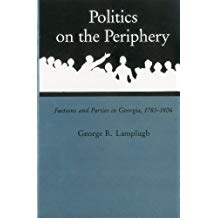
 Rancorous Enmities and Blind Partialities: Parties and Factions in Georgia, 1807-1845 (University Press of America, 2015)

In Pursuit of Dead Georgians: One Historian’s Excursions into the History of His Adopted State (iUniverse, 2015)












 Retired But Not Shy