Life–and Death–on A Cherokee Plantation (In Pursuit of Dead Georgians, 26)

john-quincy-adams-pictureA Review of Tiya Miles, The House on Diamond Hill: A Cherokee Plantation Story. Chapel Hill: The University of North Carolina Press, 2010.

amazon.com

amazon.com

[Note:  Those interested in the history of the Cherokee Nation in Georgia know about the Vann House, or think they do. Yet, historian Tiya Miles has produced a marvelous book that began with a series of questions raised when she visited the “Christmas by Candlelight” celebration there in 2006: “[W]hat is it we are connecting with when we walk the oak halls of this exquisite plantation home—one hundred and seventy years after Cherokees were forcibly removed from the South, one hundred and forty years after African American slaves were emancipated from slavery? What really took place on these well-worn grounds? What does this house stand for?” (xv)  Her answers to these questions challenge many preconceptions about the Cherokee Nation in general and the Vann House in particular.

Chief Vann House

Miles tells the story of the Vann House, its people, and their memories of life there, “from its prehistory, to its heyday and downfall in the 1820s and 1830s, to its restoration and commemoration as the Chief Vann House State Historic Site from the 1950s onward.” (3) Her account  crosses all sorts of methodological boundaries, employing traditional historical tools, as well as  insights from anthropology, oral history, and public history, to illuminate an incredibly complicated story.  Careful readers will never look at the Cherokee experience in Georgia in quite the same way again.]

* * * * *
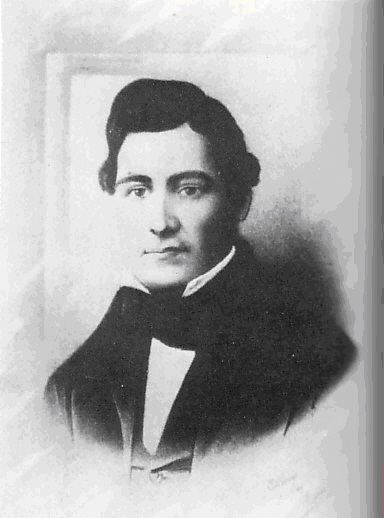
James Vann (tartansauthority.com)

James Vann (tartansauthority.com)

Cherokee entrepreneur James Vann built the first house on Diamond Hill in 1801, a much cruder structure than the current one, and he invited missionaries from the Moravian Church in Salem, North Carolina, to found a Christian mission and school at the site, which they named Spring Place.  Diamond Hill and environs was the center of economic activity for neighboring Cherokee farmers.

Vann lived in the house on Diamond Hill with his mother, Wali; several Cherokee wives, the most important of whom was Peggy Scott Vann; and his children.  James’ favorite son, Joseph (later known as “Rich Joe”) Vann, inherited the home, and his slaves built the famous brick manor house that still survives.

James Vann was murdered in 1809; his wife Peggy Scott died of consumption in 1820, ten years after becoming the first Cherokee to convert to Christianity, thanks to the influence of Moravian missionaries John and Anna Rosina Gambold; and Joseph Vann, the man who actually built what’s today known as the “Vann House,” died in a steamboat accident on the Ohio River in 1844, a decade after he and his family had abandoned Diamond Hill following pressure from the state of Georgia under the so-called “Compact of 1802,” and from the federal government, under the  provisions of the Indian Removal Act.

Sounds pretty straightforward, right? Well it would, had Tiya Miles simply concentrated on the Cherokee residents of the various houses on Diamond Hill, but she chose instead to attempt to reconstruct the relationships among James Vann, Peggy Scott Vann, and their more than one hundred African American slaves.  Miles’ strategy renders the story of “the house on Diamond Hill” incredibly complex, but also immensely rewarding.

* * * * *

James Vann was a nasty man, so much so that no one investigated his murder very thoroughly–it was almost as though the authorities believed James Vann had gotten what he deserved.  During his turbulent career, his abuse of alcohol appalled the Moravian missionaries he had brought to Georgia to provide schooling for the tribe’s youngsters.  Vann also cheated his mother, his sisters, and his wife Peggy out of their property, despite being a member of a tribe organized on matrilineal lines.  Moreover, it wasn’t just real property that Vann appropriated for his own use—and abuse—but also the labor of the African American slaves who lived and worked on it.

To Miles, a critical factor must be added when examining the rise of James Vann:  “the context and culture of U.S. colonialism and concomitant violence.” (32)  Miles argues that James Vann believed “in Cherokees’ collective right to political sovereignty and individual right to human dignity,” even if violence “became his method for pursuing Cherokee freedom, as well as his measure of his standing in social relationships.” (37)  After whites destroyed his father Joseph’s settlement in 1782, James Vann decided to take the Americans on at their own game.  He established a trading post and ferry near the ruins of his father’s business, and he used the labor of black slaves he had inherited, along with others he had wangled from his sisters.  (48-49)

As a result of his drive and his chicanery, James Vann became the wealthiest Cherokee in Georgia, or, as Miles labels him, “a fat cat of the planter elite microculture.” (62)  Although Vann’s economic success helped him rise in the esteem of the Cherokee political elite, the Moravian missionaries at Spring Place were not persuaded of his usefulness. According to Miles, John and Anna Rosina Gambold “had come to Vann’s place to impress their faith on the Cherokees, but they found instead a social world where Cherokee cultural ways persevered and Cherokee community agendas predominated.” (69)

Miles sees James Vann both pushing his own materialistic agenda in ways that brought his tribe’s traditions into conflict with those of their white neighbors, and at the same time “advocating for the Cherokees when they needed a hearing and intervening with the U.S. agents when he saw situations that made Cherokees vulnerable.” (69-71)  Vann began building a new home on Diamond Hill in 1803, yet again demonstrating “his acclimation to—and simultaneous rejection of—the Euro-American colonial presence.” (74)  To Miles, then, the Cherokees’ changing relationship with the United State is a key to understanding what happened to their culture between the end of the American Revolution and the 1830s.

* * * * *

By 1809, the Vann family owned 115 slaves, nearly 20% of the African workforce in the Cherokee Nation. By 1835, “forty-two of the wealthiest [Cherokee] families own[ed] over 525 [slaves], or nearly a third, of the 1,592 slaves in the nation.” (87)  Miles argues that the treatment of the slaves on Diamond Hill in the early nineteenth century suggests that Vann’s plantation shared “core features in common with slave communities across the South.” (92) Yet, among the slaves at Diamond Hill “core aspects of African cultural systems were shared, learned, and preserved.” (97) Moreover, Vann’s slaves “socialized with Cherokee adults of both the poorer and the planter classes.” (105)

Joseph Vann (New Georgia Encyclopedia)

Joseph Vann (New Georgia Encyclopedia)

Following the murder of James Vann in 1809, the Cherokee Council indicated that they disagreed with Vann’s fondness for the Moravian missionaries, ordering that all Euro-Americans leave the Cherokee Nation, though eventually they amended that edict to preserve the presence of a few “useful whites.”  Vann’s widow, Peggy Scott, married Joseph Crutchfield, the white overseer of Diamond Hill. James Vann’s favorite son, Joseph, began to build the brick dwelling that modern Georgians know as the “Vann House”; “Rich Joe” Vann and his family eventually emigrated to Tennessee, and from there to the Arkansas River area during the Indian Removal crisis, thereby ending control of Diamond Hill by the Cherokees. (181-182)

* * * * *

Tiya Miles (amazon.com)

Tiya Miles (amazon.com)

In 2002, an Interpretive Center was constructed on the grounds of the Vann House site. And yet, according to Miles, no attention was being paid “to African-descended slaves or Cherokee women” at that time. (190)  Since then, however, the site’s small but dedicated staff has tried to incorporate information about the lives and labors of Vann House slaves into their public presentations.

By 2005, local white supporters, organized as the Friends of the Vann House, had even raised enough money to purchase 85 acres across the road, preventing that land from being turned into a trailer park development.

Miles sums up her observations after ten years of studying the Vann House:  It “is not an amusement park, not a fantasy farm, not a great escape, but is instead a local and national memorial, a place of suffering for enslaved African Americans and their Cherokee captors.” (197)  The diligent research and interpretive skills of Tiya Miles amply buttress that complicated conclusion.

Not only does the author present members of the Vann family with “warts and all,” but her careful massaging of the scattered evidence available also enables her to offer the reader fairly detailed sketches of a number of individuals in the plantation’s slave community, including Caty, who was born to black parents in the Cherokee Nation; Patience, an African native who survived the “Middle Passage”; Grace, a devout Christian purchased by James Vann from Virginia; and Pleasant, who was pregnant by a white man and was purchased in North Carolina by Anna Rosina Gambold, wife of Moravian missionary Brother John Gambold.  (Anyone interested in how Tiya Miles’ research strategies enabled her to create these sketches from sometimes fragmentary information should read Appendices 1-3, where Miles not only explains her approach but also gives credit to others who compiled some of the information she uses.)

In short, in The House on Diamond Hill, Tiya Miles upends in significant ways what we thought we knew about life among a prominent Cherokee family and the slaves who did the backbreaking labor on their plantation.  And that, as it turns out, is a very good thing, indeed.

____________

For those interested in reading more about Georgia History, here are links to my books on the subject:

REABP CoverRancorous Enmities and Blind Partialities:  Parties and Factions in Georgia, 1807-1845 (University Press of America, 2015)

Pursuit Cover

In Pursuit of Dead Georgians:  One Historian’s Excursions into the History of His Adopted State (iUniverse, 2015)

Politics on the Periphery:  Factions and Parties in Georgia, 1783-1806 (University of Delaware Press, 1986)

Posted in American History, Books, Cherokee Indians, Cherokee Removal, Georgia History, Historical Reflection, History, Southern (Georgia) History, Southern History, Uncategorized | Tagged , , , , , , , | 4 Comments

William McIntosh, Jr. v. Seth John Cuthbert (1788): Historical Problem, 6

[NOTE:  The response to “A Citizen’s” 1784 pamphlet, Cursory Remarks on Men and Measures in Georgia, by the Sheftall family in 1785, criticizing the author as an anti-Semite, seemed at first to have ended the controversy.  Yet, the dispute was resurrected three years later, in the spring of 1788, when Seth John Cuthbert found himself in the crosshairs of “A Citizen’s” foes, especially William McIntosh, Jr., son of Revolutionary hero General Lachlan McIntosh.]

1.  Georgia Gazette (GG), 17 Apr. 1788—a number of documents were printed in the course of a long letter from William McIntosh, Jr, to the editor.  McIntosh claimed that while his father, General Lachlan McIntosh, was defending himself in a legal action brought against him by John Cuthbert, Sr., the General had made statements that Cuthbert’s son, Seth John Cuthbert, publicly labeled “infamous falsehoods.” The younger McIntosh challenged the younger Cuthbert to a duel, but Seth John Cuthbert refused the challenge, arguing that remaining differences should be settled between himself and General McIntosh.  Eventually, the question was submitted to three umpires, but no decision was made, so William McIntosh branded Seth John Cuthbert a coward “by posting him under the Venduehouse” and by publishing their correspondence.  The younger McIntosh opened his letter with a description of Seth John Cuthbert that seemed to move the latter into the realm of the potential author of Cursory Remarks.

According to William McIntosh, Seth John Cuthbert was:

a man habituated to this innocent mode of [newspaper] warfare, who oft has stained his venal pen to gratify the meaner passions, and under fictitious signatures assassinated respectable characters, regardless of either age, sex, or condition, and yet dare not appear to satisfy [by agreeing to a duel] those whom his rancorous heart is base enough to despoil.  Reared up in these habits, it is admitted he excels.  However successful he has been behind the curtain, one ray of light only is necessary to make him shrink from such attempts, and faultering [sic] he retires.

2.   “Correspondent,” GG, 24 Apr. 1788Georgia Gazette editor James Johnston summarized a letter [i.e., he chose not to print it verbatim, probably deeming its content potentially libelous], praising the importance of freedom of the press to the maintenance of free government, but the letter’s author also asserted that the press should not descend from its lofty responsibilities to “the impertinent frivolity of private quarrels and the indecent language of Billingsgate abuse.” [Probably an oblique reference to McIntosh’s letter against Seth John Cuthbert in the previous issue.]  The author claimed that aspersions cast upon a character through the press often failed of their purpose,

by the insignificance of the detractorfor who will regard the clamours [sic] and abuse of one who is himself a reproach to society—whose daily practices are daily violations of government, law, decency, and decorum, and whose situation in society is perhaps so contemptible and desperate as to make life itself burthensome [sic] to him. . .

3.  GG, 1 May 1788—William McIntosh returned, attacking “Correspondent” in the Georgia Gazette’s previous issue.  McIntosh asserted that “Correspondent” soon lost his high moral tone and “slid like the eel into the mire, and in his natural element bespatters all around him with the most scurrilous abuse, far beyond the powers of all the old women of Billingsgate. . . .”  Although such “palpable falsehoods” did not affect him personally, McIntosh claimed that he had learned “that was intended,” so he took the opportunity to reply.  The tenor of his remarks seem to indicate that he believed “Correspondent” was none other than Seth John Cuthbert, although he did not name him—McIntosh repeated the charges in his original letter that Cuthbert was a prolific, if scurrilous, pamphleteer (e.g., Cuthbert would “parry the stabs [of slander] more openly which he attempts giving in the dark, according to his custom”).  William McIntosh asserted that he would not let others fight his quarrels, “covering my own head under a shroud, by every evasion and protection of the laws, or shrink from it like your correspondent, if the object should prove to be as contemptible and insignificant as he is.”  McIntosh admitted that he might have made errors, but, if so, he claimed they were no worse than those “which thousands of the most respectable characters are guilty of. . . .”  For instance, his errors were,

of no injury to any individual of the community, and therefore impertinent even to hint at them; but I never was so despicable a creature as to sacrifice my reputation and honour [sic] to prostitute the most solemn and sacred of vows, or to betray the trust and confidence solicited for, and placed in me by my country, like your correspondent, for the little property he possesses, and afterwards securing that property, and his own dear person, by a criminal neutrality, if not worse, and a connivance with the bitterest and cruelest enemy this country ever had during its greatest distress.  Thus the backbiting treacherous cur, who disturbs the repose of the neighbourhood [sic] by his yelping, is bribed with a crumb, and deserts his duty, ever flying from every appearance of danger himself, and ever prompting others to engage in his quarrels, while the trusty mastiff can be confided in.

4.  GG, 13 November 1788—editor James Johnston published an anonymously-written obituary of Seth John Cuthbert, who had died in Savannah on November 10. The author speaks in verse of

   [Cuthbert’s]pen severe, where glaring vice appear’d,

   Gall’d the struck culprit when her head she rear’d.

   With him the innocent could fondly stray,

   And mark the faults and follies of the day.

   But ah!  too true!  no more shall Cuthbert write,

   No more bring vices of the age to light. . . .

The author of the obituary also mentioned that Cuthbert had been appointed Major in the 2nd Continental Battalion of Georgia in in 1776, and Treasurer of the state in 1784, in which post “he acted with reputation to himself and advantage to the publick [sic].”

* * * * *

We are still not at the end of the trail in identifying the author (“A Citizen”) of the pamphlet Cursory Remarks on Men and Measures in Georgia.  Perhaps we’re close, but  the fat historian has not yet sung.  In the next installment, “Portrait of ‘A Citizen,” I’ll summarize what I believe I’ve learned about “A Citizen.”  Then, in the final part, I’ll tentatively answer the question, “Who Was ‘A Citizen?'”

To prepare for the next post, I suggest that you also review the five previous posts (part 1, part 2, part 3, part 4, and part 5) of this series, taking notes on what you learn about the ideas, history, and character of “A Citizen.”

* * * * * *

For those interested in reading more about Georgia History, here are links to my books on the subject:

REABP CoverRancorous Enmities and Blind Partialities:  Parties and Factions in Georgia, 1807-1845 (University Press of America, 2015)

Pursuit Cover

In Pursuit of Dead Georgians:  One Historian’s Excursions into the History of His Adopted State (iUniverse, 2015)

Politics on the Periphery:  Factions and Parties in Georgia, 1783-1806 (University of Delaware Press, 1986)
Posted in American History, American Revolution, Historical Reflection, History, History Curriculum, Research, Retirement, Southern (Georgia) History, Southern History, Teaching, Uncategorized, WP Long Form, WP Long Read | Tagged , , , , , , | Leave a comment

“The Flags, Daddy, the Flags!”: “Retired But Not Shy” at Six

[NOTE:  I launched Retired But Not Shy: Doing History After Leaving the Classroom a couple of weeks following my retirement, in May 2010, from nearly four decades teaching History in an Atlanta prep school.  I really didn’t know what I was doing, but, as the months—and years—rolled by, I got a firmer grasp of what I might be able to accomplish with the blog, as I strove to “do History” after leaving the classroom.  To remind myself—and my readers—of what I had originally hoped to do, and of what I believed I had accomplished, I have taken time periodically to summarize the previous year or so at Retired But Not Shy.  This is another of those posts.]

* * * * *

"The flags, Daddy, the flags!"

“The flags, Daddy, the flags!”

In the 1970s and 1980s, British journalist Alistair Cooke hosted PBS’s signature program, Masterpiece Theatre.  Each week, the show’s introduction featured a classical music theme and, among other pictures, a montage of flags.  And, each Sunday night at about 9:00, just when the Willowy Bride and I had decided that our boys should be in bed, here came the familiar Masterpiece Theatre theme (we were big fans of the program) and images of those waving flags.  Our guys had seen at least the beginning of Masterpiece Theatre often enough that they knew the music and connected it with the flags, so we’d hear, wafting on the breeze from the boys’ bedroom, “the flags, Daddy, the flags!”  In response, we’d tell them, lovingly of course, “go to sleep, guys,” which actually worked for at least the first few years.

Anyhow, as I’ve been preparing this annual homage to wordpress.com and Retired But Not Shy, I’ve been thinking about those flags on Masterpiece Theatre, largely because the most recent version of wordpress.com’s “stats” page includes a review of the blog’s traffic, including the countries from which “views” have come.  Each national roundup, situated below a world map color-keyed to the countries from which “visits” have emanated, is accompanied by pictures of the flags of those nations.

I guess when you’re “retired but not shy,” it doesn’t take much to grab your interest!

* * * * *

From June 2015 through May 2016, my blog received almost 3700 views from approximately 2700 visitors.  I noticed that, in addition to “visitors” from the United States, I also attracted hits from nearly 50 other nations, including Brazil; the UK; France; Italy; Canada; Russia; Colombia; Ireland; and Australia, among the “Top Ten.”  Now, you may wonder, why would a blog produced in the United States by a historian of the American South draw visitors from such varied parts of the world?

The biggest “draws” from among the 120 or so posts I’ve put up since June 2010 are those about teaching History in a prep school with a PhD; teaching History “backwards”; and various posts on the history of the Blues.  It’s not like I intended (let alone believed) that essays on those topics would have “legs” that would both make them popular in the United States and take them beyond our borders, but that’s what has happened.

A lot of the interest in teaching History in prep school with a PhD, I’m convinced, is directly related to the relative scarcity of college and university-level teaching jobs in the United States for new History PhDs.  Some desperate, frustrated, perhaps even angry, new holders of History doctorates may have taken “temporary” positions abroad in hopes of burnishing their vitas; then, while trolling the Internet looking for hope, they have come upon my post about transforming one’s History PhD, once upon a time the ticket to the ranks of college professors, into a productive career on the secondary school level, in a private, or “prep,” school.  Another likely source of interest in this post is from graduate schools themselves:  trying to be “proactive” in what they realize will be a stressful, perhaps unfulfilling job search for their PhD candidates, grad schools have begun to emphasize that there can be a life–and a career–“beyond the professoriate,” as My Old Grad School likes to say.  (In fact, this popular post originated as just such a talk, which I delivered to History grad students at MOGS a few years ago, then decided to post on this blog.)

As far as “teaching History backwards” is concerned, I confess that the title is, at least in some ways, misleading.  It was mainly a response to remarks by our junior high school principal at the time—and, as an Economics teacher, a member of the History Department at my school—about how much fun it might be to “teach History backwards.”  Eventually, I took him up on the challenge and published the results in the History Department Newsletter, which I then edited.  However, the only course I actually was able to teach “backwards” was a fairly narrow one, the History of the Modern American Civil Rights Movement.  So, those who click on that link in hopes of discovering a sort of “cosmic” plan to “teach History backwards” throughout the curriculum will be disappointed, and I apologize for that.

As for the Blues, I’ve pointed out in other posts that in some ways the Blues (and, I suppose, my posts on them) apparently have been of greater interest to the worldwide fraternity of Blues aficionados than to Blues fans in the United States.  Virtually every month, a number of visitors, quite a few from outside the U.S., sample posts on various aspects of the Blues.  Though what I’m about to say is imprecise, it seems likely that many of those who visit the Blues posts are folks, in Europe and South America mainly, who love the Blues and have discovered that Retired But Not Shy is a place where they can “feed their habit.”  Thank you, one and all!

* * * * *

Between June 2015 and May 2016, I continued to push my “agenda” at Retired But Not Shy, pursuing “dead Georgians” in eight of the twenty-six posts; the history of the Blues, Southern history, and the Civil Rights Movement in others.  In addition, I completed a series of posts on the History of American “republicanism”; offered suggestions for those wishing to “pursue dead Georgian” on the Internet; published an appreciation of my best friend in graduate school, Dr. Arnold M. Shankman, who died of cancer in 1983; and continued to reflect on relations between Georgia and the Creeks and Cherokees, who lived within her boundaries, but whom the white population in the state was eager to evict.

Five of the top fifteen posts over the past year were on the Blues.  Of course, “Teaching in a Prep School with a PhD:  Is It for You?” was numero uno yet again, the gift that keeps on giving at Retired But Not Shy.  Two of the top ten posts were in the “Dead Georgians” series (sketches of antebellum Governors Wilson Lumpkin and George R. Gilmer).  Again, I’m amazed at the popularity of these essays. I keep thinking that I owe a vote of thanks to Georgia History teachers throughout the state who send their students to the Internet looking for information on Cherokee Removal.

And then there was number 10, “High School—Now and Then—Reflections on a Fiftieth Reunion,” the popularity of which remains a mystery to me.  The post grew out of my attendance at the fiftieth reunion of Newark (Delaware) High School’s Class of 1962, coupled with reflections on my employment at a very different, private high school in Atlanta, Georgia, between 1973 and 2010.  I can see how people of a certain age facing their fiftieth high school reunions might click on the link, but I wonder how many of them actually read the piece through to the end.  Still, thank all of you who visited that post; I hope you enjoyed what you read, because it’s one of my favorites!

I also decided that this year I would offer my readers an “historical problem.”  The idea, which certainly should resonate with the veterans of my AP United States History course at “Atlanta’s Finest Prep School,” was to create a sort of “Documents-Based Essay Question [DBQ]” on steroids.  My target was a pamphlet, Cursory Remarks on Men and Measures in Georgia, by “A Citizen” (1784).  This project required that I revisit material I’d abandoned while working on my dissertation more than four decades ago.  I wondered whether any of my readers would be willing to “play along” with me and try to identify the author of Cursory Remarks.  The answer thus far:  not all that many.

Regardless of the interest of my readers in that “historical problem,” working through it for the blog led me finally, after more than forty years, to decide on, at least tentatively, the identity of the pamphlet’s author, a step I had been unable to take while working on my dissertation.  I’m still not sure my answer is correct, but I feel more certain about it now than I did in the 1970s, so that’s something, I guess.

* * * * *

One other memory from an earlier time seems relevant to this post:  During my first stint in the Chair of the History Department at “Atlanta’s Finest Prep School,” I decided to revive the electronic department newsletter.  Aided by our IT folks, I had a great time learning how to use Microsoft Publisher to turn out a pretty neat looking (if I do say so myself!) newsletter every month or so—but there was a problem.  Our school apparently had a sort of “wimpy” computer network.  So, I’d send out a new issue of the History newsletter, wait for responses, and finally learn that a number of the recipients on my “subscription list” had been unable to open my monthly offering!  In fact, trying to do so had “frozen” their computers.  Oops!  So, I’d apologize profusely and drop off a hard copy of the newsletter to those who wanted to receive one.

That isn’t a problem now for me as a blogmeister:  I prepare a post; e-mail folks on my “subscription list” to tell them it’s coming; then publish the thing.   Since Retired But Not Shy is also linked to Facebook, Google+, and LinkedIn, word of the new post appears on those sites as well.  And, at least to my knowledge, no recipient has been unable to open one of my posts.  Once I’ve sent my latest essay into cyber space, I sit back and wait for the “stats” page at wordpress.com to show me how many visitors I’ve had, and from whence they’ve come.

And, as I contemplate the statistics and look at those flags, once more I hear, faintly, my sons calling from their bedroom, “the Flags, Daddy, the Flags!”

"The flags, Daddy, the flags!"

“The flags, Daddy, the flags!”

* * * * * *

For those interested in reading more about Georgia History, here are links to my books on the subject:

REABP CoverRancorous Enmities and Blind Partialities:  Parties and Factions in Georgia, 1807-1845 (University Press of America, 2015)

Pursuit Cover

In Pursuit of Dead Georgians:  One Historian’s Excursions into the History of His Adopted State (iUniverse, 2015)

Politics on the Periphery:  Factions and Parties in Georgia, 1783-1806 (University of Delaware Press, 1986)

Posted in American "republicanism", American History, Arnold M. Shankman, Cherokee Indians, Cherokee Removal, Civil Rights Movement, Creek Indians, Delta Blues, Dr. Martin Luther King, Education, Elias Boudinot, George R. Gilmer, Georgia History, Historical Reflection, History, Interdisciplinary Work, Martin Luther King, Mississippi John Hurt, Newark (Del.) High School Class of 1962, Prep School, prep school teaching with a PhD, Research, Retirement, Southern (Georgia) History, Southern History, Teaching, The Blues, Uncategorized, Wilson Lumpkin, WP Long Read | Tagged , | 4 Comments

The Sheftalls Strike Back: “Mr. Printer” (Two versions, 1785)–Historical Problem, 5

[NOTE:  Parts of “A Citizen’s” pamphlet, which was scattered about the streets of Savannah, Georgia, late in 1784, reeked of anti-Semitism.  Thus, it was no surprise that, early in 1785, the Sheftalls, one of Savannah’s leading Jewish families, responded.  Thanks to the work of dedicated archivists, we can compare two versions of this Jewish response to Cursory Remarks on Men and Measures in Georgia, which might have been produced by different members of the Sheftall family.]

Levi Sheftall (ancestry.com)

Levi Sheftall (ancestry.com)

1.  “Mr. Printer,” from “A Real [Whig] Citizen”–a manuscript in the Sheftall Papers, Keith Read Collection, University of Georgia, attributed by the organizer of the collection to Levi Sheftall. Yet, M.J. Kohler, at the American Jewish Historical Society, also had seen the original draft of this letter and believed the manuscript “is in the handwriting, and was composed by Levi’s brother, Mr. Mordecai Sheftall, of Georgia, in 1785.” (Papers of the American Jewish Historical Society, XVI)  So, I guess you pays your money and you takes your choice. . . .

Version number 1 is the letter found in the Keith Read Collection, and appears, based on the grammatical problems found therein, to have been written hastily and in anger (the published version, whether by Levi or Mordecai Sheftall, number 2 below, is a much more effective argument):

Mordecai Sheftall (geni.com)

Mordecai Sheftall (geni.com)

A Pamphlet, Having been last week circulated about this Town, Under Cover of the Night, Intitled [sic] Cursory Remarks on Men and Measures in Georgia, Evinces me that the Hart [sic] of the Author, is as Base, as his performance is false and Scandilous [sic].  He subscribes himself a Citizen, this Leads me to make an Inquiry, what Intitles [sic] him to so worthy a name, And from the best Information I can gather, I cannot help thinking but that he merrits [sic] more a Halter, from his Country, than the sacred name of Citizen[.]  Let us on this supposition then take a review, of this Heroes [sic] Conduct, during, the late Revolution and we shall finde [sic] that this pretended Citizen, This destroyer of the rights and Prevelidges [sic], of a whole sett [sic] of people, is no other than a Base deserter of his Countrys [sic] Cause, He attributes, to the Jews, the love of lucer [sic], let me ask him was it his abhorence [sic], to property, that caused him after the fall of Charles Town in may [sic] 1780, when his negroes, and other moveable property, was far removed from the Enemy, to cause it, to be brot [sic] back, within the Enemys [sic] Lines, or was it abhorence [sic] to property that caused him (as it is said) to Implore Sir Henry Clinton, for his Majestys [sic] most Gracious pardon, or is it his abhorence [sic] to property that has now made him step forth, the champion of the poor Creekite, or is he afraid [sic] that an Inquiry, should be made into the Character, of his Indian freind [sic], least by such Inquiry, it may appear that, the Creek, and he have been copartners, for it’s Evident that he is too, well acquainted with publick [sic] matters not to know that some time [sic] last summer, a half Breed Indian named Johnny Carnard, and then Citizen in the Creek Nation, sent a Talk to the Governor and Councill [sic] intimating that as it was now peace, he supposed that every body [sic] would be looking for their own [property], and that he had to Inform them, that he had in his possession, nine or ten negroes, belonging to the Inhabitants of this and the Neighbouring [sic] State, which had been stole [sic] from the said Inhabitants—and which he, the said Carnard, had bot [sic—bought] and paid our heroes [sic] Creek freinds [sic] for, No wonder then that he should be so great an advocate for him for if he has not allready [sic] benefitted [sic] by him, no doubt he has it in view but that, at some future day he will be able to prove red is white and then add some of those Gotten negroes to his plantation as the Reward of freindship [sic].

He says he has traveld [sic] with the Jews through a wilderness of History it had been much better for him, had he traveld [sic] as far as the northward, as some of them had  done, and partook his share of the sufferings which they and many other good Whigs sufferd [sic], Rather than basely submit, themselves to becom [sic] tools to the Enemy and Traitors to theire [sic] Country.

A Real [Whig] Citizen

2.  “A Real Citizen,” Georgia Gazette, Jan. 13, 1785:

Mr. Printer,

A Pamphlet having lately with much industry circulated about this town [Savannah], under cover of the Night, entitled Cursory Remarks on Men and Measures in Georgia, shows that the author has been at a great deal of trouble to collect and put together the sufferings and persecutions of the Jews in those days of ignorance and superstition; this has given him an opportunity to show his hatred to those people in nine pages of this masterly piece of learning and wit.  The little countenance it has met with from the public in general must long ere this have convinced him that he might have employed his time to some better purposes.  He subscribes himself a Citizen, this leads me to inquire what the Jew particularly alluded to in that masterly piece has done that he should not also be entitled to the rights of citizenship.  Did he get his property removed from the reach of the enemy, and then cause it to be brought back within the enemy’s lines?  Or did he ever implore Sir Henry Clinton, or any other of the enemy’s Generals, although near two years their prisoner, to obtain for him his Britannick [sic] Majesty’s most gracious pardon?  Or was he even, during the war, ordered by American officers to be put into irons, and sent to headquarters for treasonable practices against the States?  Or did he not, as became a faithful citizen, discharge the several trusts reposed in him?  If he did, why so much spleen, and so much pains taken to put him, and the rest of his profession in this State, on the same footing of an African that deserts his Master’s services?  But, should there be any such characters as described above in Georgia, I leave to the Whigs to judge what they merit from their injured country.

A Real Citizen

And, from Jacob Rader Marcus, The Colonial American Jew, 1492-1776, III (1969), 1301-1302, we learn that, in an era of confiscation and banishment acts,

What could have motivated the Georgians to proceed against Levi Sheftall remains a mystery.  In his autobiography, which he did not write for publication, Sheftall claimed he had taken an active part in the [Revolutionary] war—indeed there had been times when “several guns” were “laded and cocked ready to fire [at] my breast.”  “Every body had there hands and herts full.”  He had worked closely with John Wereat, an agent for a continental “secret committee,” in December 1776, and had later cooperated with [the Comte] d’Estaing and [General Benjamin] Lincoln.  In a personal letter to his brother Mordecai on May 29, 1783, [Levi] wrote he hoped to be rehabilitated; he told Mordecai he had the support of some notable Georgia patriots and had been the victim of delation [i.e., he had been informed against, denounced, accused].  Certainly it is a fact that he had seen service with the Continental forces, been imprisoned by the British as a rebel, and as he stated, lost a substantial fortune because of his devotion to the Whig cause.  By 1785, in any event, the punishments of Levi Sheftall and [Isaac] De Lyon were modified.  Some of their rights were restored, and the financial fines imposed on them were reduced to an amercement [i.e., a fine] of twelve percent, though neither was to vote or hold office for fourteen years.  Two years later all of Levi Sheftall’s rights were restored to him.

In other words, whatever Levi Sheftall”s hopes for redemption despite the charges of disloyalty lodged against him, the Georgia legislature initially classed him with other Georgians believed guilty of collaborating with the British enemy during the Revolution.  It was this legislative punishment that underlay “A Citizen’s” sneering prose in Cursory Remarks.

And yet, within two years of the end of the war, Levi Sheftall’s punishments were reduced, and, two years after that, his full rights of a citizen of Georgia were restored.  So, was the controversy over “A Citizen’s” pamphlet now over?  Not hardly. . . .

[End of Part 5]

* * * * * *

For those interested in reading more about Georgia History, here are links to my books on the subject:

REABP CoverRancorous Enmities and Blind Partialities:  Parties and Factions in Georgia, 1807-1845 (University Press of America, 2015)

Pursuit Cover

In Pursuit of Dead Georgians:  One Historian’s Excursions into the History of His Adopted State (iUniverse, 2015)

Politics on the Periphery:  Factions and Parties in Georgia, 1783-1806 (University of Delaware Press, 1986)


Posted in American History, American Revolution, Historical Reflection, History, History Curriculum, Research, Retirement, Southern (Georgia) History, Southern History, Teaching, Uncategorized, WP Long Read | Tagged , , , , | Leave a comment

Changing Views of the Removal of the Cherokees from Georgia (In Pursuit of Dead Georgians, 25)

[NOTE:  Over the past several years, while researching Rancorous Enmities and Blind Partialities: Factions and Parties in Georgia, 1807-1845 (2015), I read a lot of books on Cherokee removal and the “Trail of Tears,” key events during the years covered in that volume.  These works run the gamut when it comes to their usefulness to the classroom teacher who is trying to help students make sense of Georgia’s treatment of the Cherokees.  So, I thought I’d offer a rundown of some of them, with a few comments of my own, as a way of suggesting how well they might go over in the classroom, or at least how they might serve as a resource for the teacher.  I’ve arranged the list chronologically, in order of publication.] 

* * * * *

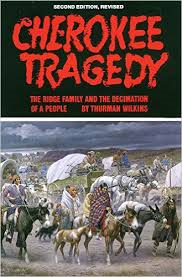
Wilkins, Cherokee Tragedy

Wilkins, Thurman. Cherokee Tragedy: The Ridge Family and the Decimation of a People.  Paperback; 2nd ed., revised. Norman, Okla. Red River Books, the University of Oklahoma Press, 1986 (1st ed., 1970). As the subtitle suggests, this is the story of Cherokee removal and the “Trail of Tears” through the eyes of Major Ridge and his son John Ridge. Well-researched, clearly written, and more even-handed than the subtitle might suggest.  And, as a paperback imprint of Red River Books, this volume should be readily available.

* * * * *

Ehle, Trail of Tears

Ehle, John. Trail of Tears: The Rise and Fall of the Cherokee Nation. Paperback; New York: Anchor Books, 1988.  I found this work frustrating, and occasionally infuriating. Ehle seems to be writing as a novelist, or at least for the stereotypical “general reader.” He only cites sources for direct quotes, and many of those are taken from other secondary works on the topic. But, if you’re interested in “story” rather than “history,” this might be the book for you.  In fairness, it is engagingly written; the chronological scope runs from the birth of Major Ridge (c. 1771) through the Trail of Tears (1838-1839); and an epilogue carries the story to the end of the Civil War, at least in a sketchy way.

* * * * *

Perdue, Boudinot

Perdue, Theda, ed. Cherokee Editor: The Writings of Elias Boudinot. Paperback; Athens, Ga., and London: Brown Thrasher Books, the University of Georgia Press, 1996. A wonderful compilation, not least because the editor demonstrates consummate skill in selecting important editorials from the Cherokee Phoenix, along with Boudinot’s more propagandistic efforts (e.g., An Address to the Whites; and his controversial pamphlet, Letters and Other Papers relating to Cherokee Affairs: Being a Reply to Sundry Publications Authorized by John Ross); as well as a few of Boudinot’s contributions to other contemporary American periodicals. Also not to be missed: Perdue’s 35 page biographical introduction; no fan of Boudinot, the editor’s closing assessment of the man is thoughtful, yet devastating.  And, because this is an imprint of Brown Thrasher Books, it should be available for years to come.

* * * * *

Garrison, Legal Ideology of Removal

Garrison, Tim Alan. The Legal Ideology of Removal: The Southern Judiciary and the Sovereignty of Native American Nations.  Athens, Ga., and London: University of Georgia Press, 2002. Garrison views the work of the southern courts in Georgia, Alabama, and Tennessee as crucial in creating the legal justification for Indian removal, which, once developed, enabled southern states, especially Georgia, to ignore the rulings of the United States Supreme Court involving the Cherokees. The cases he examines grew out of decisions by southern states to extend their laws over territory claimed by the Cherokees within their borders.  Garrison explicitly shifts the focus of the removal controversy to state courtrooms, away from the famous clash of President Andrew Jackson and various Georgia governors with Chief John Ross of the Cherokees, which makes the volume pretty dry.  This one’s for teachers, not for high school or college students.

* * * * *

Perdue and Green, Cherokee Removal with Documents

Perdue, Theda, and Michael D. Green. The Cherokee Removal: A Brief History with Documents.  Paperback; 2nd ed. Boston & New York: Bedford/St. Martin’s, 2005. Just what it says: the history covers about 25 pp., documents about 160 pp. Also includes chronology and serviceable index.  This text is perfect for the classroom, especially if used in conjunction with readily available primary sources on the subject (see NOTE below).

* * * * *

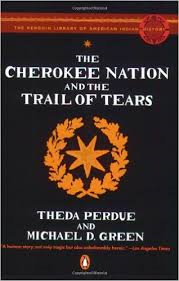
Perdue and Green, Cherokee Removal and the Trail of Tears

Perdue, Theda, and Michael D. Green. The Cherokee Nation and the Trail of Tears. New York: Viking, 2007. Short (164 pp. of text), hardback volume in the “Penguin Library of American Indian History.” Another fine selection for the classroom.  A concise treatment of the topic, with no primary sources included (i.e., it’s like an expanded version of the 25-page history of Cherokee removal offered by Perdue and Green in the preceding volume, but with none of the documents that might help bring the issue to life).  Considering both cost and the approach adopted here, I recommend the preceding Perdue/Green volume from Bedford/St. Martin’s over this one.

* * * * *

Langguth, Driven West

Langguth, A.J. Driven West: Andrew Jackson and the Trail of Tears to the Civil War. New York: Simon & Schuster, 2010. A strange yet readable volume by a popular historian, Driven West tries, with mixed success, to place Indian removal within the concept of Manifest Destiny and, by extension, within the struggle over slavery in the territories that led to the Civil War. Langguth traces the story using chapters focused on both prominent white American figures (Henry Clay through John Tyler) and Native Americans (Sequoyah through Stand Watie). Overly ambitious, but accessible.

* * * * *

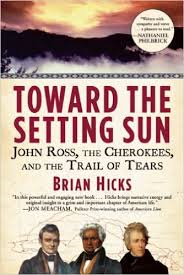
Hicks, Toward the Setting Sun

Hicks, Brian. Toward the Setting Sun: John Ross, the Cherokees, and the Trail of Tears. New York: Atlantic Monthly Press, 2011. Cherokee removal set within the rivalry between Andrew Jackson and John Ross. Very harsh on the “Treaty Party,” whose members signed the Treaty of New Echota in 1835, describing them as “a group of renegade Cherokees, hungry for the money promised for their land if they relocated beyond the Mississippi, [who] joined forces with Jackson’s men on a removal treaty.”  But, for balance, one also needs to consider Daniel Blake Smith’s An American Betrayal:  Cherokee Patriots and the Trail of Tears (see below), which tends to support the members of the “Treaty Party” over the Ross faction.

* * * * *

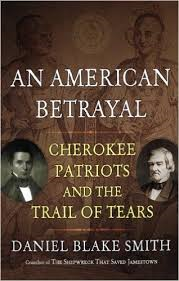
Smith, An American Betrayal

Smith, Daniel Blake. An American Betrayal: Cherokee Patriots and the Trail of Tears.  New York: Henry Holt, 2011.  Once more, Andrew Jackson is the villain, but the “Cherokee Patriots” in the subtitle are none other than the members of the “Treaty Party” who signed the New Echota agreement (1835), with special emphasis on John Ridge and Elias Boudinot.  Smith’s treatment needs to be compared with that by Hicks, above.

* * * * *

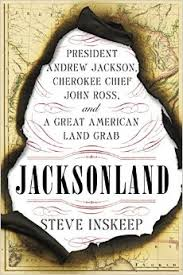
Inskeep, Jacksonland

Inskeep, Steve. Jacksonland: President Andrew Jackson, Cherokee Chief John Ross, and the Great American Land Grab.  New York: Penguin Press, 2015. As the subtitle suggests, Inskeep casts his tale, like Brian Hicks above, as the product of the rivalry between two former allies, Andrew Jackson and Cherokee Chief John Ross (during the Creek War that culminated in the epochal Treaty of Horseshoe Bend in 1814), who dueled for over a quarter of a century about whether the Cherokees would be allowed to remain in what Inskeep dubs “Jacksonland.” Jackson is clearly the villain here, but Inskeep paints his villainy in soft, muted colors; Ross is the hero, though, again, the author does not enlist in his cause uncritically.

I especially enjoyed Inskeep’s treatment of the part ultimately played by Georgia’s infamous Yazoo Land Fraud in Indian removal (see here and here), which goes off in some surprising directions but makes sense nonetheless. Moreover, Inskeep’s handling of the greedy, arrogant, quick-tempered Georgians who made life so difficult for Ross and the Cherokees is admirable, says one who’s been studying them for almost five decades.  This work also includes the best explanation of the motives of the leaders of the Treaty Party that I’ve seen, again without validating their position. A thoroughly delightful read about a complex, depressing subject.

* * * * *

One thing that comes through in reviewing these volumes is that there has been a decided shift in trying to explain Cherokee removal over the last half century or so–the first edition of the Wilkins book was published in 1970.  In the works examined here, unlike in earlier works, there is no real effort to exculpate President Andrew Jackson for his role in the Cherokee removal controversy:  the attitude is, more or less, he’s white, he’s President, he’s southern, he’s a slaveholder, so what more could you have expected?

On the other hand, there is still a serious historical debate when it comes to apportioning blame among Cherokee leaders. Was John Ross’s stubborn resistance to removal noble, or was he simply being unrealistic in the context of 1830s America?  Were the leaders of the “Treaty Party” a bunch of “Uncle Tom-Toms,” or were they the ones who saw the future most clearly and attempted to pull the Cherokees in the “right” direction, only to lose their lives as a result?  These are not easy questions for the classroom teacher, nor for his/her students, to answer, but grappling with them is certainly worth the struggle.

* * * * *

[NOTE:  Please remember that using one or more of the works discussed in this post should not be the only source(s) a teacher employs to help his/her students make sense of the events leading up to the “Trail of Tears.”  Any teacher worth his/her salt will want to incorporate primary sources into such a study.

For example, Georgia newspapers of the period, many of which are available online, would be wonderful supplements to whichever secondary source(s) a teacher elects to assign.  In addition, I have posted on this blog a two-part essay on the Cherokee Phoenix and its role in covering the Indian Removal crisis from the perspective of the Cherokees that is sympathetic to Phoenix editor Boudinot and other leaders of the “Treaty Party” (see here and here).

Please bear in mind that I’m not offering my effort in explaining the coming of the “Trail of Tears” as the be all and end all.  The blog posts on Boudinot and the Cherokee Phoenix, and those on the Yazoo Land Fraud, noted above, sketch my interpretation; for additional details and deeper context, see Rancorous Enmities and Blind Partialities.  Still, working through the Cherokee Removal issue enabled me to approach the topic in that book with some degree of objectivity, and without having to ram my head into the nearest wall, metaphorically or otherwise.]

* * * * * *

For those interested in reading more about Georgia History, here are links to my books on the subject:

REABP CoverRancorous Enmities and Blind Partialities:  Parties and Factions in Georgia, 1807-1845 (University Press of America, 2015)

Pursuit Cover

In Pursuit of Dead Georgians:  One Historian’s Excursions into the History of His Adopted State (iUniverse, 2015)

Politics on the Periphery:  Factions and Parties in Georgia, 1783-1806 (University of Delaware Press, 1986)
 

Posted in "Cherokee Phoenix" (newspaper), American History, Books, Cherokee Indians, Cherokee Removal, Chief John Ross (Cherokees), Civil War, Georgia History, Historical Reflection, History, History Curriculum, Research, Retirement, Southern (Georgia) History, Southern History, Teaching, Uncategorized, WP Long Form, WP Long Read | Tagged , , , , , , , | Leave a comment

“A Citizen,” “Cursory Remarks on Men and Measures in Georgia” (1784): Historical Problem, 4–The Pamphlet

“A Citizen,” Cursory Remarks on Men and Measures in Georgia. N.p., 1784.  Microprint:  American Antiquarian Society, Worcester, Mass.  30 pp.

[NOTE:  If you have read the previous posts in this series, you know that you have embarked on an “historical problem,” the goal of which is to identify the pseudonymous author of Cursory Remarks on Men and Measures in Georgia (1784).  This thirty-page pamphlet, which was published in Savannah late in 1784, actually had its genesis almost a year earlier.  Moreover, the pamphlet was intended to answer criticisms leveled against “A Citizen’s” first newspaper essays by a writer signing himself “Brutus.”  What follows is a synopsis of Cursory Remarks, along with excerpts from a couple of interesting responses.]

* * * * *

“A Citizen” decried the “baneful influence of an interested and designing faction” in  Georgia’s affairs.  Factionalism had been present in the state for several years; now there were two parties:

On the one hand we behold a most powerful combination of individuals zealously embarked in the scheme of advancing their private fortunes on the ruins of every thing [sic] that is dear and valuable to the community.  On the other we observe a more virtuous, though a less active set of citizens, opposing such views, and counteracting knavery and vociferation with reason and argument. . . . [W]hatever seems best calculated to create distrust and jealousy against those whose fortunes offer a security for confidence, and whose private characters command respect and esteem, is most industriously propagated. . . . (2)

Members of this nefarious “confederacy of citizens” were governed “by no considerations but those of lucre,” and they have been deserted by “every man of honor, virtue, or property,” until “they stand the sole champions of their own disgraceful undertaking.” (2)  The dispute is between those who have purchased confiscated propertywithout any intention or means of paying and others of the same complexion, and those who may or may not have purchased, but who nevertheless mean the thing that is just and right towards the publick.” (3)  “[T]he men who make the most noise and pother against the law [making distinction between certificates and specie in paying for their purchases], because it does not allow them to pay the whole of their bonds in [worthless] certificates, are those who have not paid the half they might have in that way, although the time allowed for such purpose has run out.” (4)

One of the “principal heroes of this confederacy [probably Richard Howly]” is “in the full and indisputed [sic] possession of that kind of subtle midnight cunning which formed a Mississippi scheme, or a South Sea bubble, more the result of a bad heart, and a plodding temper than the characteristick [sic] of genius. . . . [T]he other, versed in all the little tricks of life, having passed through the different gradations from the lowest mechanick [sic—George Walton began his career in Virginia as a carpenter] to the highest law officer, finds it as easy to explain away a forgery [Speaker William Glasscock’s signature on the anti-McIntosh petition during the Revolution] as to assassinate a character.” (4-5)

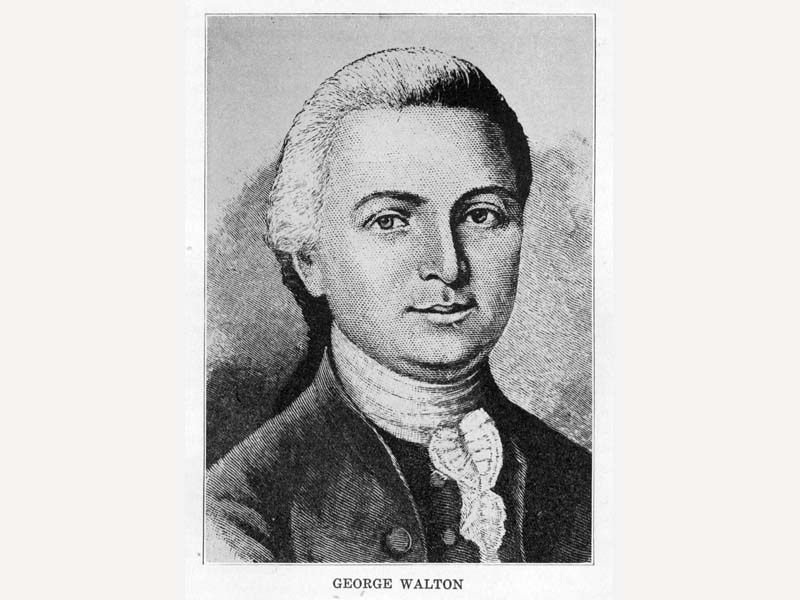
George Walton

George Walton

“A Citizen” charged that Chief Justice Walton used the power of his judicial office to secure fifty-three slaves from a relative who had been banished for Loyalism during the Revolution.

Governor John Houstoun (wikitree.com)

Governor John Houstoun (wikitree.com)

This redoubtable duumvirate lately, under the signature of Brutus, (two in one, like man and wife) made a most angry attack upon the conduct of the present Administration [of Governor John Houstoun in 1784]but failed.”  (5)  On the eve of the election, the author wrote that voters must become acquainted with “characters,” and  tried to remove the stain of the charge of “Toryism” evidently being leveled against their political opponents by Walton and Howly, in an attempt to deter worthy men from offering their services to the state.

Although conceding that government originated with the people, “A Citizen” maintained that “the people” must not attempt to administer the government themselves, for that would lead to the tyranny of the mob and, eventually, to the tyranny of the individual.  He contended instead

that . . . the only use a wise people will make of such power is, at certain stated periods, to elect or appoint fit persons for their rulers; after such appointments, to invest them with a confidence equal to the trust they are charged with; to protect them against the tongue of slander, and the arts of designing men, when they do right; and to punish them, in a regular and constitutional way, if they do wrong. . . .”  (7)

Next, “A Citizen” turned to a discussion of Georgia’s current financial situation.  To meet obligations to Congress, the House of Assembly had passed a law on July 29, 1783, declaring that funds were to be raised, and obligations met, out of the sale of confiscated property.  But, the author asks, how can that work

whilst, on the one hand, it is part of a system with some not to pay without being sued, and, on the other, we have for our C[hief] J[ustice] a man who is himself among the deepest in the publick [sic] books [i.e., George Walton]?”  (8)

This explained two presentments published in the Georgia Gazette’s account of the Chatham grand jury’s October session (Oct. 14, 1784), according to “A Citizen”:

[T]he great delay which too frequently happens in the business of the Court, whereby persons attending as Jurors are detained from their homes for a much longer time than would otherwise be the case, were a closer attention on the part of the Court paid to the business;” and “[T]he increase of trifling causes, to the disgrace of the county where such causes are litigated, and to the injury of those who are obliged to attend them.

“A Citizen” complained, in other words, that, under Chief Justice Walton, justice in Georgia was neither cheap nor speedy.  Yet, according to the author, the Chief Justice received more than his due, the other court officers less, and Walton’s justification for his higher fee was singularly unconvincing   (8-12)

The writer believed that there was considerable inconsistency between charges presented by the Chief Justice to the Richmond County grand jury (where Walton lived) in March 1784, and those presented to the Wilkes County grand jury in November.

March 1784 [Richmond]:  “Many cogent reasons concurred to induce me to suggest to the Grand Juries in the counties through which I have already rode the expediency of revising our Constitutions:  as I speak to men of intelligence it is sufficient only to mention it—if with harmony and temper you can go into the consideration of the subject so truly important to us all, I hesitate not to recommend it to you.”  (15)

November 1784 [Wilkes]:  “The Constitution of our country [i.e., Georgia] contains the principles of liberty, which by attention may be improved into a basis on which the happiness of the community may rest with security—the time however for any kind of alteration is not yet arrived.” (15)

“A Citizen” labeled as “highly censurable” a recent decision by Chief Justice Walton that freed a defendant named Fox, “a native and citizen of Georgia, who stood charged with murder,” on the grounds that “he was not bound by any law of this state previous to the Definitive Treaty of Peace.” (16-17)

The author attributed the action of the Court not to “a spirit of forbearance and mercy,” but to favoritism:  “[W]hen it is beyond contradiction, that the gentle usage this prisoner met with sprung entirely from the part his connexions, and their connnexions again, have acted, and continue to act, on the little scale of politicks, it is too much for any man of spirit, sense, or justice, to tolerate it in a free country.” (18)

“A Citizen” next turned to a case in which Walton’s court supported, two to one, a Jewish defendant who was being sued by a Native American.  The author examined the rights due an Indian and those of a Jewish defendant in Georgia and claimed to find that the Native American probably had more of a right to sue in the Court than did the Jewish citizen.

According to “A Citizen,” the Jews were “a people whose increase in any country is at once a compliment and a reflection upon it; a compliment upon its natural advantages, but an implied censure upon its moral system or administration of government.”  (21)  Moreover, he claimed,

the Jews now-a-days enter very little into politicks [sic] further than to favour [sic] that system which is most promotive of their pecuniary interest, the principle of lucre being the life and soul of all their actions.” (22)  The  Georgia constitution, he averred, promised Jews nothing more than “a mere religious privilege; not a word in the whole clause, by the most forced construction, can be made to signify a grant of any civil rights whatever.” (24)

Yet, “A Citizen” also denied that his diatribe was designed “to stir up a spirit of intolerance against that dispersed and unhappy people.” (24-25)  Rather, their own acts had elicited his response:

“[W]hen we see these people eternally obtruding themselves as volunteers upon every publick [sic] occasion, one day assuming the lead at an election, the next taking upon themselves to direct the police of the town, and the third daring to pass as jurors upon the life and death of a free man, what are we to expect but to have Christianity enacted into a capital heresy, the synagogue become the established church, and the mildness of the New Testament compelled to give place to the rigour [sic] and severity of the Old?” (26)

What of the argument that the blame rested upon “our Christian officers” for allowing Jews to push their pretensions so far?

All this I will in some measure grant, but, at the same time, desire leave to remind these people they stand exceedingly in their own light, when they venture so far under the auspices of any one man, especially an officer [i.e., Chief Justice Walton] whose office, and in all probability whose consequence, will expire with the year,” when his term ended.  (26)  “Had [Walton] any feeling, he must be convinced his conduct is not approved of by the country:  the very common compliment of thanks [from the grand juries] for his charge is withheld in all the last presentments that I have seen; and no wonder, when the main scope of such charges was to stir up parties and dissensions throughout the land. . . .” (27)

Finally, “A Citizen” discussed the anticipated income from sales of confiscated estates, as against probable state expenditures:

There are, I believe, many and great demands still remaining against these estates; what channel they will next be thrown into for liquidation and settlement I am unapprised of; in my judgment there can be none so proper, or conducive to the pubick [sic] good, as that of the Auditor [John Wereat].  Could the gentleman who has nearly gone through the Herculean task of auditing and arranging the other accounts of the state be prevailed upon to undertake this, I am persuaded it would diffuse general pleasure.  To the honour of this Officer let me bear testimony, as far as I have had an opportunity of observing, that, even under the disadvantage of an infirm state of health, the effects of his zeal, fidelity, and abilities, have been conspicuous:  Whilst, on the one hand, he had done ample justice, under the article of savings, to his country, on the other, he has had the singular fortune to render satisfaction to the individuals concerned.  For him it was reserved to bring forth order from confusion, and to reduce the chaos of claims into a system of accounts.”  (29-30)

* * * * *

[Addenda]

GG, 30 Dec. 1784—obituary of Richard Howly, AND what appeared to be an oblique reference to “Cursory Remarks”: “A correspondent observes, that a pamphlet scattered about the streets, reminds him of the confused and ineffectual attacks made by a snake, after his teeth have been pulled out.”

GG, 6 Jan. 1785—“A Constant Reader” demanded, according to the editor, that the “Correspondent” in the previous issue explain the wit concealed in the parable of the toothless snake.

* * * * *

The time has come to begin trying to place “A Citizen’s” views into the context of the post-Revolutionary years in Georgia.  Which side in the argument does he seem to favor?  Do you have any idea, at this point, of who “A Citizen” might be?

The pieces in the Georgia Gazette in late December 1784 and early January 1785 were just the beginning of the controversy stirred up by the author of Cursory Remarks, as we’ll see next time.

[End of Part 4]

* * * * * *

For those interested in reading more about Georgia History, here are links to my books on the subject:

REABP CoverRancorous Enmities and Blind Partialities:  Parties and Factions in Georgia, 1807-1845 (University Press of America, 2015)

Pursuit Cover

In Pursuit of Dead Georgians:  One Historian’s Excursions into the History of His Adopted State (iUniverse, 2015)

Politics on the Periphery:  Factions and Parties in Georgia, 1783-1806 (University of Delaware Press, 1986)
 

Posted in American "republicanism", American History, American Revolution, Georgia History, Historical Reflection, History, History Curriculum, Research, Southern (Georgia) History, Southern History, Teaching, Uncategorized, WP Long Read | Tagged , , , , | Leave a comment

Blues Masters from the Delta (Blues Stories, 21)

 john-quincy-adams-pictureA Review of Ted Gioia, Delta Blues: The Life and Times of the Mississippi Masters Who Revolutionized American Music. New York: W.W. Norton & Company, 2008.

amazon.com

amazon.com

[NOTE: Once upon a time,  I hoped to write a book on the origins of the Blues in the Mississippi Delta, “the land where the Blues began” (Alan Lomax). And then I read this one.]

* * * * *

 In the eyes of Ted Gioia, the Mississippi Delta was “a Third World country . . . abandoned in the heart of the United States, left to fend for itself.” (2) And the results have not been pretty:  Mississippi in general, and the Delta in particular, have been among the poorest, most backward areas in the country for more than a century.

And yet, by way of Africa, out of the Delta came the African American musical genre called the Blues, which has had a tremendous impact on the evolution of American musical culture, for reasons that, in some respects, still remain a mystery.  In Gioia’s view, though, “Perhaps the outsider was best capable of giving expression to what was destined to become the mainstream reality, to the emotional landscape of a world in which no ties held fast, no ground remained firm underfoot, no certainties stood unquestioned.” (16)

Blind Lemon Jefferson

Taming the land in the Delta required strenuous physical labor, aided by work songs, as well as songs sung during workers’ off times that eventually evolved into commercial performances—from minstrel and medicine shows to juke joints. By the late 1920s, this music had begun to produce performers like Blind Lemon Jefferson, Ma Rainey, Charley Patton, and Tommy Johnson, with Robert Johnson and Muddy Waters waiting in the wings.

Charley Patton

Charley Patton

The next step was to transfer the Blues to phonograph records, and to live performances “hyping” said records, which introduced the Delta and the rest of the nation to performers like Bessie Smith, Son House, Skip James, and Ishmon Bracey, thanks mainly to white promoters like Henry Speir.  The most successful of these early Blues artists was probably Charley Patton, though he never really broke out of the Delta to greater stardom; that would be left to the likes of Muddy Waters, Howling Wolf, and Bessie Smith.

Son House

Son House

Blues performers were pulled between spiritual and secular forces, as is illustrated most clearly in the career of Son House. Though his records didn’t sell all that well before World War II, House had a tremendous influence as a sort of mentor to any number of other performers.  Gioia argues that House “represents the single most important figure linking together the various strands of the Delta tradition,” despite the fact that he was “merely a part-time performer, who could put aside the guitar for months or years with few regrets.” (81)

Doing time in Mississippi’s awful Parchman Farm penitentiary, Son House, like Booker Washington (“Bukka”) White, eventually was able to capitalize on his incarceration, positioning himself, with the help of John and Alan Lomax, as a sort of prototypical Blues performer. And both House and White would be “rediscovered” during the Blues Revival of the 1960s that also helped link the legacy of the Blues to the birth of rock and roll.

elijahwald.com

elijahwald.com

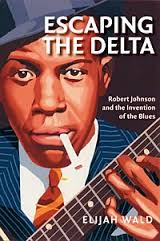
Like Elijah Wald, in Escaping the Delta: Robert Johnson and the Invention of the Blues, Gioia emphasizes the versatility of Johnson’s generation of Blues players, who were willing—and able—to play any tunes audiences wanted to hear, Blues or not.  Whatever their skill sets, Blues players of the 1920s and 1930s were adversely affected by the Great Depression, which killed off the “race record” industry and drove now unemployed black performers in various directions, looking for salvation wherever they could find it.

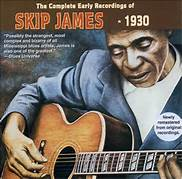
Skip James (skip-james.png)

Skip James

And yet—there was Skip James, he of the incredibly distinctive voice, who managed to hook up with promoter Henry Speir in 1931 and fulfilled the need, already perceived by Speir, for “a unique poet visionary who would take the next steps, and channel the energies and potentialities of the blues into true art song.” (136)

Like many Blues performers, Skip James was troubled by the negative views of the Blues prevalent in black religion; unlike more “flexible” Blues performers, though, James actually left the Blues altogether, joining his father’s religious ministry.  According to Gioia, “James would hardly find a real calling, religious or secular, until he was rediscovered as a blues singer in the 1960s.” (147)

Robert Johnson

Robert Johnson

Any Blues fan realizes that a key figure in the early history of the Delta Blues was Robert Johnson, and Ted Gioia is certainly no exception. He distances himself from those scholars who claim to know a lot about Johnson, especially the famous story of Johnson’s meeting with the Devil at “the Crossroads.” Sure, some of Johnson’s songs suggest just such a meeting, but Gioia seems to agree with those Johnson biographers who conclude that “The historical evidence [for a meeting between Johnson and Satan] is tainted by hearsay, dubious research, compromised methodology, and questionable reporting.” (162)

According to Gioia and the sources he draws on, there is a good chance that Robert Johnson himself spread that story about the meeting at the Crossroads.  Besides, the Johnson story takes us back to the split between the Blues and religion that was pervasive in the Delta.  According to Ted Gioia, then, “before his twentieth birthday Johnson had embraced the musician’s life with a vengeance, had started on his ramblin’ ways, and had adopted an attitude that was, at best, devil-may-care and, at worst, hell-bent on self-destruction.” (169)

John Lomax’s son Alan played an important part in the transference of the Blues into the post-World War II world. Visiting the Delta in the early 1940s, he and scholar John Work of Fisk University “discovered” McKinley Morganfield (AKA Muddy Waters) and also came into contact with David “Honeyboy” Edwards, who would become one of the most frequently-cited “primary sources” on the Delta Blues during the 1960s Blues Revival.

David "Honeyboy" Edwards

David “Honeyboy” Edwards

And, of course, both Muddy and Honeyboy were caught up in the tumult of the “Great Migration,” between World War I and World War II, when African Americans fled the South in huge numbers, searching for economic and political opportunities.

Muddy Waters

Muddy Waters

Muddy Waters’ career in Chicago gave him the opportunity to succeed, but, according to Gioia, in the long run he had difficulty escaping the Delta: “Waters had spent three decades of his life in the paternalistic environment of the Southern plantation, and the Chess [record] label filled much the same role in his life for an almost identical length of time.” (228-229)

John Lee Hooker

John Lee Hooker

Another fugitive from the Mississippi Delta, John Lee Hooker, “lived long enough to be celebrated by ravenous electronic media.” (234) Perhaps the wisest thing Hooker ever said came in a 1964 interview:  “I know why the best blues artists come from Mississippi.  Because it’s the worst state.  You have the blues all right if you’re down in Mississippi.” (238)  Assessing Hooker’s legacy following his death on June 21, 2001, Gioia argues that “the sheer global breadth of Hooker’s lineage in unlikely to be matched by any future blues artist.” (270)

Howlin Wolf

Howlin Wolf

Chester Burnett, AKA Howlin’ Wolf, was another fugitive from the Delta who had a significant impact on the development of both the Blues and rock and roll. Mentored on guitar by Charley Patton and on the harmonica by Sonny Boy Williamson II (Rice Miller), Burnett traveled and performed with the likes of Robert Johnson, Son House, Honeyboy Edwards, Johnny Shines, and Jimmy Rogers.

By the time he moved to West Memphis, Arkansas, in the 1940s, Wolf had “surrounded himself with a cacophony of amplified sound that might well make the walls shake, but his voice cut through the clash and clang, in all its sinuous and abrasive beauty.” (284)  Gioia contends that Wolf’s success probably reflected a reaction against the slickness of other forms of popular music.  Like a lucky handful of his generation of Blues players, Wolf was “rediscovered” in the ‘60s.

By the middle of the 20th century, according to Gioia, there was a musical paradox:  “[H]ow could a style of performance captivate one set of fans for its evocation of old-time ways, and impress another group as a blueprint for new sounds and attitudes never before seen?” (309)

B.B. King

B.B. King

A key figure here was B.B. King, a product of both the “Great Migration” and the move he made to Memphis, Tennessee, whose music scene “can stake a valid claim as the pathway by which this country-bred music was channeled into the wider streams of global pop music.” (322)  Until the mid-1960s, though, King seemed destined to continue endless tours on the Chitlin’ Circuit.  Eventually, however, came the move to the ABC record label, his appearance at the Fillmore in San Francisco in February 1967, and the crossover impact of his great tune, “The Thrill is Gone.”  The rest, as they say, is Blues history. . . .

In his final chapter, Gioia examines the Blues Revival, a wonderful story that deserves–and now has–a book of its own. Gioia even likens that musical rebirth to “the great religious revivals of the past.” (350—the “Great Awakening,” anyone?)  A lot of the books published in the ‘60s simply berated modern America for all the great music they’d missed over the previous generation.  Yet, Gioia’s emphasis here is strongly on the “rediscovery” of “Bukka” White, Skip James, and, especially, Son House.  The rest of his treatment of the post-1960s Blues scene is pretty downbeat, what with all the old Blues guys dying, yet Gioia refuses to abandon the possibility of a resurgence of fresh Blues talent from the modern Mississippi Delta.

* * * * *

Ted Gioia’s study of the history, music, and culture of the Mississippi Delta is a work of lasting significance, beautifully written, well-illustrated, and rightly skeptical of some of the hoariest “received wisdom” about the history of the Blues.  It belongs in the libraries of Blues fans in general and aficionados of the Delta Blues in particular.

______________

I write about history at greater length in the following books:

REABP CoverRancorous Enmities and Blind Partialities:  Parties and Factions in Georgia, 1807-1845 (University Press of America, 2015)

Pursuit Cover

In Pursuit of Dead Georgians:  One Historian’s Excursions into the History of His Adopted State (iUniverse, 2015)

Politics on the Periphery:  Factions and Parties in Georgia, 1783-1806 (University of Delaware Press, 1986)


Posted in "Charley Patton", Age of Jim Crow, Alan Lomax, American History, B.B. King, Bessie Smith, Books, Chicago Blues, David "Honeyboy" Edwards, Delta Blues, History, Howlin' Wolf, John Lee Hooker, Muddy Waters, Popular Culture, Retirement, Robert Johnson, Son House, Southern History, The "Great Migration", The Blues, Uncategorized | Tagged , , , , , , , , | 2 Comments

The “Brutus Letters” (1784)–and a Note on Purchasers of Confiscated Property: Historical Problem, 3

[NOTE:  Beginning in the summer of 1784, Chief Justice George Walton, apparently with aid from his Revolutionary associate, Richard Howley, launched a series of letters in the Georgia Gazette attacking the administration of Governor John Houstoun for being, essentially, “soft on Tories.”  Here I summarize the most important of the “Brutus” letters, along with a few responses to them.  It was these letters that led “A Citizen” to issue his pamphlet, Cursory Remarks on Men and Measures in Georgia, at the end of 1784.]

“Brutus” no. 1GG, 8 July 1784—attacks Governor Houstoun’s proclamation of 18 June as “an edict more formidable than any since the celebrated declaration of this day [July 4th] eight years [ago?].”  “Brutus” claims that Houstoun’s proclamation regarding Georgia’s boundary dispute with South Carolina and the presence in the area of Spanish subjects allied with Indians puts South Carolinians and Spaniards on a footing with savages, so Governor Houstoun is asking for trouble. [See GG, 1 July 1784, for the text of the Governor’s proclamation.]

“Brutus” no. 2GG, 15 July 1784—the author describes himself as “one of those who first espoused the cause of America, and went through all its vicissitudes of service, of suffering, of danger and expence.”  Next, he demonstrates what he sees as the influence of Tories in House of Assembly in the administration of Governor John Houston, who has decided to extend mercy to them through the amercement policy, by which they could be relieved of their burdens by paying a fine.

“Brutus” no. 3, GG, 22 July 1784—the author attacks British merchants who have been permitted to reside and trade in Georgia, aided by Governor Houstoun, to the distress of local merchants.  Yet, Chief Justice George Walton has decided in favor of local merchants, against the efforts of the Governor and his British merchant allies.  To circumvent the Chief Justice’s heroic efforts to block them, local “Tory” merchants have succeeded in having public real estate sold at auction to satisfy their debts!  Imagine, “Brutus” huffs, using public lands to pay off creditors rather than the poor but noble soldiers who carried the new nation through the Revolution!

“Brutus” no. 4, GG, 29 July 1784—in light of Georgia’s pressing problems, “Brutus” is appalled that Governor Houstoun has not yet called a meeting of the legislature.  The author is especially critical of Houstoun’s unwillingness to appeal the South Carolina boundary dispute to the Continental Congress, as allowed under the Articles of Confederation.

[This installment was probably written by Richard Howley—according to the Executive Council Minutes, 21 July 1784, a paper (“in the nature of a remonstrance”) against delay in calling the legislature into session was laid before the Council, signed by Richard Howley and Nathan Brownson (both “said to be” members-elect but neither has qualified nor taken his seat); Edward Telfair (elected to Congress but hasn’t yet accepted); John Hardy, member of the Georgia House of Assembly. The Executive Council rules that there are too few signatories on the “paper”; “a reputable part of the Legislature” had “lately met” in Augusta and made their own recommendation (not given here).  [Candler, comp., RRG, II, 672-73]

Executive Council Minutes, 25 Aug. 1784—the Governor and Council call the House of Assembly to meet in Savannah on the first Wednesday in October.  Apparently, the  “remonstrance” of 21 July (above) was from several members who wanted to meet in Augusta, where the Governor and part of the Executive Council were already sitting as a land court.  (Ibid., 691-92)  [BUT, “Brutus” #8, GG, 9 Sept. 1784, attacks this proclamation.]

“Brutus” no. 5, GG, 5 Aug. 1784—calls for change of men and measures.  Georgia Tories have bided their time since the Revolution and are now united and ready to make their move.  “Brutus” hopes to unite Whigs in order to forestall this dastardly Tory plot, despite the “malice” his letters have excited and “the calumny and threats they have produced.”

“Brutus” no. 6, GG, 12 Aug. 1784—”Brutus” had intended “to expose the danger of British influence in this country,” but instead he sends a letter from “A Centinel,” taken from the Virginia Gazette, 8 Nov. 1783, that says it all, railing against British creditors and Loyalists (“Tories”) and warning of the sad fate in store for Whigs if they do not oppose those groups steadfastly.

“Brutus” no. 7, GG, 19, 26 Aug. 1784—”Brutus” sends the proceedings of a recent meeting of New York City’s Sons of Liberty, again on dangers of Tories.  ALSO,  Governor Houstoun has issued a proclamation summoning the House of Assembly to meet prior to the next general election (perhaps as a result of the “Brutus” letters).

“Brutus” no. 8, GG, 9 Sept. 1784—”Brutus” attacks Governor Houstoun’s proclamation calling for the House of Assembly to meet in Savannah on October 6.  He asserts that the date was intended either to prevent the legislature from meeting or to allow the courts of justice to meet, because “on the first Tuesday in October begins the autumnal circuit of the Superior Court, which continues until some time [sic] in the succeeding month; and I will venture to assert, that there is scarce a Member of the Assembly in the whole state, who is not either an Assistant Judge, Grand Juror, an Attorney, or a Suitor.”  The meeting place selected by the Governor, Savannah, was contrary to law, since the House of Assembly last met in Augusta.  Therefore, the Assembly must first reconvene in Augusta, then decide whether to stay there.  [The tenor of this letter is another example of the coastal/upcountry struggle for power that emerged from the Revolution.]

[N.B.  Chief Justice Walton reprises this argument regarding the necessity for legislature to convene first in Augusta in his charge before the Liberty County Grand Jury, GG, 25 Nov. 1784.]

* * * *

Broadside, “The Modern Brutus sends greetings to all who are capable of feeling for the Distresses of an unfortunate Man.”  This is an all-out assault on Chief Justice George Walton in the form of a recantation of his defiling the name of “Brutus.”  The author mentions the forged letter incident twice.  After giving eight proofs of his “political insanity” [i.e., the number of “Brutus” letters published so far] the ghost of Caesar appeared before “Brutus” and “Brutus” asked:

“Art thou some god, some angel, or some devil,

That mak’st my blood run cold, and my hair to stare?

Speak to me what thou art.”

To which the ghost replied:

“I am thy evil spirit—Brutus,

Thou shalt see me again, in passing

From the protecting seat of justice

To thine own house.”

“These last words drew to my mind the recollection of a certain adventure, which instantly transformed the ghost into a figure a thousand times more horrible to me. I shall not trouble the reader with a description either of his shape or my fears, further than to observe he was in all respects, when pleased, a mild elegant man, but if under the influence of passion, and armed with a horse whip, as I had once the misfortune to meet him, worse than Chevy Chase Douglas himself.”  This reference to George Walton’s horsewhipping at the hands of General Lachlan McIntosh’s son William has led “Brutus” to see the errors of his ways and to recant, according to the author, who is undoubtedly William McIntosh. [See also, Hawes, ed., McIntosh Papers in the UGa Libraries, pp. 58-63.]

This source also attributes the Chief Justice’s crusade against Georgia’s remaining “British merchants” to their pressing him to repay his loans from the Revolutionary years.

“A Fellow Citizen,” GG, 23 Sept. 1784—submits letter of Frenchman, Mr. Target, to a friend in Philadelphia, as a source of some principles that would be more beneficial in revising Georgia’s constitution than “all the cabal against governor or government” represented in the inflammatory letters from “Brutus.”

GG, 30 Sept. 1784—conclusion of “Target” letter.  THEN, “Brutus” no. 9, dealing with contents of “Target” letter.

“Philo Brutus,” GG, 7 Oct. 1784—addresses a lengthy epistle “To Brutus.”  Sarcastically says that he admires his disinterested efforts for the good of the public, and says that he, too, wants to do likewise.  “Philo Brutus” discusses, with tongue firmly in cheek, what might happen if a mere mortal were to succeed the present august personage as head of the state judiciary.

* * * * *

Addendum on Purchasers of Confiscated Property: 

This and the next post focus on the debate over purchasers of confiscated property from the Revolutionary Era and whether they could meet their payments.  As an example of the available public information that underlay those charges, consider an article from an Augusta newspaper in the summer of 1787, which carries the story of purchases of property confiscated from Georgia Loyalists back to 1781 and highlights several prominent players in post-Revolutionary Georgia politics:

From GSGIR, 4 Aug. 1787—“A List of the persons who gave Bonds for Confiscated Property in this State, and of those who are security for the yearly payment of interest arising thereon; specifying the date, original amount, where the principal becomes due, payments that have been made, interest due the 1st of January 1787, and balance of the principal.

John Wereat (New Georgia Encyclopedia}

John Wereat, on 17 Dec. 1781, with James Jackson as his security, gave bond for L750, has paid L413.5.7

George Walton gave several bonds:

18 Nov. 1783—L662.10.0, with Francis Willis as security, has made no payments.  1 Jan. 1787—interest due in amount of L144.11.10.

19 Nov. 1783—L652.18.4, with John Walton as security, has paid L645 +.

17 Dec. 1783–bond for L3955.0.0, with Thomas Stone as security—has made payment of L702.5.2.

29 Dec. 1783–John Milledge as security, gave bond for L222.5.0.  Thus far, has made no payments.  As of 1 Jan. 1787, interest due for L46.15.1.

Richard Howley also in for quite a bundle, but, in fairness, it must be noted that Howly died in December 1784:

June 1783—Howley gave bond for L1486.0.0.  Paid so far L860.7.5.  1 Jan. 1787—interest due in amount of L419.17.3.

17 Dec. 1783—L666.0.0; no payments.

30 Dec. 1783—L584.3.4; no payments.

31 Dec. 1783—L1530; no payments.

[End of Part 3]

 For those interested in reading more about Georgia History, here are links to my books on the subject:

REABP CoverRancorous Enmities and Blind Partialities:  Parties and Factions in Georgia, 1807-1845 (University Press of America, 2015)

Pursuit Cover

In Pursuit of Dead Georgians:  One Historian’s Excursions into the History of His Adopted State (iUniverse, 2015)

Politics on the Periphery:  Factions and Parties in Georgia, 1783-1806 (University of Delaware Press, 1986)
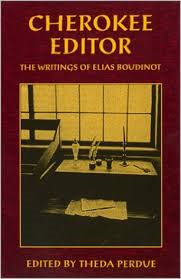
 

Posted in American History, American Revolution, Education, Georgia History, Historical Reflection, History, History Curriculum, Research, Retirement, Southern (Georgia) History, Southern History, Teaching, Uncategorized | Tagged , , , , , , , | Leave a comment

Growing Up White in the Jim Crow South: Two Perspectives from Georgia (Teaching Civil Rights, 3)

A Review of:

Hamilton Jordan, A Boy from Georgia: Coming of Age in the Segregated South (edited by Kathleen Jordan). Athens, Ga., and London:  The University of Georgia Press, 2015. 

                                           Jim Auchmutey, The Class of ’65: A Student, A Divided    Town, and the Long Road to Forgiveness. New York:  Public Affairs, 2015.

[NOTE: While teaching History at an Atlanta prep school, I inherited a one-semester, junior-senior course, the History of the Modern Civil Rights Movement. Based upon my own study of that period, I decided that the course must begin with a substantial unit on “The Age of Jim Crow.”  I believed that, without knowledge of the era before what Taylor Branch refers to as the “King Years,” students could not fully grasp what the modern civil rights movement accomplished.

To supplement our main text, Harvard Sitkoff’s The Struggle for Black Equality, and to illuminate the world of “Jim Crow” at ground level, I selected two autobiographies, Anne Moody, Coming of Age in Mississippi; and Melton McLaurin, Separate Pasts: Growing Up White in the Segregated South.  My students found these first-hand accounts engaging.  McLaurin includes a chapter on the allure of interracial sex to white boys (including himself), that could be controversial in some schools; Moody’s book covers both her Jim Crow upbringing and her later civil rights activism, while McLaurin doesn’t go into the civil rights movement in much detail.

Since I retired almost six years ago, I haven’t seen anything better on growing up under Jim Crow, at least from the African American perspective, than Moody’s book, but recently two  stories about white boys who came of age during the Jim Crow era have appeared.  One is a memoir, by Hamilton Jordan; the other, written by veteran journalist Jim Auchmutey, is about Greg Wittkamper.  Although most of you probably recognize Hamilton Jordan’s name, some may be wondering, who in the world is Greg Wittkamper?  Read on.]

* * * * *

Both boys grew up in southwest Georgia, about thirty-five miles apart. Hamilton Jordan, who was three years older, lived a middle-class existence in Albany. His father, Richard, was an insurance agent; his grandfather, Hamilton McWhorter, who lived in Lexington in the northeastern part of the state, was a veteran state legislator and quiet political power who, at least according to family legend, might have been elected Governor had his wife Helen not been Jewish.

Greg Wittkamper grew up at the Koinonia Farm near Plains, where the residents practiced communal living and worked alongside, even ate at the same table with, African Americans. Moreover, a number of residents at Koinonia were, like Greg’s father Will, pacifists who refused to join the military or even to endorse the more militant aspects of American foreign policy during the Cold War. None of these practices endeared them to their neighbors in Americus and Plains, in what would later be referred to as “Jimmy Carter Country.”  Perhaps ironically, Jimmy Carter was one of the few locals who continued to purchase produce from Koinonia, at a time when the commune’s residents were regarded by their neighbors as wild-eyed radicals, and, as a result, were harassed with mysterious fires, shootings, and economic boycotts.

Clarence Jordan (center) [New Ga. Encyc.]

Clarence Jordan (center) [New Ga. Encyc.]

The prime mover of the communal effort at Koinonia was Clarence Jordan, who became a sort of foster-father to Greg Wittkamper. Clarence Jordan also was Hamilton Jordan’s uncle, but was regarded as the “black sheep” of the Jordan family, because he actually believed in applying the teachings of Christianity to living in community with African Americans. Moreover, some residents of Koinonia went to Albany to support the “Albany Movement” (1961) one of the unsuccessful campaigns of the Rev. Martin Luther King, Jr., and Koinonia also provided shelter to some civil rights workers active in Albany.

* * * * *

Both Hamilton Jordan and Greg Wittkamper found themselves crossing the racial “party line” as adolescents.

Jordan Memoir

For Jordan, a turning point came during the “Albany Movement,” when he and his father were stunned to see their long-time housekeeper, Hattie Jackson, among the civil rights demonstrators. Although his father was unsympathetic to Hattie’s joining the marchers, Hamilton was ashamed at how the demonstrators were treated and considered his own reluctance to support them “a moment of moral failure.” (136)  The other shoe dropped a few years later, in 1970, when Hamilton’s father Richard drove Hattie Jackson to Atlanta to witness the swearing-in of the president of historically black Albany State University—who attended her church—as a member of the Georgia Pardon and Paroles Board.  According to Hamilton Jordan, “that time alone together changed their relationship forever.” Kind of like “Driving Miss Daisy,” though with the races of the passengers reversed.  (143)

Jordan became interested in arranging for African American rock bands to perform at white venues in Albany, including a band promoted by Phil Walden in Macon, whose lead singer was—wait for it!—Otis Redding.  Jordan’s career as a music promoter came to an inglorious end, through no fault of his own, when Bo Diddley visited an all-black club in south Albany, ran off with the eighteen year-old daughter of a local white doctor, and married her.  This episode made booking black bands at white venues in Albany a non-starter, so young Hamilton moved on to other endeavors.

Because of his family’s political connections, Jordan, pursuing a young lady he’d met at the University of Georgia, wangled an internship in Washington, D.C., with Georgia Senator Richard Russell.  The highlight of Jordan’s internship was a long-distance view of Martin Luther King’s “I Have a Dream Speech” in August 1963.  His assessment of that event:  “[T]he most important result—invaluable, although intangible—was that the movement finally had a face, a leader, a voice.” (204)  (A few years later, of course, Hamilton Jordan played a key role in the rise to prominence of Jimmy Carter, first to the governorship of Georgia and ultimately to the presidency of the United States, but that is not a story he relates in this book.)

* * * * *

Auchmutey

Greg Wittkamper had a different set of problems to resolve growing up white in Jim Crow Georgia. His white neighbors in Plains—and Americus—believed that residents at Koinonia Farm cared nothing for the preservation of white, southern culture, probably an accurate diagnosis.  Greg and his siblings had to attend public schools in Americus and put up with all sorts of harassment because of Koinonia’s reputation, even before the arrival of the civil rights movement.

Then, in 1964, during his junior year, when a local white official launched a low-key effort to integrate Americus High School, Wittkamper decided to demonstrate solidarity with the four black students chosen to break the racial barrier, riding with them on the first day of school in a limousine provided by a local black funeral home.  This brought down upon his head the fury of his white classmates, giving them yet another reason to despise him.  They attempted to intimidate Wittkamper, even attacked him physically, over the next two years.  For Greg, the difficulties did not stop with his graduation in 1965; he and an African American friend were attacked by angry whites following that ceremony.

By the time he graduated from high school, Greg Wittkamper had had all the fun he could stand in Americus and environs, so he headed off to the New York-based “Friends World Institute,” a Quaker-supported “college” that, Greg admitted, “wasn’t a school as much as an extended field trip.” (155) A conscientious objector during the Vietnam War, Wittkamper eventually moved to West Virginia, where he became involved in real estate.

And then came the event that brought Greg Wittkamper to the attention of journalist Jim Auchmutey:  he received an invitation to attend the Americus High School Class of 1965’s  40th reunion, as well as several letters from classmates apologizing for their conduct towards him during his junior and senior years.  After waffling about whether to attend, he decided to go.

The results of Wittkamper’s decision were mixed:  some classmates were warm, welcoming, and apologetic, while others snubbed him or grumbled, claiming that, because racism was no more, they wanted to “move on.” Wittkamper sent his classmates a letter after he returned to West Virginia, thanking them for inviting him and for their acceptance of him when he returned, and expressing his willingness to reach out to them in the future.

* * * * *

Now, is either of these accounts a candidate to replace Melton McLaurin’s Separate Pasts as a supplementary text in a course on the Modern Civil Rights Movement?  Probably not.  McLaurin, in addition to being an engaging writer, also is a professional historian who ably places his personal story of growing up in the Jim Crow South in the proverbial “larger context.” Neither Jordan nor Auchmutey quite meets this exacting standard.

Hamilton Jordan did not live long enough to produce a full-blown account of growing up in Jim Crow Georgia; he died on May 20, 2008, at the age of 63.  His children decided, correctly I believe, that the incomplete memoir he’d been laboring over during his last years was worth publishing, and they set out to whip that manuscript into shape.  They did a good job on the whole, though, because of the circumstances of its composition, the story remains incomplete.  There are some fine passages in it, especially for someone like me who was almost a contemporary of Jordan’s, but his memoir just sort of ends; there is no real closure.

Greg Wittkamper is fortunate that his story was told by Jim Auchmutey, an experienced journalist, though not a historian.  Auchmutey presents a well-rounded story, with Wittkamper at the center, to be sure, but hardly in splendid isolation.  Auchmutey also had access to surviving members of the Wittkamper family as well as to some of the classmates who tormented Greg in various ways in 1964-1965 but eventually came to regret what they’d done.

Wittkamper’s Boswell tells their story as well, and does so powerfully.  And yet:  while race is an important factor in Wittkamper’s story, it’s certainly not the whole of it.  To a great extent, he suffered not for his views on race specifically, but because of his association generally with those “crazies” who lived at Koinonia, including his siblings.  They were, if not exactly innocent, then, as the Vietnam era term had it, “collateral damage,” in a community caught up in the strains of moving between the present and the future, whether they wished to do so or not.

So, in the end, I guess we come back to the truism that generalizations about a large group of people, in this case white males who grew up in the South during the dying days of Jim Crow, are—or at least should be—based upon the sum total of all the individuals for whom you have information. And that, of course, sets a standard that few historians can meet. Instead, we “dance with one that brung us,” making what use we can of accounts like those bequeathed to us by Jordan and Wittkamper, and, of course, by Melton McLaurin.

* * * * * *

 For those interested in reading more about Georgia History, here are links to my books on the subject:

REABP CoverRancorous Enmities and Blind Partialities:  Parties and Factions in Georgia, 1807-1845 (University Press of America, 2015)

Pursuit Cover

In Pursuit of Dead Georgians:  One Historian’s Excursions into the History of His Adopted State (iUniverse, 2015)

Politics on the Periphery:  Factions and Parties in Georgia, 1783-1806 (University of Delaware Press, 1986)

Posted in Age of Jim Crow, Books, Civil Rights Movement, Current Events, Dr. Martin Luther King, Education, Georgia History, Historical Reflection, History, History Curriculum, Popular Culture, Prep School, prep school teaching with a PhD, Research, Retirement, Southern (Georgia) History, Southern History, Teaching, Uncategorized | Tagged , , , , , | 2 Comments

Historical Problem, “Who Was ‘A Citizen'” (Georgia, 1783-1788), Part 2: Debut of “A Citizen” (1783)

[NOTELast month, I introduced an “historical problem” about the writings of an angry Georgian after the American Revolution who called himself “A Citizen.” Although “A Citizen’s” pamphlet, Cursory Remarks on Men and Measures in Georgia (1784), is the focus of this exercise, the author actually made his debut on the public stage in Georgia even before his pamphlet was scattered about the streets of Savannah.

“A Citizen” lashed out at the appointment of George Walton as Chief Justice of Georgia early in 1783, and this attack set off a bitter exchange in the Savannah Georgia Gazette that lasted into November.  Thus, “A Citizen’s” 1784 pamphlet would be the culmination of a public debate that had begun almost a year earlier.  I also gave a “homework assignment” last time, a review of a post on the bitter division among Georgia’s patriots during the Revolution that played a major role in determining political alliances after the war ended, and especially George Walton’s role.]

* * * * *

George Walton (New Georgia Encyclopedia)

Document 2-1: 

“A Citizen,” GG, 6 Feb. 1783, attacking George Walton’s appointment as Chief Justice:

“How a man could be thought eligible by the Legislature to fill an office of the first consequence in the state, while a charge of the most heinous nature lay against him before that body, is an inexplicable paradox, a solecism in politicks [sic], which the world will never be able to comprehend, unless publick [sic] infamy shall be considered as the only recommendation to publick trust.”

The author also calls attention to “the heavy load of debt already contracted, and which is daily accumulating. . . ,” so sales of confiscated estates will not meet obligations.  His solution:  [A]dopt a different mode of conduct for the time to come, for every man to bear a part of the burthen, to contract your expenses, lower the salaries of your publick  officers, lessen the number of your Representatives, strike off the pay of your Council and assembly, and pursue every other oeconomical [sic] plan that can be devised. . . .”  [Note the patronizing tone, in keeping with the notion of “deferential society” later articulated in the 1784 pamphlet.  Referring to “hangers on upon government” who “like beasts of prey, fatten upon the carcass of their country as they devour it,” “A Citizen” seems to imply that  he was not active in politics—BUT, see “Scourge,” 27 Feb., below.]

Document 2-2:

“A Citizen of Georgia,” GG, 20 Feb. 1783—extract of committee report approved by vote of 22-19 in state house’s committee of the whole, 27 Jan. 1783:

That all lands and other estates, real and personal, which have been sold under the Confiscation Act passed at Augusta the 4th of May, 1782, ought by law to have been payable[note verb tense] as follows, that is to say:  the said real estates in seven years, and the said personal estates in four years; nor is any power lodged with any person or persons independent of the House of Assembly, or any discretionary power whatever to accept or receive payment of the same, or any part thereof, (except the interest from year to year as the same shall grow due,) within that time, either in specie or otherwise howsoever; it being expressly declared by law, that the commissioners should take bond and mortgage from the purchasers, and that the purchase money should remain as a fixed fund, productive of a yearly interest for said respective terms of seven and four years.”

Writer claims report “was the cause of much commotion at the time it was passed, and has since given rise to many injurious reports to individuals. . . .”

Document 2-3: 

“Scourge,” GG, 27 Feb. 1783—takes “A Citizen” to task for “the several calumnious assertions he makes use of to stigmatize the character of” patriotic Chief Justice George Walton.  Furthermore:  “The frightful picture of finance which he depicted could not be intended to promote oeconomy [sic], as he himself is an humble hanger on [the?] publick for a large salary, and has been for several years besides drawing rations for his whole family, when he had a plantation and negroes [sic] to procure him a comfortable support in the neighbourhood [sic] where he hung as a dead weight on the then drooping state of Georgia.”

Document 2-4: 

“Hercules Wormwood,” GG, 6 Mar. 1783—jumps on “Scourge,” referring him to “the opposite column to his piece in your last paper for an explanation of his card,” referring  to decision of legislative committee to label as a “forgery” the letter that had led to General Lachlan McIntosh’s suspension from his Continental Army command in Georgia.

Document 2-5:

“A Whip,” GG, 6 Mar. 1783–also attacks “Scourge,” informing him that “throwing dirt at others, whether true or false, will never cleanse himself, no more than the management of his friends to get him into office.” Also advises him “not to boast in future of his patriotick [sic] zeal as much as he has done, lest it should be made to appear, by investigating his conduct since it deserved any notice, that his zeal was always for himself, and not the publick.”

Document 2-6: 

“Scourge,” GG, 13 Mar. 1783—returns to the attack, sneering at “A Citizen” as “an herald, with a face like a rising sun” who escaped, via his letter, “from the hole cowardice thrust him into at Augusta when threatened by an attack from one Weatherford and from his being doubly protected by the British, both in person and property. . . .”  Claims that “A Citizen” also wrote letters signed “Wormwood” and “A Whip,” “for which he deserves to be made to drink his own bitters, and feel his own whip, as he formerly did those of Col. M__r__n, H__ry W__d, &c. &c. &c. &c. whose WHIPS he bore with truly Christian patience.”  “Scourge”denies that “Wormwood” and “A Whip” were correct in their assumption as to his identity.

Document 2-7:

Presentments of Grand Jury of Chatham for 4 Mar. [GG 13 Mar. 1783] contain a vigorous denunciation of Chief Justice Walton and a defense of their refusal to act under him.  [Walton was suspended.]

Document 2-8:

“Who D’ye Think,” GG, 20 Mar. 1783—tells “Scourge” to refute assertions of “A Citizen,” if he can.

Document 2-9: 

“Scourge,” GG, 27 Mar. 1783—”Scourge” returns (although Gazette editor James Johnston has refused to print part of his letter).  Asserts that “Who D’ye Think” is merely “A Citizen” with a new pseudonym.  Gets down to specifics as to charges leveled against “A Citizen”:

“Is it not true that cowardice thrust you (as it is well known you hid yourself) into a trench or hole at Augusta [ca. Sept. 1780], when Weatherford alarmed that post?  Is it not true that you took a parole from [Georgia Loyalist] Col. [Thomas] Brown, and was so much in favour [sic] with a British Capt. Smith as to obtain his protection for your property on the back of that parole?  Is it not true that you put a white feather in your hat, as if you would join [Georgia militia] Col. [Elijah] Clarke?  Did you join him?  Did not you and three others skulk at home at that critical time?  Had you not then a protection from the British, which you shewed to M—r C——, and which you afterwards destroyed at the Red House in Carolina, as did also one of your fellow prisoners who also had taken British protection?  Is it not true that, when Col. Clarke retreated, (at Cruger’s approach) you remained behind?  Did not Col. Brown, when he discovered your perfidious double dealing, make you a close prisoner, and send you to Charlestown, and so from a DESERTER of your country’s cause made you a PATRIOT?!!!  Is it not true that Col. M—r—n and H—y W—d whipped you for your insolence, and did not you bear it with truly Christian patience?  Is it not true that you speculated with large sums of PUBLICK MONEY, by purchasing goods in Charlestown to sell at Augusta at an enormous advance?  Do you think I don’t know your partners in INIQUITY, and the manner you at last accounted for part of the sums?  Is it not true that you meanly skulked from the defence [sic] of your country, and had the meanness to draw rations for your family. . .?

Document 2-10:

“A Subscriber,” GG, 3 Apr. 1783—writes to deplore exchange between “A Citizen” and his assailants, then proceeds to defend “A Citizen” against charges leveled by “Scourge.”  Claims that “A Citizen’s” “knowledge, integrity, and impartiality, in the office he now fills, is universally acknowledged, and the choice does honour [sic] to his country; if he has not been in the fighting department, his spirit is not the less doubted, he was equally useful otherwise, and necessarily employed in the publick [sic] service since the beginning of the Revolution without reflection.  When a party of the enemy in the night surprised the scattered and defenceless [sic] town of Augusta, it was surely more prudent, and indeed commendable in him, to keep out of their way, than suffer himself to be made a prisoner, as he was then disabled and could make no resistance, which was his situation also, with his right hand in a sling, when he was insulted by H—-y W—d and Col. M—–, and was disgraceful only to the assailants, which I am told the last has often acknowledged and was sorry for.”  [NOTE: John Wereat and Samuel Stirk were among Georgians made prisoner by the British in Augusta.]

Document 2-11: 

“Mentor,” GG, 27 Nov. 1783—writes on the eve of the election to offer advice to voters.  Says Georgia lacks a number of elements necessary for “national importance,” e.g., European ships in port; well-assorted stores; police; money in the treasury.  Blames lack of funds in treasury on an unfortunate fact:

“that the largest purchasers [of confiscated estates] had such powerful influence in your Assembly—the House decreed this property to the state; their friends became the greatest purchasers; they have been at the trouble of occupying, cultivating, and reaping the benefits of it for twelve or fifteen months, and, by an exertion of the same influence, have annihilated the agreement in every instance where the purchaser chooses—“ [emphases in original]

These proceedings have made the state government “a subject of abuse and contempt.”  “Mentor” agrees that purchasers’ ruin would have been inevitable if they had complied with the original agreement, but he “cannot admit they have any claim to publick commiseration.”  Argues that, if the Assembly had to be compassionate to a group of people, “the payment of that virtuous suffering soldiery who made you independent, would be a better field for the appropriation of publick property than the salvation of speculators, or the aggrandizement of a board of commissioners [of confiscated property], however respectable.”

To begin reforming this situation, voters must make wise choices during forthcoming legislative elections.  “Mentor” offers advice:  “Elect no publick defaulter:  Elect no man of infamous publick or private report; . . . Do not adopt adventurers or renegades merely because your Constitution allows it. . . .  Elect no man merely because he is called a Divine or a Lawyer, for a professional name in no  proof of common sense or common honesty. . . .  Elect no man because he is noisy, nor reject every man who may have taken protection or have sought refuge in another country, unless you can find him particularly violent and active against others in the same predicament; . . . If any man, even a former Governor, Treasurer, Delegate, an Indian Superintendent, or Purchaser of publick property, has not accounted with the state, though you cannot immediately bring him to trial, be aware notwithstanding how you confer appointments on him. . . .”

* * * * *  

[NOTE:  For next time, I have another “homework assignment” for those interested in playing along with this Historical Problem:  read the first part of my post on factions and parties in Georgia between 1783 and 1806.]

* * * * * *

For those interested in reading more about Georgia History, here are links to my books on the subject:

REABP CoverRancorous Enmities and Blind Partialities:  Parties and Factions in Georgia, 1807-1845 (University Press of America, 2015)

Pursuit Cover

In Pursuit of Dead Georgians:  One Historian’s Excursions into the History of His Adopted State (iUniverse, 2015)

Politics on the Periphery:  Factions and Parties in Georgia, 1783-1806 (University of Delaware Press, 1986)
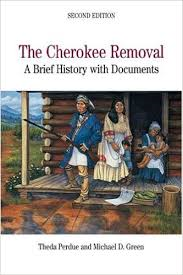


Posted in American History, American Revolution, Education, Georgia History, Historical Reflection, History, History Curriculum, Research, Retirement, Southern (Georgia) History, Southern History, Teaching, Uncategorized, WP Long Read | Tagged , , , , , | 2 Comments