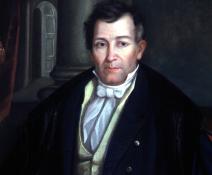
A “Fourth Dimension” in Antebellum Georgia Politics (In Pursuit of Dead Georgians, 7)

 [Note:  John Adams predicted that the colonial declaration of independence in the summer of 1776 “would be celebrated, by succeeding Generations, as the great anniversary Festival. . . .It ought to be solemnized with Pomp and Parades, with Shews [sic], Games, Sports, Guns, Bells, Bonfires and Illuminations from one End of this Continent to the other from this Time forward forever more.”  And that was what happened, at least for a while.

At the center of these celebrations was the Declaration of Independence.  In antebellum Georgia, for example, from early June onward, newspapers mobilized citizens to organize communal commemorations of American independence.  Editors often published the Declaration a day or two before the holiday, and they also wrote essays reflecting on the significance of the event for the nation and the state since 1776.

A committee in each town tapped an up-and-coming politician to read the Declaration aloud and a more seasoned local political figure to deliver an oration affirming the glories of American liberty and progress.  No Fourth of July celebration was complete without a parade of militiamen in full uniform.  Following the parade, the reading of the Declaration, and the oration, citizens continued celebrating, with meals, ample liquid refreshment, and numerous toasts to heroic figures in the struggle for freedom, and to the ideal of freedom itself.

Once the political scene became increasingly polarized, towns and cities across Georgia continued to celebrate the Fourth of July, but at an ever-growing distance, both chronologically and emotionally, from the event, so  exactly what sort of freedom was being celebrated on the Fourth was frequently rather fuzzy.  In this brave new world of American politics, what was definitely lost was the notion of the “common good” that was supposed to be at the heart of “republicanism.”]

* * * * *

Even before the organization of political parties in Georgia, the potent mixture of patriotism and alcohol could lead to trouble on the Fourth.  For instance, in 1787, Colonel James Gunn tangled at a dinner on the Fourth in Savannah with friends of James Jackson, who already had clashed with Gunn over a number of issues related to the Georgia militia.

After a lot of eating and drinking, one of Jackson’s allies, Joseph Welscher, who was also one of Gunn’s militia subordinates, was asked to sing a song, but his choice of music angered Gunn and others  because it was “an old English song made before the [Revolutionary] war.”  When Gunn objected to the song, Welscher apologized, only to have Gunn retort, “Damn the song and you too, you damned stinking puppy.”  The two men nearly came to blows, but were separated, and the still irate Gunn left in disgust.

A drunken Welscher finally stumbled homeward a few hours later, past the house of Colonel Gunn, who was waiting for him.  The two men grappled, with Gunn snatching Welscher’s sword away, then assaulting him with a whip.  Only the arrival of a neighbor, summoned by Gunn’s anxious wife, defused the situation.

* * * * *

As political factions and parties formed in the major towns of Georgia in the mid- to late 1790s, first over Treasury Secretary Alexander Hamilton’s plan to restore the nation’s credit and later over the Yazoo land fraud, it was not unusual for militia units to include members of only one faction or party. In 1796, for example, Colonel Jesse Sanders, commander of the Columbia County regiment, enlivened a Fourth of July muster with a heated oration denouncing land speculators for their opposition to the Rescinding Act, which had negated the corrupt Yazoo sale. Subsequent events helped to polarize militia units further.

Even if all the local militiamen still paraded together through the town, they usually celebrated the Fourth separately once the parade had finished. In Savannah, for instance, “Democratic Republicans” and “Federal Republicans” usually held separate dinners.  When, as in 1803, the port’s “friends of government [i.e., Federalists”] failed to meet in a body, the editor of the local Federalist paper hastened to reassure readers that the required muster of the town’s “Volunteer Corps” explained “why no Federal Republican Dinner was given by those of our citizens, who still feel an honest pride in revering the political maxims of WASHINGTON, and who will ever practice his precepts.” In 1804, the Chatham Artillery, led by three aides-de-camp of General James Jackson, fired a cannon in honor of President Jefferson and pledged their Republican faith over drinks under Jackson’s satisfied gaze.

* * * * *

In this later period, newspaper editorials, celebratory speeches, and toasts still addressed the general topic of American liberty, but the real excitement on the Fourth now came during the second phase of the celebration, when members of factions, parties, militia units, or other groups gathered to offer toasts interpreting local, state, or national issues so that their own particular views were presented as the logical outgrowth of the principles embodied in the Declaration of Independence and, thus, as examples of the nation’s founding ideals, while the political opposition was portrayed as having abandoned those things that had made the nation great, in pursuit of the rewards of greed and corruption. As had been the case on earlier occasions, alcohol and patriotism, transmuted now by increasingly rabid political partisanship,  made for a combustible combination.

In 1825, for example, George Troup and John Clark, the leaders of  Georgia’s eponymous political parties, opposed each other for the governorship in an exciting, highly emotional campaign.  To celebrate the Fourth, planners in the town of Forsyth attempted to organize a non-partisan gathering, promising that no one would offer toasts on “party” topics.  However, on the day itself, General Elias Beall, a zealous Trouper, made a strongly pro-Troup volunteer toast (“volunteer” toasts were offered late in the celebration, after the “regular” toasts, and, also, after the celebrants had had additional time to imbibe).  In response, an equally avid member of the Clark party, John Cuthbert, proposed a blatantly pro-Clark toast, then left the table, fearing that the rest of the volunteer toasts would become even more overtly political, which, he later claimed, they did.

Seven years later, in 1832, lines were being drawn in Georgia and elsewhere over the efficacy–and constitutionality–of John C. Calhoun’s doctrine of Nullification, the idea that a state unhappy with a federal law, in this case the protective tariff, could vote to “nullify” it, rendering it null and void within the borders of that state.  The Fourth of July celebration in Milledgeville, the state capital, began when local citizens, led to the Methodist church by the “Georgia Guards,” listened to a reading of the Declaration of Independence and to a rather generic oration, a throwback to the “good ol’ days” before the rise of parties.

After this well-attended ritual ended, the crowd broke up.  Members of the Troup party, avid supporters of “state rights” and/or Nullification, held a celebration featuring the usual patriotic toasts, as well as more partisan ones, like the following:  “The Cholera [then raging in parts of the state and nation] and Tariff for protection: May they both speedily become extinct; and thus the Union of our country and its families remain unbroken.”

The men of the “Georgia Guards” militia unit, on the other hand, made their way to a site just outside the capital for a festive barbecue, presided over by Captain John Cuthbert, the man who had answered Beall’s pro-Troup toast in Forsyth seven years before and was now an editor of the state’s leading Clark party paper, the Federal Union.  The “volunteer toasts” during the Guards’ celebration, like those at the Troup party conclave, were more partisan than the “regular” ones, but they were also less strident than toasts offered by the Troupers.  For instance, one of the Guard officers proposed “The union of the States, and the sovereignty of the States:  clear heads and honest hearts for the defense of both.”

Meanwhile, in the village of Hamilton, Fourth of July orator Marshall J. Wellborn denounced the protective tariff, the “American System” of Henry Clay, and the federal judiciary, warning his audience that southerners must “adhere inflexibly to the tattered fragments of our violated constitution wherever we can find them,” while in the town of Forsyth a gathering toasted Nullification as “an unconstitutional remedy for a constitutional but oppressive law.”

* * * * *

By the early twenty-first century, the Fourth of July has become almost indistinguishable from other occasions for a long weekend. Here in Atlanta, for instance, the “Salute 2 America” parade ended in 2007, after forty-six years as the largest Independence Day celebration in the country, leaving the Peachtree Road Race as the chief local observance of the Fourth.  The holiday also still serves, in Atlanta and elsewhere, as the symbolic mid-point of summer and as the occasion for “Independence Day sales.”

Over the years, the Declaration of Independence was a favorite tool for instructing school children, as well as generations of immigrants, in what it meant to be an American.  It also frequently served as a way to teach rhetoric, and, for generations, the impassioned delivery of the Declaration by aspiring adolescent orators was right up there with the Preamble to the Constitution, Webster’s reply to Hayne, and the Gettysburg Address as a show stopper during ceremonies marking the end of the school year.

Nowadays, if our young people learn of the Declaration and its ideals, they generally do so in an American History course.  One hopes that this lesson requires, at a minimum, that each student actually reads the document, and that the class discusses both what it says and, just as important, what it does not say.  For instance, do our children learn about Jefferson’s famous (or infamous) “phillipic against slavery,” charging the King of England with “forcing” slavery upon the southern colonies, a charge that was excised from the draft of the Declaration by the Continental Congress, whose members realized all too well how explosive the slavery issue was (and, just maybe, how silly Jefferson’s assertion was)?

A favorite assignment of mine used to be, after my American History classes had read, read about, and discussed the ideas in the Declaration, to give them the dictionary definition of the word “propaganda” and ask them to evaluate–in writing and orally–how accurately that term described Jefferson’s handiwork.  These discussions were always very lively!

In this day of the twenty-four hour news cycle and of complex ideas reduced to sound bites and bumper sticker quotes, we should continue to insist that students examine the Declaration and its principles, but that they do so by placing the document and its ideals in historical context.  (And, yes, I recognize that, in today’s hyper-partisan political world, I’m whistling into the wind by suggesting this–but that’s the great thing about being retired, not shy, and having my own blog. . . .)

* * * * *

The problem with calling the Declaration of Independence “American scripture,” as some historians do, is that it plays into the literalist mindset of many Americans.  If Jefferson wrote that “all men are created equal,” then that’s the way it was, despite the fact that Jefferson was a slaveholder, and an American “aristocrat” as well.  Of course King George III was guilty of all the charges leveled against him by Jefferson in the Declaration.  (Aren’t lawyers always truthful in presenting cases to a jury?  Don’t they invariably avoid exaggeration?)

Moreover, so long as we continue to base evaluations of our children’s knowledge of American history on standardized tests, where the answer is always one of the choices offered and there is no room for contingency or complexity, students will miss much of the richness of the past, messy and hard to pin down in an objective, “multiple-choice” sort of way.  The system requires unambiguous answers, easily graded–“historical truth” be damned!

* * * * *

Jefferson’s “Great Declaration,” it turns out, was a kind of national “to-do list,” a collection of inspiring ideals to which we committed ourselves as a nation, but which even some who heard the Declaration read in the summer of 1776 knew did not approximate reality.

One way to understand our national history, then, is as “the story of American Freedom” (Eric Foner), a still-evolving saga wherein the very definition of “American Freedom” has been contested, stubbornly and consistently, with “progress” measured by which groups enjoy “the blessings of liberty,” and which remain outside the sacred circle, at any given time.  And, make no mistake about it, even today groups do remain on the outside, looking in.

* * * * * *

For those interested in reading more about Georgia History, here are links to my books on the subject:

REABP CoverRancorous Enmities and Blind Partialities:  Parties and Factions in Georgia, 1807-1845 (University Press of America, 2015)

Pursuit Cover

In Pursuit of Dead Georgians:  One Historian’s Excursions into the History of His Adopted State (iUniverse, 2015)
Politics on the Periphery:  Factions and Parties in Georgia, 1783-1806 (University of Delaware Press, 1986)
Posted in 4th of July, Current Events, George M. Troup, Georgia History, History, James Gunn, John Clark, John Cuthbert, Nullification, Research, Retirement, Southern (Georgia) History, Southern History, Teaching | 1 Comment

Antebellum Georgia’s Dueling Memoirists, Wilson Lumpkin and George R. Gilmer (In Pursuit of Dead Georgians, 6)

[NOTE:  Two previous posts (here and here) have looked separately at memoirs by antebellum Georgia governors George R. Gilmer and Wilson Lumpkin, focusing on each man’s role in the removal of the Cherokees.  This time, I want to consider other aspects of their careers and personalities, as well as elements of antebellum Georgia’s political culture revealed in their writings.]

* * * * *

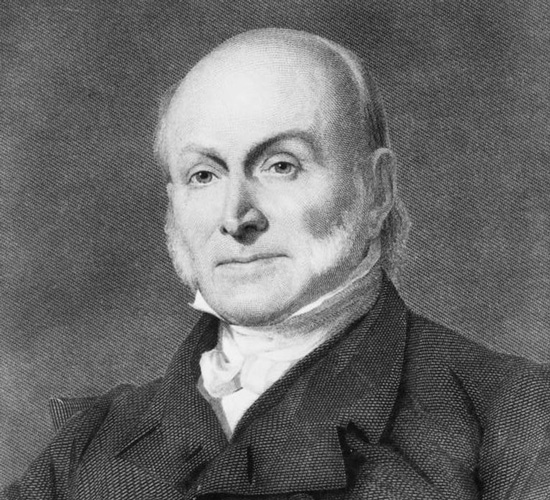
George R. Gilmer

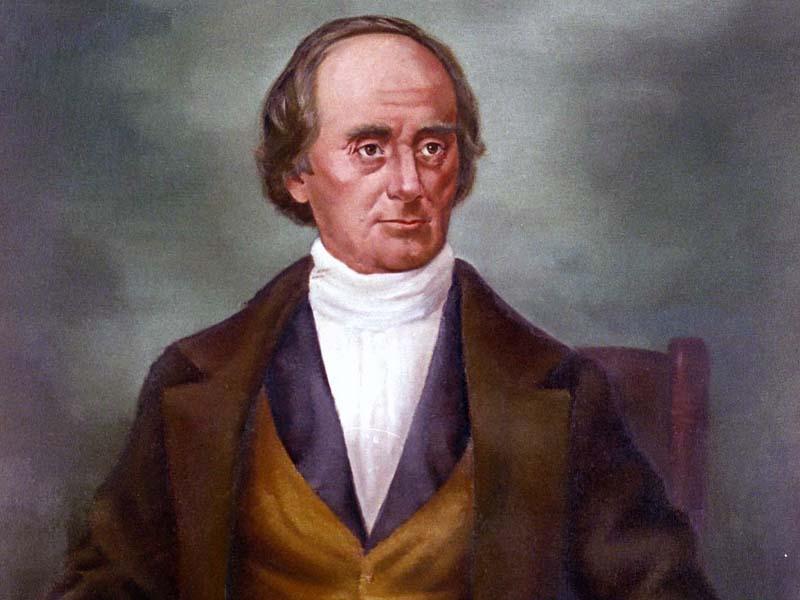
Wilson Lumpkin


George Gilmer, who valued things Virginian above all, came from a family with roots there but was himself born in Georgia. Wilson Lumpkin, whom Gilmer in his memoir grouped with the lower-class North Carolinians who formed the Clark party, actually was from a Virginia family and, unlike Gilmer, had been born in the Old Dominion.  Moreover, while Lumpkin did wind up in the Clark party, he began his political career, like Gilmer, as a member of the Crawford/Troup party.  Both men’s fathers served as local magistrates.  Gilmer studied at Moses Waddel’s academy in South Carolina and read law under the distinguished lawyer Stephen Upson in Lexington, Georgia, while Lumpkin got what education he could locally, then polished his skills by helping his father with his duties as clerk of the superior court.

* * * * *

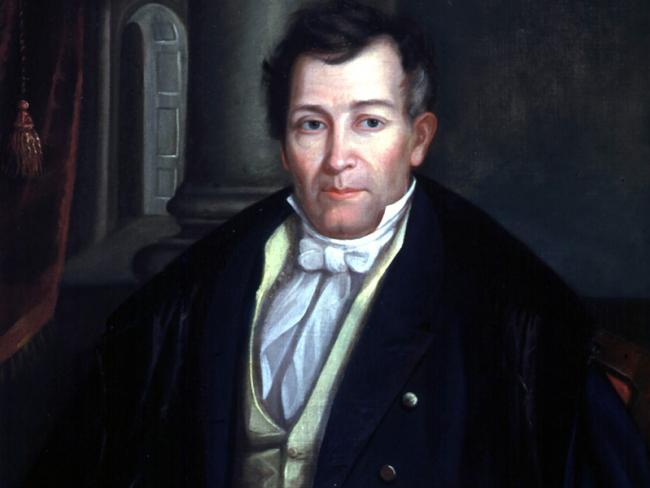
In his autobiography, Lumpkin remarked, “Political parties fifty years ago in Georgia, and indeed long since, turned more upon popular leaders–more on men than on measures.”  William Harris Crawford and John Clark were “personal enemies,” Lumpkin conceded, and each controlled a “considerable portion” of each house of  the legislature, “while perhaps a majority of the members, like myself, desired to keep aloof from the personalities of these gentlemen.” (Lumpkin, I,14)  Lumpkin wrote that Crawford and his supporters referred to the Clark party as “the Federal party,” because some Clarkites had held office under John Adams, and also charged that some Clarkites had participated in the Yazoo land fraud (1794-1795).  Yet, Lumpkin asserted, “Clark and most of his leading friends of that day professed to be, and in many respects sustained well, the character of real Democrats, if not Red Republicans.” (Lumpkin, I,14)

George Gilmer also claimed to have a low opinion of political factions, but he admitted that he entered public life as a “friend” of William Harris Crawford, which, of course, made him an “enemy” of John Clark. Moreover, during his initial campaign for the state legislature, Gilmer had to fight off charges of “Federalism” aimed at him by the Clark party. (Gilmer, pp. 201-202)

Lumpkin worked to secure removal of the Cherokees from Georgia because he believed that was his “particuliar mission,” while Gilmer did so because he saw Indian removal as in the best interests of (white) Georgians and because dealing with that issue was part of serving  in the state legislature, in Congress, and, eventually, in the Governor’s chair.

Both men also “bucked the system” when it was in their political interests to do so. For example, Lumpkin throughout his career was portrayed by his political enemies as without firm political principles, largely because he had abandoned the Crawford/Troup party for the Clark party, and because he supported Andrew Jackson for President in 1824, when the leader of the faction to which Lumpkin belonged at the time, William Harris Crawford, wanted the presidential nomination for himself.

Gilmer, in his turn, successfully challenged Joel Crawford for the Crawford/Troup Party gubernatorial nomination in 1829, despite the fact that Crawford had announced for the nomination first, which, under the party’s usual practice, should have made him the nominee. When Gilmer won the election, supported by some members of the Crawford party and by the Clark party, he pledged to govern in the interests of all the people, not those of one party.  Yet, because he successfully challenged Joel Crawford and refused to offer patronage appointments to the Clark party in return for their support during the campaign, Gilmer was beset on all sides during his term in the Governor’s chair by angry members of both parties.

* * * * *

Wilson Lumpkin comes across, at least in his memoir, as a “democrat,” a believer in the power of “the people” to act in their own best interests if given the necessary information. For instance, when Congress in 1816 passed the Compensation Act, changing pay for congressmen from a per diem basis to a salary, the popular uproar was tremendous. Even members who, like Lumpkin and his fellows on Georgia’s House delegation, had voted against the measure, were sent packing.  Looking back on the furor a generation later, Lumpkin claimed it proved to him that, while “the people” might err, they could nevertheless be counted upon to regain their equilibrium eventually.  (Lumpkin, I,30)  Lumpkin seems to have been humorless, though that might be because his modern editor shaped his manuscript autobiography to focus on his political career.

In his memoir, George Gilmer seemed a self-styled “aristocrat,” quite capable of peering archly at “the people” or their self-appointed champions (i.e., Lumpkin and other members of the Clark Party) when he thought they were wrong, which, evidently, was quite often. In contrast to Lumpkin, Gilmer possessed a sharp sense of humor, though one heavily conditioned by a sardonic feeling of noblesse oblige.  Thus, his story about how John Clark, drunk and on his way to Milledgeville to chastise Governor David Mitchell for a perceived insult, was found “asleep upon a log which projected over a precipice, where a turn the wrong way would have precipitated him below, and probably killed him–the recklessness of his temper and his desire to fight Mitchel [sic] having put him into the humor to hunt for danger.”  (Gilmer, p.159)  And then there was Gilmer’s ironic lament that, at a dinner given by his supporters in his “honor” after his defeat for re-election, he was “called upon to say how, and why, I had contrived to deprive those by whom I was surrounded of the public offices to which they considered themselves entitled.”  (Gilmer, p.359)

Gilmer published his memoir in 1855.  Lumpkin wrote his in the early 1850s, but it was not published during his lifetime, which was to Lumpkin’s advantage: he was able to “correct the record” in his manuscript whenever something was said or printed about him with which he disagreed (i.e., he was, in a sense, a “blogger” before blogging was cool). Lumpkin did this, for example, after  Gilmer’s book appeared, and after George White issued a new edition of Statistics of Georgia, because both included interpretations of Lumpkin’s Indian policy that he believed wrongheaded. In criticizing Gilmer’s book, Lumpkin got off a zinger that applied just as well to his own memoir:  “[Gilmer] can neither speak nor write of those with whom he differs, without manifesting a superlative degree of prejudice.” (Lumpkin, II,300)

* * * * *

Our dueling memoirists also furnish insights into Georgia’s political culture in the early antebellum period.  About his initial nomination for the state legislature, Gilmer modestly noted that, “Whilst I was temporarily absent from Lexington [his home town], . . . it was determined by some of the leading politicians of the county that I should be a candidate.” (Gilmer, p.201) Gilmer also recounted an episode revealing the bitterness of the rivalry between the Crawford and Clark parties.  An ardent Crawford supporter, Baptist preacher Jesse Mercer, delivered a sermon at the funeral of Governor William Rabun, a member of the Crawford party, with newly-elected Governor John Clark in attendance. According to Gilmer, Mercer “enforced the doctrine with great zeal, that when the Lord taketh away a good and righteous man [Rabun], he does it on account of the sins of the people, and will punish them by putting wicked rulers [Clark] over them, and ended by saying Georgia had reason to tremble.”  (Gilmer, p.214)  Gilmer also denied that his decision to challenge Joel Crawford for Governor was motivated by personal ambition, claiming instead that his “friends” had convinced him he was the better candidate.

Wilson Lumpkin, too, commented on the power of  political “friendship,” asserting that, while he preferred to remain in Congress, his “friends” in Georgia pressed him to run for Governor against Gilmer in 1831, arguing that, as Governor, he could work more effectively on behalf of  his “particular mission,” Cherokee removal.  (Lumpkin, I, 90)  Lumpkin knew that his candidacy would anger Gilmer’s supporters, and, he was not sure he could defeat the incumbent.  But he was “forced to become a candidate,” he wrote, “Because nothing else would satisfy my beloved friends and constituents who had stood by me through evil and good reports, for upwards of thirty years.” (Lumpkin, I, 91; II, 302-03)  And, reminding us that being a “good loser” was no more popular in antebellum Georgia than it is today, Lumpkin told how, after his inaugural address, Gilmer escorted him to the Governor’s office, but then he and all but one of his staff left the new Chief Executive to find his own way–and to locate papers called for by the legislature! (Lumpkin, I, 92)

By 1826, public opinion in Georgia had embraced Andrew Jackson as a presidential candidate for 1828, but, according to Wilson Lumpkin, some members of the Crawford/Troup party were too pushy in jumping on the General’s bandwagon, alienating members of “the old original panel of the Jackson party,” by which he meant members of the Clark party like himself. (Lumpkin, I, 41) In his memoir, George Gilmer remarked that “All in Georgia were Jackson men whilst Gen. [sic] Jackson was in office, the Clark party from choice, the Crawford party from necessity, so that the old factions began to lose their lines of demarcation, and new parties to be formed upon the general principles which divided the people of the United States.” (Gilmer, p.438)  The Crawford/Troup/State Rights party of which Gilmer had been a member became the Whigs shortly after he retired from public life, while the Clark/Union party to which Lumpkin belonged morphed into the Democrats, with Lumpkin himself playing a key role in making that happen.

* * * * *

Wilson Lumpkin, derided by his political foes for his lack of consistency, always had an answer.  For example, after admitting that he had supported the broader vision of the federal government’s role in guiding the nation’s destiny that emerged after the War of 1812, he added that he had “long since repudiated these votes” and was “firmly resolved that no necessity whatever should ever induce me to contribute my mite to the enlargement of the powers of the Federal Government one hair’s breadth beyond the limits of the Constitution.” Lumpkin even claimed (in 1852) that he had “long believed . . . that the consolidating tendency of the Federal Government is the great rock upon which our glorious union of states will be sundered to fragments.” (Lumpkin, I, 24-25)

George Gilmer also was quite capable of boxing the political compass without a blush.  For instance, in 1832, responding to voters interested in his stand on Nullification, Gilmer wrote that he did not believe a state could nullify an act of Congress, but he disagreed with the group’s opinion that the recently passed tariff was an improvement over previous ones.  Moreover, he informed his constituents, he rejected their statement “that the evils of the tariff have been greatly exaggerated,” and disagreed that the tariff question should be left to state legislatures, preferring that the issue be decided by a popularly elected state convention; yet, he also asserted that any recommendations by such a convention could not be binding until approved by a popular referendum. (Gilmer, pp.361-62)  Can I get an “a-men!” for this effort at political obfuscation?

Ironically, had it not been for the controversy stirred by the removal of the Cherokees, it is unlikely either man would have  written a memoir. Gilmer and Lumpkin attempted to place their actions in a historical context that made them appear founts of wisdom and restraint in dealing with the “backward” Cherokees, their irrational northern supporters, and feckless administrations in Washington. Establishing that context led them to consider their broader political careers. For anyone trying to understand the political culture of antebellum Georgia , these dueling memoirs are more useful than either George Gilmer or Wilson Lumpkin probably intended.

_______________

For those interested in reading more about Georgia History, here are links to my books on the subject:

REABP CoverRancorous Enmities and Blind Partialities:  Parties and Factions in Georgia, 1807-1845 (University Press of America, 2015)

Pursuit Cover

In Pursuit of Dead Georgians:  One Historian’s Excursions into the History of His Adopted State (iUniverse, 2015)

Politics on the Periphery:  Factions and Parties in Georgia, 1783-1806 (University of Delaware Press, 1986)
Posted in Cherokee Indians, George R. Gilmer, Georgia History, History, Research, Southern (Georgia) History, Southern History, Wilson Lumpkin | 2 Comments

David “Honeyboy” Edwards (1915-2011): An Appreciation (Blues Stories, 1)

“Blues ain’t never going anywhere.  It can get slow, but it ain’t going nowhere.  You play a lowdown dirty shame slow and lonesome, my mama dead, my papa across the sea I ain’t dead but I’m just supposed to be blues.  You can take the same blues, make it up-tempo, a shuffle blues, that’s what rock ‘n’ roll did with it.  So blues ain’t going nowhere.  Ain’t goin’ nowhere.”  (David “Honeyboy” Edwards, 2008)

* * * * *

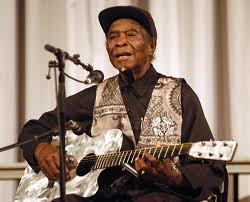
David “Honeyboy” Edwards, the last of the Delta bluesmen, died on August 29 in Chicago, at the age of 96.  Among my cd collection are a couple of shelves of blues compilations, which group songs by early blues performers topically, geographically, chronologically, etc.  In all of the songs on those compilations, I found exactly two (count ’em, two) tracks by Edwards.  So, obviously I own almost nothing from his blues repertoire, yet I knew who he was as soon as I saw the headline on the obituary in the local paper.

Checking amazon.com, I discovered that there are perhaps eight audio cds with selections by Mr. Edwards available for purchase, and a couple of those are dated 2011, which suggests (call me a blues cynic) that they have been re-released to take advantage of any late-blooming interest in the deceased guitarist’s career.  Amazon.com also lists an autobiography, The World Don’t Owe Me Nothing:  The Life and Times of Delta Bluesman Honeyboy Edwards (1997), which one source describes as a rare,  detailed account of the life of an itinerant Delta bluesman, but I had not yet read it. [Note: Several years after I originally wrote this post, I finally purchased–and read– this work.]

I checked my 1996 edition of the All Music Guide to the Blues and discovered that reviewer Bill Dahl thinks that the once underappreciated Edwards had recently begun to receive the credit he deserved, because “his slashing, Delta-drenched guitar and gruff vocals are as authentic as it gets.” (80)  A second reviewer, Ron Wynn, notes that “Edwards does not rely on slickness, inventiveness, or niceties; his riffs, lines, phrases, and licks are as aggressive and fiery as his vocals.” (Ibid.)  And yet–I have only two tracks by Edwards in my collection, and they are found on compilations I seldom listen to.  So, why was his name so familiar?

* * * * *

Eventually, I realized that it was my own training as a Southern historian that brought me into contact with David “Honeyboy” Edwards, but by a roundabout route.  Nearly a quarter of a century ago, when my older son and I rode to school together, we quickly realized we would have to come to an understanding about what music to listen to en route, because our tastes were very different.  After a few days of trial and error, we discovered a local public radio station that played the blues from 6-10 a.m. every weekday.  Once we found this station, we both were hooked on the blues, at least for the duration of my son’s high school career.  Once he graduated and moved on to college, I taught at the same school for two more decades, and, during all that time, I started off each workday listening to the blues.

It was the rootedness of the blues in American history and culture that resonated with me.  I eventually developed a unit on the origins of the blues in the Jim Crow South for my American History survey course, and in more recent years I worked up a number of one-hour “classes” on the blues and on different blues performers.  To aid in my research, I gradually amassed a bulging shelf of books on the blues, as well as a number of documentary films on vhs and dvd.

It was while using these books and videos to prepare lectures on the blues that I began to notice how frequently David “Honeyboy” Edwards cropped up as a source of information on the history of the blues.  While the reviewers in the All Music Guide to the Blues might be right about the Delta-esque quality of his guitar-playing abilities and the “fiery” quality of his voice, David “Honeyboy” Edwards, for me at least, is much more significant for what he told us about the lore of the blues and the lives of its performers than for his music.

During the revival of interest in the blues in the 1960s, a few determined researchers headed South to locate and interview surviving African-American Blues performers.  Of course, they were looking for the “big names,” men and women who had recording careers before World War II but then seemingly vanished into the vastness of the rural South, victims of changing musical tastes of fickle American audiences.  These researchers were so zealous to fill in gaps in blues history, however, that they were ready to talk to anyone in the Deep South willing to speak on the subject, whether they were known beyond the Delta or not.  Among the many sources these interviewers encountered, no one looms larger in retrospect than David “Honeyboy” Edwards.

For example, David Edwards provided clues that helped researchers finally to illuminate the painful last days of the legendary Delta bluesman Robert Johnson, poisoned in 1938 by the husband of a woman he fancied, in Three Forks, a Mississippi crossroads community.  Edwards’s story about Johnson’s death is the most frequently cited of his contributions to blues history, but there were numerous others.  His nearly eighty years as a professional bluesman took Edwards from the Mississippi Delta to Memphis, then to Chicago and beyond, yet his most memorable contributions often came, not when he sang, but when he told researchers–and concert audiences–what he knew, had seen, or had heard about the early decades of the blues and those who made them.

And Edwards seems to have been everywhere during the 1930s and 1940s, when the blues, like its performers, after flourishing in the Delta, fled the Jim Crow South and headed for the sprawling, industrial cities of the Midwest, especially Chicago.  And since, unlike a number of his contemporaries among the emigre blues performers, David Edwards both continued to perform (though he was not recorded very often) and was willing to tell what he knew about the formative years of the blues, he became a primary source for blues historians.  Mr. Edwards’s stories about the lives and times of Robert Johnson, Charley Patton, Muddy Waters, Big Joe Williams, Little Walter, Howlin’ Wolf, and other early blues performers found their way into magazine articles, books, television performances, and documentary films.  His engaging, cheerful, and perceptive reminiscences gradually elevated Edwards to blues legend status himself, as he came to be regarded, in the words of an obituary headline,  as the “last link to [the blues] genre’s greats.”

* * * * *

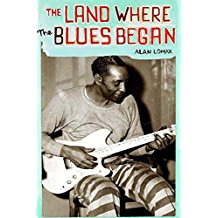
Even with all this information about the sunset years of Mr. Edwards, I couldn’t help wondering what he was like as a young bluesman.  To help answer that question, I turned to Alan Lomax’s The Land Where the Blues Began (1993).  When Lomax ventured South in 1942 as part of a mixed-race team hoping to record “folk musicians” in the Delta, one of the first places he visited was Clarksdale, Mississippi.  There he encountered a young African American musician who had been “selected” for the military draft but was looking for a way to avoid that obligation.

Lomax learned that his new acquaintance already had made a few commercial recordings and, because of that, did not want to be identified by his real name; so the young man asked the visiting scholar to refer to him by an alias if he mentioned him in any published research.  Fifty years later, in The Land Where the Blues Began, Alan Lomax revealed that this musician was David “Honeyboy” Edwards.

Lomax’s account of his relationship with Edwards in 1942 casts a fascinating light on the personality of the then twenty-seven year-old  bluesman.  “Young Dave,” as Lomax called him, was talented, cocky, seemingly fearless, and he reveled in the magnetism of his bluesman’s persona to the opposite sex.  The young Edwards knew he had talent, and he planned to capitalize on his gifts somewhere beyond the constraints of the Jim Crow system–but not just yet.  As he told Lomax,  “I just loves to ramble.  If it wasn’t for this army draft business holding me down, I’d be gone now.  They ain’t nothing doing around here.” (395)   (In 1942, Edwards identified for Lomax a number of local musicians he should record, but, the Lomax of 1993 reported with embarrassment, he neglected to follow up any of Edwards’s leads, and, forty years later, all those named were dead.)

Honeyboy bragged to Lomax that musicians liked two things, “whiskey and women.  And the womens [siclike us [blues players] better than they do the average working man.” (397)  Edwards boasted that he had a lot of girlfriends, along with “four or five children scattered here and about other country places.” (397)  He also claimed that his mother used to accompany his musician father to dances and juke joints until “she got converted and joined the church and got him to quit playing the blues.” (398)  Young Edwards even cheerfully agreed that the blues were the “devil’s business”:  “Well, I believe the blues is.  And I’m the devil’s child right now.  I guess it’s been seven or eight years since I been to church.  If I’m not a church man, I just won’t be a hypocrite.” (399)

And David “Honeyboy” Edwards was no hypocrite.  He played and sang the blues; he eagerly shared, with anyone who asked, the stories he had collected over a long lifetime; he spoke the truth as he saw it; and he did so with grace.  With his death, as the song “Six Strings Down” has it, there’s been “another blues stringer called home.”  I have a feeling there’ll be “good times tonight” in “Blues Guitar Heaven,” once Honeyboy sings (or talks) his way through those pearly gates.

SOURCES:

Edwards, David Honeyboy. The World Don’t Owe Me Nothing: The Life and Times of Delta Bluesman Honeyboy Edwards. Chicago: Chicago Review Press, 1997.
Gioia, Ted. Delta Blues: The Life and Times of the Mississippi Masters Who Revolutionized American Music. New York and London: W.W. Norton & Company, 2008.
Lomax, Alan. The Land Where the Blues Began. New York: Pantheon Books, 1993.

* * *

Edwards, David Honeyboy. The World Don’t Owe Me Nothing. Earwig Music Company, Inc., 1997 (Earwig CD4940).
Edwards, Honeyboy. Honeyboy Edwards: Mississippi Delta Bluesman. Smithsonian Folkways Recordings, 2001 (SFW CD 40132).

* * * * * *

For those interested in reading more of my reflections on history, here are links to my books on the subject:

REABP CoverRancorous Enmities and Blind Partialities:  Parties and Factions in Georgia, 1807-1845 (University Press of America, 2015)

Pursuit Cover

In Pursuit of Dead Georgians:  One Historian’s Excursions into the History of His Adopted State (iUniverse, 2015)

Politics on the Periphery:  Factions and Parties in Georgia, 1783-1806 (University of Delaware Press, 1986)
Posted in Alan Lomax, Current Events, David "Honeyboy" Edwards, History, Southern History, The Blues | 5 Comments

Governor George R. Gilmer,1829-1831, 1837-1839, and the Cherokees (In Pursuit of Dead Georgians, 5)

[NOTE:  My last post was about Georgia Governor Wilson Lumpkin (1831-35), whose heavy-handed justification for championing removal of the Cherokee Indians from Georgia makes his autobiography, the cleverly named The Removal of the Cherokee Indians from Georgia, a real slog for anyone with an ounce of modern sensibility.  Lumpkin’s political rival, whom he defeated in the 1831 governor’s election, was George Rockingham Gilmer.  Like Lumpkin, Gilmer produced a memoir,  Sketches of the First Settlers of Upper Georgia, of the Cherokees, and the Author (1855), which defended his role in the Indian removal controversy of the 1830s.  When Gilmer was Governor of Georgia, between 1829-1831 and 1837-1839, getting rid of the state’s Cherokee inhabitants was Job #1 on his to-do list.

Gilmer opens his book with warm, fuzzy sketches of some of the early settlers of the Broad River valley of Georgia who, along with Gilmer’s own family, had come from Virginia after the American Revolution.  Next, Gilmer offers a series of portraits of emigrants from North Carolina who settled in Wilkes County, Georgia.  Gilmer looks down his  “aristocratic” Virginia nose at this latter group, picturing their way of life in graphic, unflattering terms.  Not surprisingly, the Virginia clique eventually produced members of the Crawford/Troup “party” to which Gilmer himself belonged, while the descendants of the scruffy North Carolinians dominated the political opposition, headed by General (and, later, Governor)  John Clark and, eventually, by Wilson Lumpkin. The last half of Gilmer’s  Sketches focuses on his own life and political career, especially his part in bringing about the removal of the Cherokees from Georgia.]

* * * * *

Born in Georgia in 1790, George R. Gilmer studied at Moses Waddel’s famous academy in Willington, S.C., leaving at age 18 to teach school for a year before beginning to read law under Stephen Upson in Lexington, Ga.  He took a break from his legal studies to serve as a militia officer in a regiment engaged against the Creeks during the War of 1812, then returned to Lexington to practice law in 1818.  That same year, the young attorney was elected to the legislature from Oglethorpe County, launching a career in politics that would  span more than two decades.

Though he professed to have a low opinion of the state’s political factions, Gilmer did admit that he was a “friend” of William Crawford–and, the way politics worked in the state at the time, that made him an “enemy” of John Clark.  Over the next several years, Gilmer alternated between serving in Congress and representing Oglethorpe in the state legislature.  He was re-elected to Congress in 1828, but his seat was declared vacant on a technicality by Governor John Forsyth.  Following a debate in the state press between Gilmer and Forsyth couched in the high falutin’ language of “Southern honor,” Gilmer “retired to private life” but that period of repose proved short-lived.

George R. Gilmer

At the 1829 college commencement in Athens, the annual epicenter of Georgia politics, Gilmer was asked by his “friends” to run for Governor, despite the fact that another member of the Crawford Party, Joel Crawford, had already announced for the office.  Because Gilmer and his “friends” believed that Joel Crawford’s candidacy had been engineered by outgoing Governor John Forsyth, the man who had declared Gilmer ineligible to hold the congressional seat to which he had been elected in 1828, Gilmer entered the gubernatorial race.  In a very confusing campaign, even by Georgia standards, Gilmer and Crawford both ran as Crawfordites, much to the chagrin of party leaders, while the Clark Party supported Gilmer rather than run a candidate of their own.  Gilmer was elected.

* * * * *

On the morning of his inauguration, Gilmer wrote, a Clark Party newspaper editor demanded that he split state patronage between the Crawford and Clark forces as a reward for Clarkite votes during the gubernatorial campaign, but he refused.  This meant that Gilmer entered the governorship having earned the enmity of both factions, the Clarkites because of his refusal to offer them patronage and the Crawfordites because he had defied party leaders by opposing Joel Crawford.  As Gilmer summarized his situation, “I soon found that to be chief magistrate of the State, when party politics are violent, without party support, is to run barefooted over a thorny way.” (245)

In his memoir, Gilmer made two things clear:  he had a very low opinion of the state’s Native American population; and, with Andrew Jackson now in the White House, he believed that the new President would be on Georgia’s side on the Indian removal question.  Gilmer had been in office only a few months when he received a letter from former U.S. Attorney-General William Wirt, informing him that the Cherokees had retained Wirt to push their suit against Georgia before the  U.S. Supreme Court.  (270-272)  Gilmer was livid, and replied with biting sarcasm and white-hot, state-rights fueled anger. (273-275)

For example, the Governor responded to Wirt’s praise of the “civilized and well-informed men” on the Cherokee delegation in Washington by asserting that they were “not Indians, however, but the children of white men” who lived among the Cherokees.  “The real aborigines” (i.e., those without “white blood”) had “become spiritless, dependent, and depraved, as the whites [among them] and their children have become wealthy, intelligent, and powerful.”  These mixed-blood leaders, the Governor thundered, had “destroyed the ancient laws, customs, and authority of the tribe, and subjected the natives to that most oppressive of governments, an oligarchy.” And that development, in turn, “rendered it obligatory upon the State of Georgia to vindicate her rights of sovereignty, by abolishing all Cherokee government within its limits.”

Finally, the Governor maintained, for Georgia willingly to participate in settling the controversy before the Supreme Court would endanger the efforts of “the friends of liberty and the rights of the people,” who were “endeavoring to sustain the sovereignty of the States.”  George Gilmer was consistent in his attitude toward the Supreme Court, refusing to recognize its authority in two important cases, Cherokee Nation v. Georgia (1831) and Worcester v. Georgia (1832).

Once a law extending Georgia’s control over the Cherokee territory took effect on June 1, 1830, Governor Gilmer was concerned with enforcing that authority.  The Cherokees and the gold in their territory both needed to be protected from greedy whites, the Governor believed, but the only force authorized to keep the peace there was the U.S. Army, which aroused Gilmer’s state rights scruples.  Consequently, he secured the withdrawal of federal troops and the creation by the legislature of a forty-man unit, the Georgia Guard, to police the area.

This group of “patriotic” good ol’ boys soon earned a reputation for harassing and intimidating the residents of the Cherokee territory.  They especially enjoyed rousting white missionaries who refused to take an oath of loyalty to Georgia as required by state law, arresting them and dragging them in chains to the state penitentiary.  In the face of angry criticism of the Guard’s conduct from outside the state, Governor Gilmer defended their actions in letters to religious leaders, but he also warned the unit’s commander to avoid excessive brutality.

When Gilmer ran for re-election in 1831, he lost to Wilson Lumpkin by 1500 votes out of 51,000 cast, in a nasty campaign highlighted by debate over Gilmer’s “aristocratic” ways, the continuing schism in the ranks of the Crawford Party, and Gilmer’s Indian policy (e.g., his refusal to include Cherokee gold mine properties in the lottery used to dispose of the lands).

Following his defeat, Gilmer’s party threw him a public dinner, where he “was called upon to say how, and why, I had contrived to deprive those by whom I was surrounded of the public offices to which they considered themselves entitled.” (359)  In his speech, Gilmer claimed that his most unpopular decision, refusing to order an immediate survey and distribution of the Cherokee lands, had been made for two reasons:  “what I considered justice to our Indian population”; and a belief that, given President Jackson’s support for the state’s Cherokee policy, Georgia should not aid Old Hickory’s political enemies by doing anything to put Georgia on a collision course with the federal government, when the President was already dealing with the Nullification issue in South Carolina. (360)

* * * * *

In Gilmer’s second gubernatorial term (1837-1839), the deadline approached for the Cherokees to leave the state, and things got pretty tense.  White Georgians were eager to see the Cherokees depart, the sooner the better, while Principal Chief John Ross was in Washington, trying to negotiate an extension of the deadline for removal with the Van Buren Administration.  To Gilmer’s chagrin, Ross’s stalling tactics seemed on the verge of success.

Governor Gilmer refused to countenance any further delay in executing the Treaty of New Echota (1835), stubbornly insisting the Cherokees must go, and, if the federal government would not act, he vowed that Georgia would.  Of course, the Cherokees did go, on the infamous “Trail of Tears,” where thousands of them died, before Gilmer retired from office.

Gilmer’s final assessment of his own role in Cherokee removal was that he  “felt it was something to have overcome, by directness of purpose, and the means at my command, the power and subtility [sic] of [President Martin] Van Buren and John Ross, and to have secured to the State and the people the great good which has followed what was done.”  (431)

* * * * *

Like Wilson Lumpkin, George R. Gilmer’s perspective on Indian removal was heavily tinged with racism.  He believed that all of the “advances” made by the Cherokees were attributable to Cherokees who had “white blood”; yet, that very taint supposedly led those modernizers to oppose removal.  According to both Gilmer and Lumpkin, Cherokee opponents of removal did not represent the views of “the real aborigines” (Gilmer’s phrase).  In fact Gilmer believed, again like Lumpkin, that Principal Chief John Ross and his allies were only interested in money and did not care what happened to the majority of the tribe.  Ironically, that dismissive view of Cherokee leaders opposed to removal could also be said to fit members of the so-called “Treaty Party” like Major Ridge, John Ridge and Elias Boudinot, who signed the Treaty of New Echota and would eventually forfeit their lives for having done so.

The “Treaty Party” represented the views of only a small minority of the Cherokees, but President Jackson and leaders of the state of Georgia nevertheless regarded the treaty as valid, and it was ratified narrowly by the U.S. Senate.  This blatant hypocrisy made it easier for men like Gilmer and Lumpkin to congratulate themselves on their roles in driving the Cherokees west of the Mississippi, where, they professed to believe, the “aborigines” would be “protected” from whites and allowed to preserve their tribal way of life in an edenic setting, in perpetuity.   As Gilmer wrote, the time had come for whites to celebrate “the great good which has followed what was done,” and, after the “Trail of Tears,” there was no need to invite the Cherokees to the party.

_______________

For those interested in reading more about Georgia History, here are links to my books on the subject:

REABP CoverRancorous Enmities and Blind Partialities:  Parties and Factions in Georgia, 1807-1845 (University Press of America, 2015)

Pursuit Cover

In Pursuit of Dead Georgians:  One Historian’s Excursions into the History of His Adopted State (iUniverse, 2015)


Politics on the Periphery:  Factions and Parties in Georgia, 1783-1806 (University of Delaware Press, 1986)

Posted in Cherokee Indians, George R. Gilmer, Georgia History, History, Research, Southern History, Wilson Lumpkin | 1 Comment

Getting Reacquainted With Georgia Governor Wilson Lumpkin,1831-1835 (In Pursuit of Dead Georgians, 4)

[NOTE:  Almost four decades ago,  while looking for useful contemporary descriptions of Georgia politics in the first decade of the nineteenth century, I stumbled upon former Governor Wilson Lumpkin’s ponderous autobiography, The Removal of the Cherokee Indians from Georgia (2 vols.).  I found a couple of apt quotations early in Volume I and immediately stopped looking for anything else.  After all, Lumpkin’s claim to fame (infamy?), his role in helping to oust the Cherokees from Georgia, fell well outside the chronological boundaries of the dissertation I was then completing.  Well, guess what:  I am currently working on a sequel to that first study, and–wait for it–in order to do this, I needed to revisit Wilson Lumpkin, his “particular mission” of Indian removal, and the “Trail of Tears.”

Thanks to the abundance of highly partisan Georgia newspapers available for the years of my current research interest, I found lots of information, pro and con, about Lumpkin–before, during, and after his four years as Governor (1831-1835).  Then, through the magic of “Google Books,” I  downloaded  Lumpkin’s autobiography.]

Amazon.com

* * * * *

Wilson Lumpkin (Wikepedia)

Wilson Lumpkin was a polarizing figure in Georgia politics.  His enemies really disliked him, while his supporters adored him.  I found this puzzling at first, because the idea of moving Georgia’s Native American inhabitants west of the Mississippi River was not controversial among white Georgians at the time:  while there were occasional spats about means, the end to be achieved, Indian removal, enjoyed broad support across party lines.  So, what was it about Wilson Lumpkin that made him such a controversial politician?

To his foes, Wilson Lumpkin was an opportunist of the first water, a perpetual candidate who wouldn’t have known a political principle if it bit him on the leg.  While “patriotic” Georgians were fighting and bleeding during the War of 1812, his critics charged, Lumpkin stayed home and nursed his political fortunes.  In the eyes of his political opponents, Lumpkin’s early support of Andrew Jackson for President in 1824 was disloyal to Georgian William Harris Crawford, who was seeking that office himself.  Moreover, critics asserted, when he pardoned two missionaries imprisoned because they refused to take an oath of loyalty to Georgia in order to keep their posts among the Cherokees, Governor Lumpkin betrayed the concept of “state rights” developed by one of his gubernatorial predecessors, George M. Troup.

According to the political opposition, Lumpkin also was all over the map on the doctrine of Nullification, posing as an opponent of John C. Calhoun’s theory but practicing Nullification by ignoring John Marshall’s pro-Cherokee ruling in Worcester v. Georgia. (1832). Finally, despite the popularity of Indian removal in Georgia and much of the South, observers outside the region took frequent editorial potshots at Governor Lumpkin, refusing to credit his sincerity in claiming to “protect” the Cherokees and their culture while at the same time forcing them beyond the Mississippi.

Lumpkin’s autobiography suggests that he never forgot an insult or a criticism. For example, in dealing with the charge that he had no political principles, Lumpkin argued that, when his public career began, the motive force in Georgia politics “turned more upon popular leaders [William Harris Crawford and John Clark]–more on men than on measures.” (I, 14)  He also claimed that he “imbibed a disrelish to becoming a partizan to either of the factions.”  (I, 15-17)  When his account reached the War of 1812, Wilson Lumpkin dealt forthrightly with another sore point to his political opponents, his decision not to join the fight against Great Britain on the battlefield, asserting that he “never had a taste for human slaughter, and therefore did not seek the glory of military fame.” (I, 20)

After the war, Lumpkin counted himself among those Republicans who, though originally committed to strict construction of the Constitution, had come to believe that changes ushered in by the war made it necessary for the national government to establish a new Bank of the United States; enact a protective tariff in order to encourage manufacturing; and aid in the construction of internal improvements (e.g., roads and canals) to help tie the nation’s regions together. Yet, he continued, as he gained more knowledge and experience over the course of his public career, he repudiated those “liberal and latitudinarian measures,” deciding instead that “the consolidating tendency of the Federal Goverment is the great rock upon which our glorious union of states will be sundered to fragments.” (I, 21-25)

As for refusing to support fellow Georgian William H. Crawford for President in 1824, Lumpkin averred that he knew that Crawford’s health was too precarious for him to discharge the duties of the presidency (he’d had a stroke, the severity of which was kept from the public).  Lumpkin ran as a Jackson elector in 1824, and, though he lost, the experience brought him closer to the pro-Jackson Clark Party, whose head, General John Clark, had no love for William Crawford, titular leader of the state’s other party.  When Jackson finally was elected President in 1828, Wilson Lumpkin was a prominent Georgia Jacksonian, while many in the opposition Crawford-Troup party ultimately moved into the camp of the anti-Jackson Whig Party, though they refused officially to adopt the Whig name as their own until after 1840.

* * * * *

Although he penned his autobiography in the early 1850s, Wilson Lumpkin remained sensitive to criticism of the Indian removal policy that he and other white Georgians had championed in the 1820s and 1830s. He claimed that his interest in the Indian question had developed when he  accompanied Georgia’s chief engineer on a tour to prepare a list of needed internal improvement projects. The tour took him into the Cherokee section of Georgia, where he met a number of tribal leaders and tried to persuade them of the efficacy of removal to the west. That year’s experience, at least according to Lumpkin, convinced him that “it was my particular mission, to do something to relieve Georgia from the incumbrance of her Indian population, and at the same time benefit the Indians.” (I, 40)

Winning a congressional seat in the fall of 1826, Lumpkin used the period between his election and the start of the new Congressional term to study the issue of Indian removal and prepare himself for his “particular mission.” He believed that no system of internal improvements could be put in place until what was called “Cherokee Georgia” was inhabited exclusively by white citizens, and he contended that the biggest obstacle to Indian removal was the activity of Cherokees “composed mostly of mixed breeds and white bloods.” (I, 42)   Lumpkin and others in the removal camp, including future President Andrew Jackson, were constantly frustrated that those darn Cherokees could not understand how removing west of the Mississippi River would preserve their tribal culture by separating them from whites and putting them under the benevolent control of the federal government.

When Wilson Lumpkin took his seat in Congress, he wangled an appointment to the House Committee on Indian Affairs and, in December 1827, introduced an Indian removal resolution.  Adoption of that resolution won him support in Georgia and in other states with Indian “problems,” but it also stirred up, according to Lumpkin, “Northern fanatics, male and female,” who launched a petitioning movement to block Indian removal that maligned Georgia and Congressman Lumpkin. (I,47)  Still, convinced that Andrew Jackson would be the next President, Lumpkin waited patiently.

Re-elected to Congress, he spent additional time boning up on the removal issue, convinced that he was “laboring in the cause of humanity, and to promote the best interest of the Indian, as well as the white race.” (I, 49)  This time, the Indian Affairs committee  submitted an elaborate report and an Indian Removal Bill, a measure Lumpkin championed in debate, while warning that, if Congress did not pass the bill, Georgia was prepared to go it alone, as she had five years earlier in dealing with the Creeks.  Congress narrowly approved the Indian Removal Bill in the spring of 1830, and President Jackson signed it into law on May 28.

* * * * *

Governor Lumpkin (New Georgia Encyclopedia)

Wilson Lumpkin found himself on the horns of a dilemma following his next re-election to Congress: while he hoped to continue his “particular mission” as a member of Congress, his “friends” in Georgia pressed him to resign his seat and run for Governor, arguing that he would be more effective on Indian removal in that office than in Congress. After performing a highly-publicized Hamlet act (“To be Governor, or not to be”), Lumpkin caved to his supporters’ pressure, entered the governor’s race, and was elected over incumbent George R. Gilmer by 1500 votes.  When, early in his term, the U.S. Supreme Court summoned Georgia to defend its policy towards the Cherokees, Governor Lumpkin informed the legislature that he would disregard the Court’s order on state rights grounds, terming it “Federal usurpation.” (I, 94)  And his response was no warmer several months later, when John Marshall’s court handed down the Worcester ruling.

Knowing that President Jackson supported Georgia, Governor Lumpkin confidently ignored the Supreme Court’s decision. To bolster his view of Cherokee removal, Lumpkin included in his autobiography addresses and letters from his years as Governor, and he concluded the survey of his governorship with the assertion that he saw the hand of God in Cherokee removal! (I,368-369)

Volume II of Lumpkin’s memoir picks up the story when, after retiring as Governor, he was appointed a U.S. Commissioner to implement the controversial Treaty of New Echota (1835), signed by a small minority of tribal leaders but accepting removal, and therefore recognized as legitimate by both Georgia and the Jackson Administration.  The rest of the second volume  follows the process of Indian removal through the forced departure of the Cherokees from Georgia in 1838, during the Van Buren Administration.

Lumpkin was elected by the Georgia legislature to the U.S. Senate in late 1837, and, not surprisingly, threw himself into the task of finally bringing about the removal of the Cherokees.  He believed that Van Buren spent too much time trying to convince Principal Chief John Ross to drop his opposition to Cherokee removal.  Angrily, Lumpkin charged that this ham-handed policy contributed to the deaths by assassination of Major Ridge, John Ridge, and Elias Boudinot, the Cherokee leaders who had defied the Ross faction and signed the Treaty of New Echota, but nothing was ever done to punish the murderers. Lumpkin insisted that, on the question of Cherokee removal, there was only “one party” in Georgia: “The whole people anxiously desired the speedy removal of the Indians, in terms of the late Treaty [of New Echota].” (II, 218)

* * * * *

Becoming reacquainted with Wilson Lumpkin was definitely an acquired taste.  I am willing to concede that he was sincere in his view of the Cherokees, and I’ll even accept his statement that he worked hard to familiarize himself with the issue of Indian removal, but clearly he had made his mind up on the question long before his election to Congress.  By his own admission, he was already convinced that the Cherokees must leave Georgia when he visited tribal leaders in 1825, and he pushed that view unwaveringly over the next fifteen years, until his “particular mission” became a reality.  So give the Governor an “A” for consistency.  It is important to remember, though, that Lumpkin’s view of the Cherokees was shared by many whites, including President Andrew Jackson, which both bolstered Governor Lumpkin’s confidence and doomed the Cherokees.

The insistence of Georgia whites that Native Americans must be forced out of the state had many causes.  The main one was the so-called Compact of 1802, whereby the state sold the “Yazoo lands” (roughly, modern-day Alabama and Mississippi) to the national government, in return for a pledge that Washington would eliminate tribal land claims in Georgia when that could be done peacefully and on reasonable terms.  Numerous treaties were concluded with the Creeks and Cherokees after 1802, but this piecemeal process was too slow for land-hungry Georgians caught up in the burgeoning cotton economy’s demands for fresh fields to be exploited.  The discovery of gold in the Cherokee region of North Georgia was simply the last straw.

While it is certainly not necessary for historians to accept the world view of white Georgians in the early nineteenth century regarding Native Americans, it is crucial that they understand it and take it seriously.  Only then can the historian establish the full context for the decades-long drive to oust the Creeks and the Cherokees from Georgia.  One of the richest sources for viewing Antebellum Georgia through the eyes of an intelligent, articulate, and politically significant figure is Wilson Lumpkin’s The Removal of the Cherokee Indians from Georgia.

* * * * * *

_______________

For those interested in reading more about Georgia History, here are links to my books on the subject:

REABP CoverRancorous Enmities and Blind Partialities:  Parties and Factions in Georgia, 1807-1845 (University Press of America, 2015)

Pursuit Cover

In Pursuit of Dead Georgians:  One Historian’s Excursions into the History of His Adopted State (iUniverse, 2015)


Politics on the Periphery:  Factions and Parties in Georgia, 1783-1806 (University of Delaware Press, 1986)
Posted in Cherokee Indians, Georgia History, History, Research, Southern History, Wilson Lumpkin | Tagged , , , , | 1 Comment

A Love of History: Nature or Nurture? Yes!!

 [NOTE:  In my last post, I looked at the debate over standardized testing as the “end game” of the History curriculum, and I suggested instead that we need to–gasp!–inculcate a “love of History” in our students. I want to look this time at how that could be done, beginning with an autobiographical excursion.]

* * * * *

My mother regularly read to us, and early on I was hooked by “stories,” whether these stories were true or fictitious.  As a child, Robin Hood and Robinson Crusoe were as “real” and as “interesting” to me as any of the “young Americans” whose early lives were portrayed in the orange-covered biographies, illustrated only with silhouettes, that I borrowed from the public library.

I think I committed myself irrevocably to the study of history largely because of the Civil War Centennial celebration, which was beginning as I entered high school.  I was already conditioned to “like” the Civil War because of a series of novels by Joseph Altsheler, who showed how the war tore apart a particular family.  During the Centennial, I bought a lot of paperbacks about the War, including a number of memoirs by participants, reissued to take advantage of the presumed interest of modern Americans in the nation’s travails between 1860 and 1865.  I even subscribed to a new magazine, Civil War Times Illustrated.  Despite the obvious allure of the past for me, however, I began ninth grade determined to be an engineer.  Unfortunately, I was allergic to math and science courses–while I didn’t fail them, I didn’t do very well in them either, nor, most importantly, did I enjoy them.

* * * * *

By the time I graduated from high school,  I wanted to teach history at the secondary level.  Yet, this decision was hardly the product of my having been exposed to an unbroken line of inspiring history teachers.  I experienced both the best and the worst in history teaching between tenth and eleventh grades.  In Modern European History, I ran into the energetic, eccentric, and supremely talented Miss Gertrude Weaver, who was new to our school after teaching for many years at high schools on U.S. military bases in Europe.  It took me a while to get used to Miss Weaver’s approach to teaching History, but, once I did, I was captivated.  She made the past–and its denizens–live; set high standards she expected all of us to meet; and projected such warmth and enthusiasm about her subject and her students that I was afraid not to give my best, lest I disappoint her.  Miss Weaver was, hands down, the best teacher I had in high school, and one of the best I’ve ever had.

On the other hand, as a junior I encountered probably the worst teacher I had in high school, and what made this doubly distressing was that he taught American History, which I was already predisposed to love. “Big Bill” (the name has been altered to protect the guilty) was a large man with thinning blonde hair, who stood in front of his classes, jingled the change in his pocket, and spoke in a monotone.  A typical class saw him leading us methodically through the questions at the end of each chapter in our very dull textbook.  I just knew that this nation’s past was a much more interesting panorama than “Big Bill” seemed to think.  At the ripe old age of seventeen, I vowed that I could–and, by God, someday would— do a better job teaching American History than he did!

* * * * *

Because I was determined to teach high school history, I began college as a “History Education” major, but that lasted one semester.  The dean of the Education School called all  freshman Ed majors together early in the first semester and outlined our course of study over the next four years.  I saw immediately that, in this program, I would spend more time on “Education” courses than on history offerings, and would not get beyond the survey level in any area of history.  So, I soon transferred to the School of Arts and Sciences (or, as we called it, “Air and Sunshine”) as a History major.

What that meant was that I had the opportunity not only to take lots of advanced courses in history but also to explore other areas–and I did. As an undergraduate, I had several good history professors, others in the so-so category, and a couple of bad ones; but I also encountered a gem:  Dr. David Healy, who taught a graduate-level course in the History of American Foreign Policy that I was allowed to take as an undergraduate.  Professor Healy was an interesting lecturer with a sly sense of humor, and he treated me the same way he treated his graduate students, which, in the long run, was to my benefit.

* * * * *

In grad school, I trained to be a college professor, yet, by the time I was finishing my dissertation,  it was clear that there would be no college job out there for me, so I shifted to plan B.  I began looking for a job teaching history in a private school, not a public one, because I had no “Education” courses and thought that I could teach in an independent school without them.  (I was wrong, at least as far as the state of Georgia was concerned, but that’s another story.)

In grad school, I encountered a truly great history teacher,  Professor James Z. Rabun, who taught graduate courses on the American Revolution and the Old South and served as my dissertation director. Dr. Rabun delivered interesting, thoughtful lectures; kept up in his field; was a first-rate story-teller; had a dry but engaging sense of humor; and graded student written work as though he were editing it for publication.  As a dissertation director, Dr. Rabun was a proponent of the “give ’em enough rope” theory:  the topic and the approach were pretty much left up to the student, as was the length.  Dr. Rabun’s primary concerns were stylistic, which suited me just fine.

* * * * *

Looking back on my education, then, it seems I was “naturally” inclined to “like” History and to struggle, but not fatally, with courses in math and science.  Yet, that “natural inclination” towards history was also conditioned by my mother, Miss Weaver, “Big Bill” (in a negative way), and professors Healy and Rabun.  In other words, I came by my “love of history” through a combination of nature and nurture, and eventually applied what I had learned in my own classroom. Based on that background and education, as well as on almost four decades of teaching high school history in an independent school, I believe that, to be a successful in that setting, a history teacher  must:

  • Be enthusiastic–if you are not yourself excited about the subject you teach, how can you expect your students to like it?  By this, I don’t mean simply to come to class every day with a smile on your face, a few jokes, and loads of energy (though these help!).  Enthusiasm grows naturally out of self-confidence:  the better you know your subject, the more clearly you can explain it to your charges.  Hence, never stop “reading in your field”–study all kinds of history, formally (in grad school) and informally (on your own or through “professional development” opportunities).
  • Be flexible.  Never let your students know what to expect from one class to the next. Okay, sometimes this is impossible (e.g., “Tomorrow we are having a test on Unit 2”); but often you can require reading or writing assignments, yet still take an unexpected approach to the topic(s) under investigation.  The key here is to maintain the element of surprise, and, thus, to make your students actually look forward to coming to class.  (I.e., “What’s he going to do today?”)  Familiarize yourself with the advantages and disadvantages of the modern technology you have available to add interest and variety to your classes. The more enthusiastic and self-confident you are, the easier it becomes to modify your “lesson plan” on the fly, if you suddenly realize that your charges are mentally somewhere else on any given day.  In other words, remember that, even as the teacher, you will not always know what to expect from your students!
  • Feel free to be eccentric.  Here, I took lessons from both Miss Weaver and Dr. Rabun.  The point is to cultivate an approach to teaching History that will keep your students off guard and, on most days, anticipating your class.  Your “eccentricity de jour” could be a funky necktie; a tagline (I had one that I used to good effect during the whole of my teaching career); a frequently expressed bias (e.g., “I don’t really like American History after 1800,” “Bonzo would have made a better President than Ronald Reagan,” “President George W. Bush. . . .[insert deprecating remark]”); or any other characteristic that will resonate with your students (e.g., I attacked the state of New Jersey on any number of grounds, and  this became something my students looked forward to, don’t ask me why!).
  • Try to make connections between the history you’re teaching and the contemporary world in which you and your students live.  I found that this really wasn’t difficult in American History.  In Ancient, Medieval, or World History, though, you might need to “reach” a bit to make these connnections, but remember that your students will not know nearly as much as you about the subject in question, so fire away!
  • Textbooks?  Sure, but remember that History textbooks tend to be dull–and, even if you don’t think so, most of your students will!  So, if you are to excite your charges about what they’ve been asked to read, you must do more with the material than “Big Bill” did with American History in my high school.  Over nearly four decades in the classroom, I became a big fan of employing a variety of ways to supplement the text(s), including videos, current events, popular culture (e.g., rock music, the Blues), even autobiography (my “Growing Up With Vietnam” lecture–see earlier posts), to enliven the study of the past.  It is also important to hold your students responsible for such supplementary materials–in discussions, written assignments, or tests and exams.
  • Do not “teach to the test,” whether it is a unit test, a final exam, or an A.P. Exam.  When asked the inevitable question, “Is this going to be on the test?”, I found that one of two answers worked really well:  1) “Of course it is!”; or, 2) “Well it wasn’t going to be, but now that you mention it, . . .”  When deciding what to emphasize in your courses,  go with what interests you;  if the topic bores you, it will surely not engage your students.  If you “know your stuff,” and, more importantly,  if your students are convinced you know your stuff, then you do not have to follow slavishly any “suggested” syllabus.  Above all, remember that teaching history at the high school level is a two-way proposition.  Your kids do not show up at the “history service station,”  receive a tank full of “history knowledge,” and magically become”historically literate.”  You have an obligation to present the most interesting, engaging history courses you can, but your adolescent charges are equally responsible, not only for attending your class but also for attending to what goes on in class, which brings up another point:
  • The lecture method, while certainly useful in dealing with key periods/events, is not the be-all and end-all.  Class discussions can also be quite valuable as a means to review important topics.  Technology is wonderful, but should never be used as a substitute for discussion.  Rather, give your students every opportunity to be exposed to supplementary material (reading, videos, music, power point presentations, etc.), use that material as a springboard for discussion, and don’t be afraid to include it on tests and exams.
  • Finally, stress that mastering history may not be as immediately rewarding as doing well in math or science. Yes, knowing history will serve them well on AP or other end-of-term exams, but the real reward will come much later, when they apply what they’ve learned to the thorny task of understanding current events, and making educated decisions as citizens of the United States.

In short, the study of the past is learning how human beings faced the realities of their lives and tried to come to terms with the problems that faced them.  Context is everything!

* * * * * *

For those interested in reading more of my reflections on history, here are links to my books on the subject:

REABP CoverRancorous Enmities and Blind Partialities:  Parties and Factions in Georgia, 1807-1845 (University Press of America, 2015)

Pursuit Cover

In Pursuit of Dead Georgians:  One Historian’s Excursions into the History of His Adopted State (iUniverse, 2015)

Politics on the Periphery:  Factions and Parties in Georgia, 1783-1806 (University of Delaware Press, 1986)
Posted in Current Events, History, Teaching | 6 Comments

It’s Navel-Gazing Time for Historians (Again)

 Wouldn’t you know it?  No sooner does another school year end than harried historians, most of whom are panting for summer break like a marathoner at mile 26, learned that Sarah Palin, on a historical tour in Boston, delivered a version of Paul Revere’s ride that might have embarrassed Parson Weems.  About a week later, the “Nation’s Report Card,” revealed that–surprise!–only 20% of fourth-graders, 17% of eighth-graders, and 12% of high school seniors “demonstrated proficiency,” as measured by the latest version of the National Assessment of Educational Progress (NAEP) standardized U.S. History exam.  Yes, fellow History professionals, it’s time once again to defend to the death (or at least into retirement) what we teach and how we teach it, both against creators of standardized tests and those politicians and pundits who draw sometimes wacky conclusions from them.

* * * * *

Take, for example, the brouhaha over Palin’s remarks about Revere’s famous “Midnight Ride.”  Leonard Pitts, Jr., of the Miami Herald opened his column on that topic with the obligatory put down of Governor Palin (“She makes mistakes like Apple makes iPhones, so there is a temptation to catalogue her recent bizarre claim . . . as superfluous evidence of intellectual mediocrity”), but then veered off in a different direction.  Ignorance of the American past is not the special province of Palin and other media and political figures, Pitts wrote, and therein lies the problem:  “Where history is concerned, this is fast becoming a nation of ignoramuses and amnesiacs.”  He added that some observers dismiss the results of the NAEP exam, on the grounds that history is no longer useful (if it ever was) in navigating one’s career path and fulfilling one’s civic duties, both of which must be done in the present and the future, not in the past. Pitts countered that view by arguing that “[O]ur history is the master narrative of who we are. . . . And we allow all that to be forgotten at our own peril. How can our children write the next chapter of a story they don’t even know?”  In other words, according to Pitts, we are becoming a nation of Sarah Palins, at least insofar as our knowledge of this nation’s history is concerned.

Andrew Burstein and Nancy Isenberg took on the former Alaska Governor’s latest foray into historical misinformation in a Salon piece, “Sarah Palin’s Vacation from History.” Interestingly enough, the treatment of Palin offered by these two professional historians  is more of a supercilious hatchet job than the approach adopted by journalist Pitts.  To Burstein and Isenberg, the college history students they see in their classrooms “are generally careful not to embarrass themselves,” and they “possess at least a modicum of self-respect.”  Governor Palin, on the other hand, clearly does not read much or exhibit genuine curiosity about the past, and “she is not embarrassed by her ignorance.”  Near the end of the article, the professors do broaden their assessment slightly, asserting that  “Palin’s constant mangling of our history is indicative of nothing so much as the state of America’s celebrity culture.”  The Governor lacks “a basic respect for knowledge,” and, by extension, so do those who breathlessly follow–and accept as gospel–her every word.

* * * * *

The “History News Network ”  web site (HNN) took a more “academic” approach to the latest allegation that American kids “don’t know much ’bout History,” publishing a “roundtable” where five commentators offered their views on the NAEP assessment.

To one degree or another, all the contributors cited the deleterious effects on the teaching of history of No Child Left Behind as a factor in the test results. One historian asserted that there clearly is a need to restore history “to a central role in the K-12 curriculum,” with the federal government taking the lead in this reform effort.  (And, no, she did not seem to see the irony in her demand, given that it was the federal government that gave us NCLB.)  Two others at the HNN roundtable faulted the NAEP test itself, with one asking, “Can Educators Even Answer These Lame Questions?” and the other offering a “modest suggestion:  anyone who voices criticism of our students or our teachers based on this test ought to take the test themselves.”

Still another contributor, a historian much concerned about the gullibility–even ignorance–of  many American voters, suggested that discussions of reforming the teaching of American history ought to center on the ends to be achieved rather the means of doing so. This writer proposed several goals for teaching history:  “History should prepare students to understand 1) the complexity of events, 2) why they react to events the way they do given our history, and 3) key turning points in history, both at home and abroad.”

The final participant in the HNN roundtable, a history teacher at a private school in New  York, took the opposite tack, contending that ” the most compelling questions in terms of improving historical literacy turn less on what we want students to know . . . than how we can help them know it.” Based upon his own experience in the classroom, this critic asserted that, “when it comes to raising student proficiency, top-down standards are a poor substitute for ground-level judgment.”

* * * * *

I come at this issue from a different angle.  I admit that every student should acquire a “body of knowledge” about American–and other–history.  I will also concede that at least some of this “knowledge”–if retained (a major qualification), and built upon by reading and reflection–should enable high school and college graduates to exercise their civic responsibilities in a more intelligent fashion than sometimes seems to be the case. But what I wonder is, how do we convince our students that the study of the past is not just worth doing in a general sense–i.e., some of this stuff will be on the test–but also that history can be usefulinteresting, even fun?

If we ignore this question , we will continue to be regarded by our students as overanxious authority figures stridently urging them to eat their vegetables, whether they want to or not (and those of us who are parents know how well that works!).  Based upon nearly four decades of teaching history at the secondary level, let me suggest that the “you need to study history so that you can earn impressive scores on standardized tests and oh, by the way, become historically literate as well” approach to the study of the past is not going to sway very many adolescents; just the opposite, in fact.  No, I believe we should strive to inculcate in our charges a genuine love of history, a strong belief that history is worth knowing for its own sake, regardless of any other benefits such knowledge might bring.  But, how do we go about doing that–or, better yet, can we “teach” students to love history? . . .

* * * * * *

For those interested in reading more of my reflections on history, here are links to my books on the subject:

REABP CoverRancorous Enmities and Blind Partialities:  Parties and Factions in Georgia, 1807-1845 (University Press of America, 2015)

Pursuit Cover

In Pursuit of Dead Georgians:  One Historian’s Excursions into the History of His Adopted State (iUniverse, 2015)

Politics on the Periphery:  Factions and Parties in Georgia, 1783-1806 (University of Delaware Press, 1986)
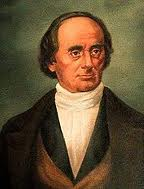
Posted in History, Teaching | 2 Comments

Twelve-Month Check-Up

[Note:  My Civil War History professor in grad school, Dr. Bell I.Wiley, used to try to inspire us to ever-greater heights of scholarly productivity by relating how Allan Nevins, the legendarily  prolific Columbia University historian, carried a portable typewriter with him on long trips so that he could write while waiting for flights in various airports.  According to Wiley, Nevins was also known to welcome guests to his home for parties, then disappear into his study, where he worked on his next article or book while his friends mingled below.  Now, for all I know, those anecdotes about Nevins could well be “academic urban legends,” but, since I still remember them over forty years later, they obviously made quite an impression on me.  A year ago, as I contemplated the prospect of having uninterrupted time to devote to my long-running “project” (AKA, my second book on the formation of political parties in the state of Georgia), I wondered if I would be as disciplined as Professor Nevins.  Not surprisingly, the answer turned out to be “no,” but I still haven’t done too badly.  “Retired But Not Shy” for about a year now, I thought it only proper to review my progress “Doing History After Leaving the Classroom.”]

* * * * *

A lot of what I’ve done over the past twelve months has been what I call “scut work,” grind-it-out research:  reading and taking notes on a half dozen Georgia newspapers (fortunately available on-line) for the period 1838-1845.  I did this because I  decided, while still gainfully employed, that I would be unable to answer the question I originally set out to research on the latter phases of political party formation in Georgia if I concluded the study at the end of 1837.  I needed to go further, but how much?  The solution, based on preliminary research in the years after 1837, was, through about 1845.  So, that’s what I’ve done over the past year.  And, it turns out, extending the scope of the study was the right thing to do, though I’m still not sure exactly how I’ll use what I’ve found from those years.  My idea at this point is to present my findings for 1838-1845 into a sort of “epilogue,” but that strategy is certainly not set in stone.  In addition to this fresh research, I’ve also revisited the notes I’ve taken for the project, reorganizing or combining several different sets.  Funny thing, though: I don’t feel as if I’m done with any of them yet, a feeling I’m sure any of you who have embarked on a large-scale research endeavor are familiar with .

I’ve also done quite a bit of preliminary writing over the past year.  Once I took notes on the Georgia newspapers and other primary sources from a particular year, I composed what I called an “annual survey,” basically using the cut-and-paste feature of Word to arrange the most useful notes into a “topical summary” of each year, with information under each topic arranged in chronological order.  But then, just when I thought the time had arrived to begin work on a draft, I discovered that those wonderful folks at the “Galileo” website I’ve raved about before in this blog had added yet another relevant newspaper, the Athens (Ga.) Southern Banner, to the data base.  This meant that I had to read and take notes on the Southern Banner for the period 1838 through 1845, add those notes to the  “topical” surveys, and convert the end product into an “essay ” written in my deathless prose.  Just the other day, coincidentally the first anniversary of my retirement, I finished what I hope will be the final essay, on 1845.

I also have a serviceable outline, covering 1807-1837, that I created a couple of years ago, and, once I revise it to include highlights of the research on the period 1838-1845, I should be able  to begin to write that so far elusive first draft.  I’ve also prepared a number of other essays on topics that I found interesting, or puzzling, or both, over the years I’ve been laboring in this particular historical vineyard, and these too must be blended into the larger work.

At the very beginning of my retirement, I needed to complete work on an article, “James Gunn, Georgia Federalist, 1789-1801,” for publication in the Fall 2010 issue of the Georgia Historical Quarterly.  By that point, all I had left to do was to correct the galley proofs of this second–and final–installment in my biography of the Georgia United States Senator (and prime mover of the infamous Yazoo Land Fraud).  Since part one of the study appeared in the same journal way back in the Summer of 1996, you can see how little importance my “prep school” employer placed on “publish or perish” (which I rather selfishly believe was to their great credit)!

As I knew I would, I have also used the past year to plow through a large number of books, though only a few were directly related to my research project because I have always been able to  keep abreast of relevant publications as they appeared over the long gestation period of this project.  The rest of the volumes I’ve read since retiring fall into several broad categories:  general history (a few of which I’ve written about in this blog); mysteries; and a surprisingly large number of works that, for lack of a better label, I’ll simply call  “miscellaneous.”  My usual practice over my teaching career was to ease into summer by immersing myself in what I liked to call “cheap, trashy thrillers,” by which I meant detective fiction.  Essentially, I’ve continued this practice since retirement, the difference being the amount of time I’ve had available to spend on them, because I’ve obviously had a lot longer than three months to read since I saw the front gate of the school in my rearview mirror for the last time, in late May of 2010.

So, to sum up:  While my productivity cannot hold a candle to that of the assiduous Professor Nevins, I have gotten off to a pretty good start on this next phase of my career, and I am definitely looking forward to what lies ahead.

* * * * * *

For those interested in reading more of my reflections on history, here are links to my books on the subject:

REABP CoverRancorous Enmities and Blind Partialities:  Parties and Factions in Georgia, 1807-1845 (University Press of America, 2015)

Pursuit Cover

In Pursuit of Dead Georgians:  One Historian’s Excursions into the History of His Adopted State (iUniverse, 2015)

Politics on the Periphery:  Factions and Parties in Georgia, 1783-1806 (University of Delaware Press, 1986)

Posted in History, Research, Retirement, Southern (Georgia) History | 2 Comments

Editorial, “On Dixie Station”

[NOTE: The following editorial comes from the History Department newsletter in April 2000. Like the previous post, this one  reflects on teaching about–and remembering–the War in Vietnam.]

* * * * *

I spent a recent Saturday at a seminar, “On Dixie Station: The Impact of the Vietnam War on the American South.” The moderator, a historian at a local college, spoke on “The Vietnam War: Debate Without End.” This talk was probably the most interesting to the audience, which was comprised mainly of schoolteachers.

The moderator made several provocative points. For instance, he argued that the incidence of drug use among soldiers in Vietnam was no higher than among 19-26 year olds in the U.S. at that time. He also asserted that neither the antiwar movement nor the media had much impact on domestic opinion about the war. Rather, he claimed, the development of widespread disillusionment with the conflict was rooted in the Johnson Administration’s failure to demonstrate success in managing it: the generals could not show the public that we were winning.

In laying out the chronology of American involvement in Vietnam, the moderator maintained that the war was already lost by 1961, when it became clear that the Diem regime could not sustain itself; then, however, President Kennedy acted to bolster the Saigon government. And, the historian continued, the situation was even worse by late 1964, at which time the Viet Cong controlled 75% of South Vietnam; then, President Johnson decided to use the so-called “Gulf of Tonkin incident” to deepen American involvement still further.

Another paper, on the antiwar movement in the South, started me to thinking about President Nixon’s decision to widen the war in 1970. The angry reaction of college students over the Cambodian “incursion” led to shootings at Kent State and Jackson State universities, which sparked protests at colleges throughout the nation, including on the usually placid southern campus where I was in graduate school. The faculty agreed to suspend classes and to hold “teach-ins” about the war instead. Students gathered in front of the main administration building and demanded that the university’s president express to Washington the outrage of our university community. When the president at last appeared, he announced that he had sent President Nixon a telegram deploring the invasion of Cambodia and the violence against American college students. (Yea!) Then, he told the crowd that he had signed the telegram as a private citizen, not as president of the university. (Boo!)

A third member of the panel, who spoke on the impact of the war on Southern fiction, used a bit of imagery I found arresting. The war was, he said, like a wound that is scabbed over but won’t heal; it’s the modern equivalent of the Civil War in Southern memory.

Like the “Requiem” exhibit I described last month, “On Dixie Station” revealed that it is possible to treat the Vietnam Era more or less dispassionately, as history, despite my personal difficulty in doing so. Two of the presenters looked too young to have strong memories of the war. Comments from the audience came either as questions or as personal reminiscences. While a couple of the latter, on the extent of drug use in Vietnam and on the effects of post-traumatic stress disorder, were truly scary, most of what the audience contributed was pretty prosaic.

No one defended the war as a “noble cause,” but neither did anyone go off on a rant about how “evil” it was. Most members of the audience seemed to be there for the same reason I was, to see whether “history,” as presented by the experts, squared with “autobiography,” past events as they themselves remembered them. And the answer is. . . ?

* * * * * *

For those interested in reading more of my reflections on history, here are links to my books on the subject:

REABP CoverRancorous Enmities and Blind Partialities:  Parties and Factions in Georgia, 1807-1845 (University Press of America, 2015)

Pursuit Cover

In Pursuit of Dead Georgians:  One Historian’s Excursions into the History of His Adopted State (iUniverse, 2015)

Politics on the Periphery:  Factions and Parties in Georgia, 1783-1806 (University of Delaware Press, 1986)

Posted in History, Southern (Georgia) History, Teaching, Vietnam War | Tagged , , | Leave a comment

“Springtime and Vietnam”

[NOTE: : For a number of years, I edited the History Department newsletter at my school. Each issue opened with an editorial. Below is one from March 2000, about ten years after I had begun delivering annually my “Growing Up With Vietnam” lecture (see previous posts–Parts 1, 2, 3, 4), reflecting on teaching–and remembering–the Vietnam War.]

* * * * *

Teaching American history in the spring is a real challenge when the teacher’s autobiography bumps up against the chronology of the Postwar era. For me, the spring’s biggest stumbling block has always been Vietnam. I have only been able to teach about our involvement there for the last decade or so, and anger remains just below the surface during every class period I devote to the topic. The war and its aftermath continue to gnaw at me and keep me from achieving much in the way of objectivity when I approach them anew each year.

Over the years, I have to some extent transformed the period since the end of World War II into the “Age of Lamplugh,” because it coincides with my time on earth. No longer are my only points of reference the facts and interpretations gleaned from courses, texts, and monographs. Instead, my understanding of recent decades must also take into account my personal memories of events and people.

[Recently, my wife and I went to a local history museum] for the opening of a new exhibit called “Requiem,” in memory of photographers who died while covering the war in Vietnam. The day’s events started with a panel discussion by several media types who had reported the war and survived to tell the tale. One of the panelists asked people in the audience who had served in Vietnam to stand, and perhaps 20% of those in the auditorium rose. As I looked at the standees, I was struck by how old they seemed. I couldn’t shake the image of Memorial Day parades in which I had marched as an ROTC cadet in college, when the “old guys” in attendance were veterans of World War II. And I thought, “Could Vietnam have been that long ago?”

During the question and answer session following the panel discussion, I was stunned when one of the veterans in the room, whom I had known for years only as a prominent physician, choked up when asking a simple question about events nearly thirty years ago. Then, as we toured the photographic exhibit, I couldn’t get over how many of those moving from picture to picture were too young to have participated in the war or, in some cases, to have any real memories of it. And I wondered, “Are these powerful photographs any more real to them than, say, the artifacts at the recent George Washington exhibit or scenes from the film ‘Saving Private Ryan’?”

Sometimes, I guess, it’s hard to “tell the story” when the story you must tell is your own. But we have to try. Peace.

* * * * * *

For those interested in reading more of my reflections on history, here are links to my books on the subject:

REABP CoverRancorous Enmities and Blind Partialities:  Parties and Factions in Georgia, 1807-1845 (University Press of America, 2015)

Pursuit Cover

In Pursuit of Dead Georgians:  One Historian’s Excursions into the History of His Adopted State (iUniverse, 2015)

Politics on the Periphery:  Factions and Parties in Georgia, 1783-1806 (University of Delaware Press, 1986)

Posted in History, Southern (Georgia) History, Teaching, Vietnam War | Tagged , | 2 Comments